House on a Hill by New Material Research Laboratory in Japan
Project: House on a Hill Architects: New Material Research Laboratory Location: Japan Area: 3,369 sq ft Year: 2022 Photography by: Masatomo Moriyama
House on a Hill by New Material Research Laboratory in Japan
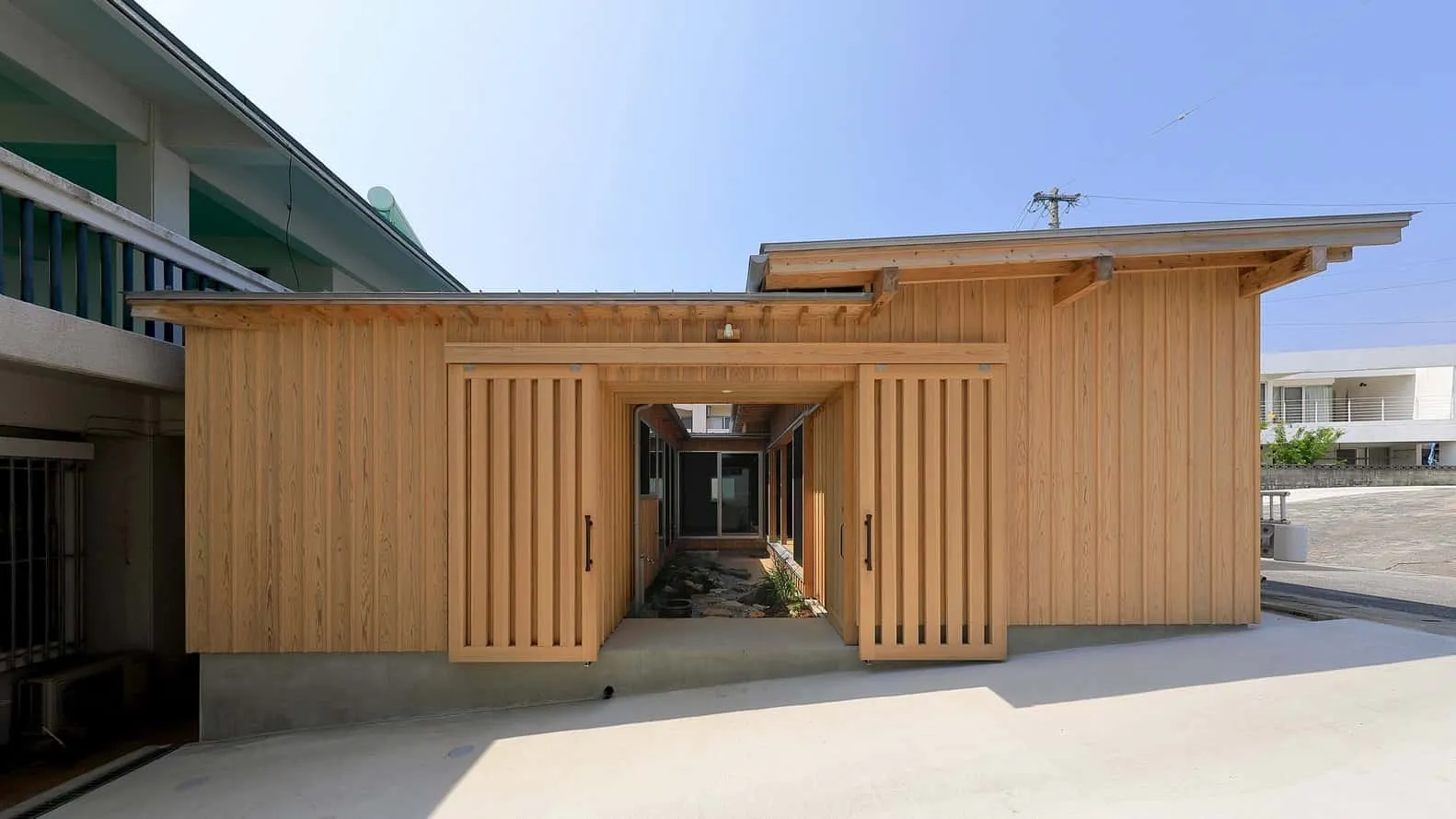
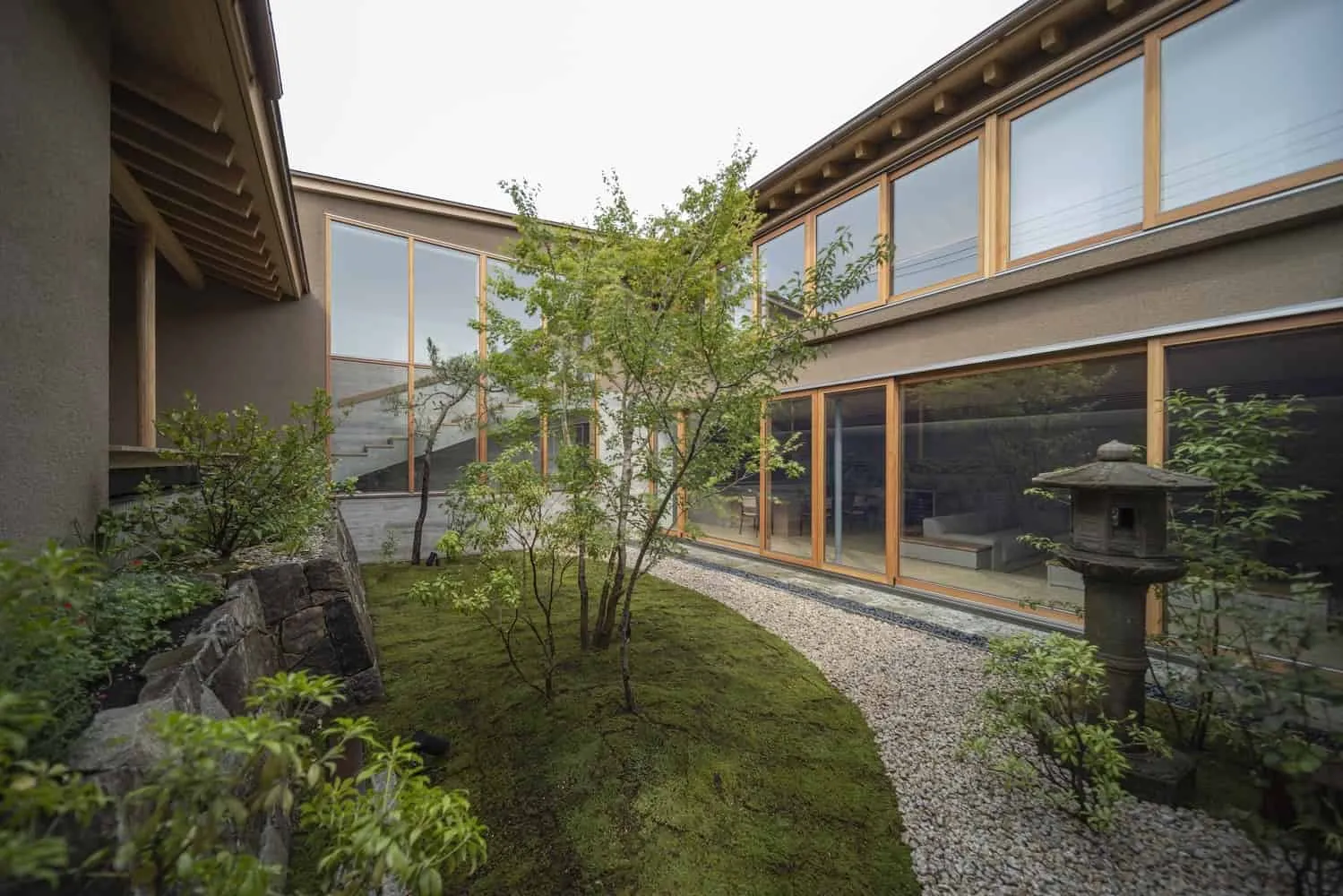
The House on a Hill, designed by the New Material Research Laboratory in Japan, uses a unique two-level layout between two buildings to harmoniously blend with the natural topography of its hilly location. The architects prioritized privacy, ensuring each room offers a view of the tranquil garden. The exterior facade is designed to evoke calm and restraint, featuring a vertical system of solid wood strips and pegs with evenly distributed strips. The house has a mixed construction: the first floor is made of reinforced concrete, while the second is built with wooden columns and beams. Japanese materials take center stage, creating a space that smoothly integrates with nature and highlights the importance of wood craftsmanship despite challenges related to fire safety requirements in urban areas.
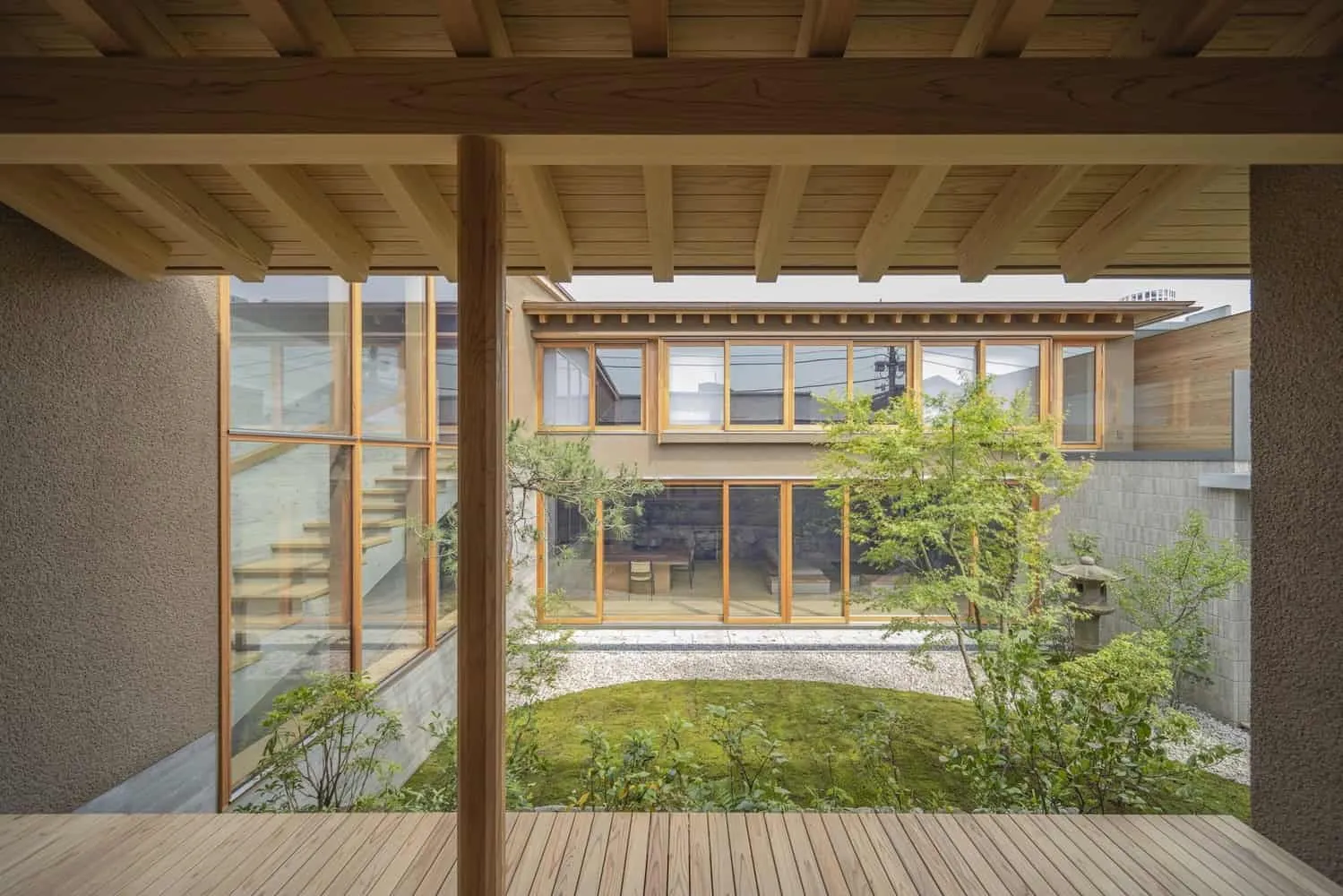
We designed this courtyard house on a plot of approximately 330 m² (100 tsubo) in the middle of a hill in a quiet residential area. Since the site has a 2-meter elevation difference, we employed a two-level layout between the northern and southern buildings to match the topography. Our goal was to create a courtyard house that cannot be seen directly from outside, and we chose a highly private layout where each room offers a view of the peaceful garden. Since sufficient natural light comes from the garden, we made the southern facade 'closed' without windows. We aimed to create an appearance that evokes calm and restraint, while the vertical system of solid wood strips and pegs with evenly distributed strips provides a visual accent.
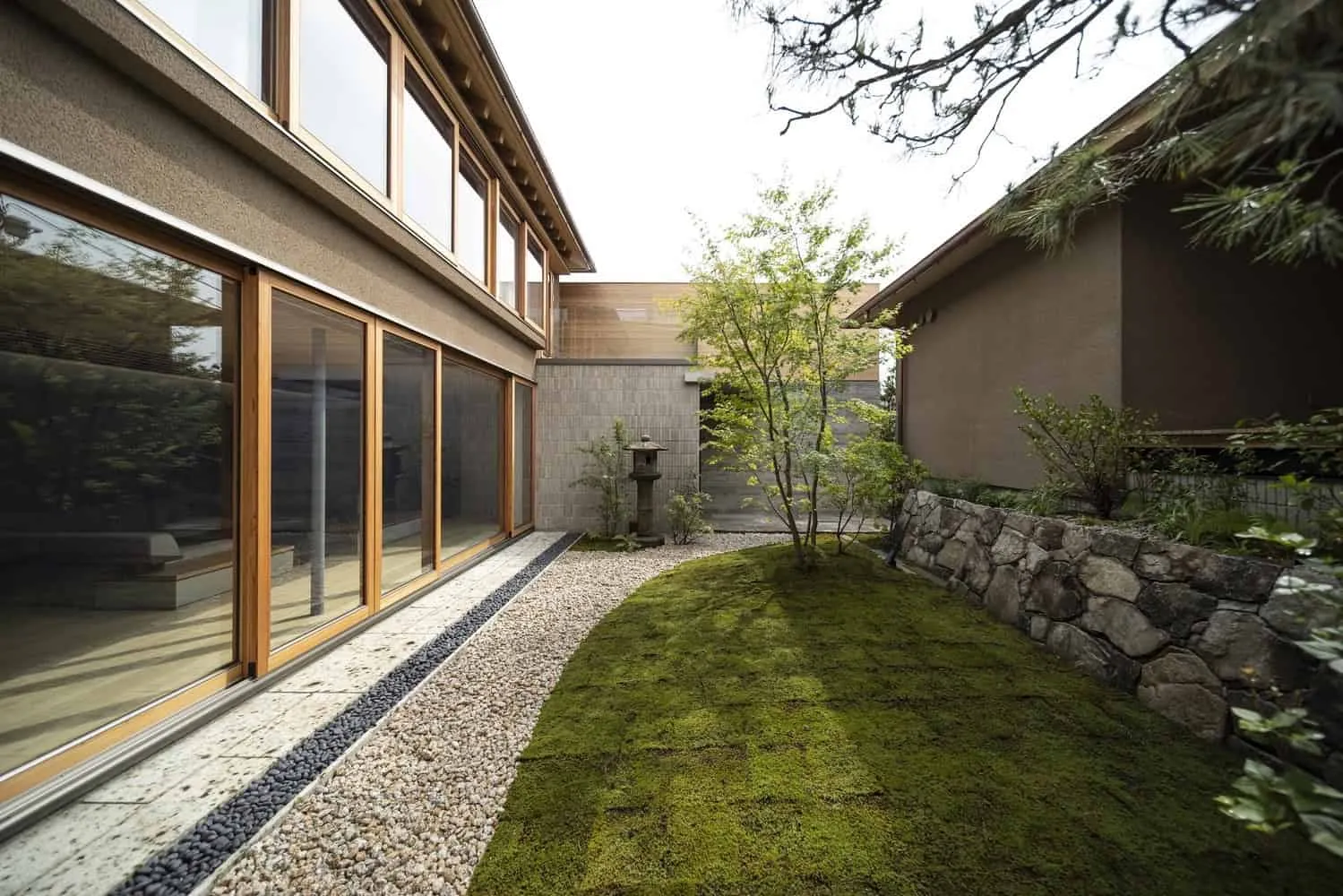
The building structure is mixed: the first floor is made of reinforced concrete, and the second is constructed with wooden columns and beams. Part of the reinforced concrete structure protrudes as a platform supporting the ground nearby, while the upper part consists of handcrafted framing. A key element of the space is the ridge beam – a 10-meter long strip of Tohoku pine with a nakuri finish¹. Shinsu Larch is used for wooden windows leading to the courtyard garden, and the wood's distinct reddish hue harmonizes with specially crafted stone slabs and scratched plaster finish. For external elements around the house, we used ancient concrete tiles from an old tramway for the entrance and Aiki stone for garden walls. For greenery, we planted evergreen Japanese holly and pine trees; opposite the courtyard garden, we planted deciduous trees that change color in autumn, creating a sense of seasonal transition across the entire site. Living and dining areas were designed to be at the same level as the courtyard garden, making them seem like an extension of it.
Using the features of the two-level structure, we maintained a low roof on the southern building so that it appears as a single-story structure when viewed from other parts of the house. The double-slope roof with overhanging edges is covered with straight copper tiles and adorned with a ridge made of two-level nosigawara². Regarding the wooden roof elements, we left rafters and sheathing exposed to show that separate spaces are part of a larger whole and make the wooden frame visible throughout. For the main structure, we used coniferous species, primarily Tohoku pine and Yoshino cedar. For joints, we selected Yanimatsu pine, Yakusugi cedar, and chestnut, while also enjoying the love for southern Pacific woods such as Indian redwood, Myanmar teak, and maracuja. For stone materials, we used Oya and Tatsuyama tuff, hard sandstone from Isahayi, and Katsuren travertine from Okinawa. Overall, we did everything possible to create a space where Japanese materials always play the leading role.
The staircase connecting the southern and northern buildings has a window. We gave the staircase a gentle incline and quite deep steps to create a flowing line that indicates two connected spaces without interruption. The key point of the house is attention to how views from windows change toward the courtyard garden. As a result, floor levels can vary without you noticing.
We did not want to build the standard fire-resistant construction required by Japanese building codes, so we distributed the building across a 330 m² generozan plot to make it fire-safe. Our meticulous attention to legal details gave us comparative freedom in handling wooden external walls and eaves, as well as internal floors, which contributed positively to the overall design. When increasing wooden constructions or frame systems in urban areas of Japan, architects must comply with fire safety requirements. However, due to the many rules governing natural wood usage, building with large amounts of timber and frame construction (which is relatively easy to implement in rural areas) simply isn't possible in cities.
However, there is something terribly sad about urban streets consisting only of buildings with the required fire safety level. We hope to clearly point out various problems faced by wooden construction in urban conditions and find solutions for them. Skilled woodworkers are an essential part of any solution. Recent trends toward simplification and efficiency, along with the use of pre-finished wood and ready-made joints, have led to a leveling down of craftsmanship. Therefore, practicing architects have three responsibilities: we must tell the world about the excellence of wood craftsmanship, help develop individual creativity among skilled woodworkers who can cut and shape timber themselves, and give them the opportunity to apply their skills.
–New Material Research Laboratory