Foundation Repair
The foundation is one of the most critical components of any structure. Its reliability is the primary factor determining the longevity of the entire building and depends on factors such as correct choice of construction technology, quality of materials used, and proper execution of construction work.
The foundation is one of the most critical components of any structure. Its reliability is the primary factor determining the longevity of the entire building and depends on factors such as correct choice of construction technology, quality of materials used, and proper execution of construction work.
Foundation deformation can occur not only due to builder errors but also as a result of physical-mechanical and hydraulic changes in soil layers. In any case, timely repair of a damaged foundation ensures structural strength and safety.
When Is Foundation Repair Necessary?
Experts recommend repairing a building's foundation in the following cases:
- If the foundation has been damaged due to constant water erosion. Often, the cause of continuous water flow is a roof not equipped with proper gutters. In this case, reinforcing the foundation becomes the only way to fix such damage. If water exposure has caused not only settlement but also cracking, the structure must be strengthened using steel rebar.
- If the foundation was installed above the frost line. Insufficient depth of installation leads to gradual deterioration of the entire structure, as frozen water in the soil melts during warmer months, causing uneven settlement. Such a foundation must be reinstalled below the frost depth.
- If additional floors are planned for construction. In this case, the foundation must be expanded, which can be done in two ways: by double-sided brick cladding or concrete pouring. This will evenly distribute the increased load and prevent structural deformation.
- If any extension is planned near the main building. Since the soil around an existing structure is often disturbed, the new section must be installed at a depth free of damage. To align foundation levels, concrete leveling (under-basement) is performed.
Foundation Repair Using Screw Piles
Various technologies are used for foundation repair, and the choice depends on several factors: building structure, soil type, and more. However, one of the most universal and effective methods for fixing existing damage is repair using screw piles.
Screw pile load-bearing capacity is comparable to traditional concrete. Moreover, they cost several times less, and installation is easier than any other known foundation method. Additionally, screw piles have physical properties that allow them to last at least 100 years.
Repairing a foundation using this method involves several steps:
- Based on expected load, soil type, frost depth, and other criteria, specialists select the type and quantity of screw piles.
- The building is lifted, and the old foundation is partially or fully dismantled.
- Marking is done along load-bearing walls around the building perimeter.
- Screw piles are installed at marked locations.
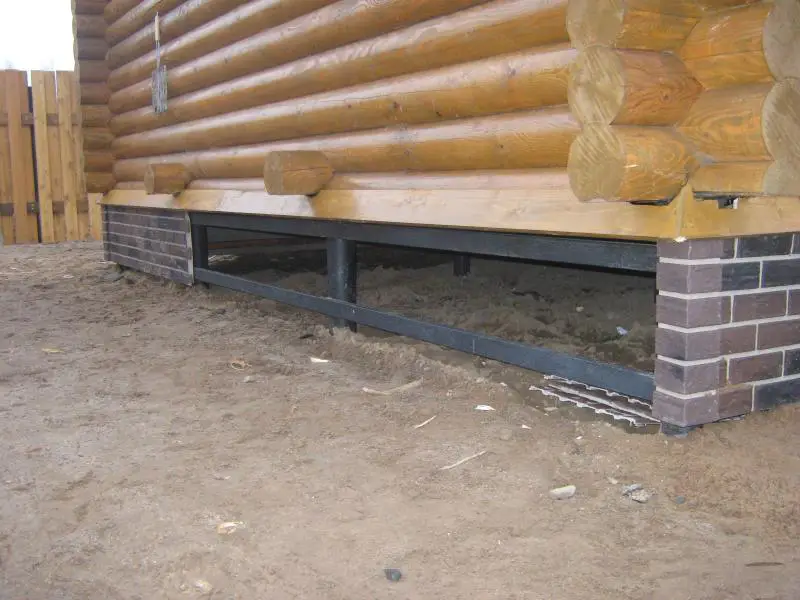
- Double-T beams and channels are welded onto the installed piles to form a rigid framework.
- The building is carefully lowered onto the new screw pile system.