How to Repair a Ceiling Yourself
Types of Ceilings
Let's explore what types of ceilings exist and what options are available.
- suspended ceiling (made of PVC film);
- wallpapered ceiling;
- paint-coated ceiling;
- whitewashed ceiling;
- suspended ceiling (recessed, made of gypsum board sheets, plastic).
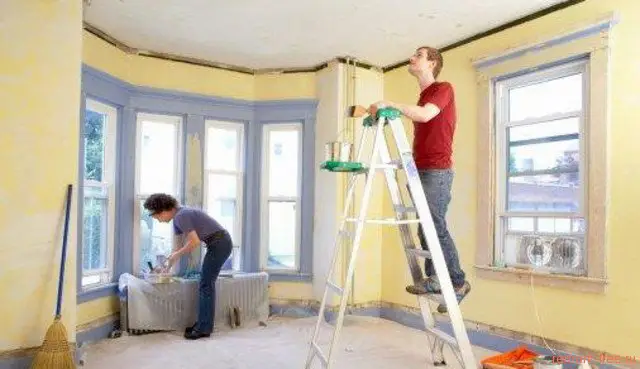
Photo 1 — DIY Ceiling Repair
Each type has its pros and cons. For example, whitewashed, painted, or wallpapered ceilings are suitable for apartments with low ceilings, as they don’t reduce height by several centimeters (suspended structures take up at least 5 cm). These types are often used in Khrushchyovka-style apartments, where ceilings are low. However, they don’t hide utilities or allow installation of recessed lighting.
These first three repair types can be considered cosmetic and are generally inexpensive.
Suspended and tensioned ceilings are becoming increasingly popular in the construction market. Consider this: you don’t need to prepare the ceiling so thoroughly, or level it—just clean it. Additionally, suspended structures perfectly conceal ventilation systems, pipes, and utilities.
Moreover, in suspended ceilings, you can design custom lighting systems to zone rooms or simply enhance their appearance and add unique character.
Of course, there are downsides too. For example, tensioned ceilings cannot be installed without professionals, and gypsum board suspended ceilings cannot be installed alone. Also, as previously mentioned, they reduce ceiling height by 5 to 15 cm. But on the other hand, you have plenty of room for creativity.
Suspended and tensioned ceilings are especially popular in Stalin-era buildings.
Also, suspended structures are better suited if your ceiling is made of lath. This reduces the risk that, over time or after a neighbor’s leak, your ceiling will deteriorate or crack.
If you want to create something unique from your ceiling, you can either design it yourself or look for inspiration online. In new buildings, ceiling height is now typically sufficient to allow any type of ceiling repair.
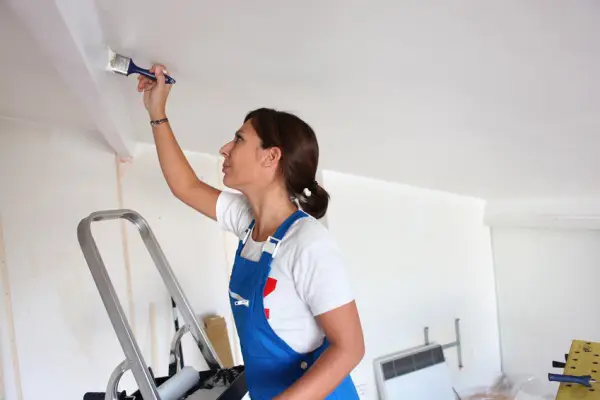
Photo 2 — Whitewashing a Ceiling
How to Repair a Ceiling: Step-by-Step
Now let’s examine the repair process for each type. In every case, the work will involve several stages. However, the first step in every case is to clean the surface of mold, yellow stains, old finishes, and debris. Use a trowel to remove old wallpaper or plaster, clean out cracks (if any), and rinse off whitewash with warm water. Apply a penetrating primer (e.g., Knauf) to protect the plaster from cracks and improve adhesion.
WallpaperingNow let’s look at wallpapering. This material has several advantages. For example, it helps hide minor cracks and ceiling imperfections. However, major repairs should not be overlooked. Also, ceiling wallpapering is more complex than wall wallpapering and requires skill.
Ideally, the work should be done by three people so tasks can be divided. But if you’re doing it alone, fold the wallpaper into a fan and press sections between folds onto the ceiling one by one.
Use one hand to smooth the sheet and the other to hold the remaining part. The adhesive should be thicker. Begin applying from the direction of light from windows. If your wallpaper is thin, reinforce cracks with mesh tape to avoid excessive material waste. Before applying liquid wallpaper, prime the ceiling with oil-based paint. Then proceed with application.
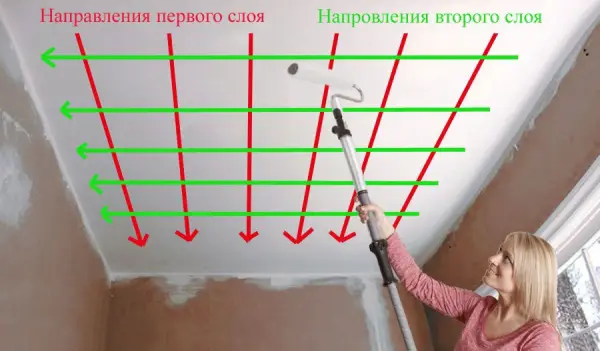
Photo 3 — Painting a Ceiling
Painting the CeilingIf you decide to paint the ceiling, preparation must be more thorough—remove all defects and level the surface if needed.
For residential spaces, acrylic, latex, silicate, and silicone paints are commonly used.
Acrylic paints are most popular—two coats are usually sufficient. Silicate paints are typically used on mineral surfaces, such as mineral plasters, or previously painted surfaces using lime, cement, or silicate paint. They are often used in high-moisture areas. Silicone paints, according to experts, combine the best features of acrylic and silicate paints.
Whitewashing is the simplest option. Don’t forget to prime the ceiling again after whitewashing. As with painting, the surface must be thoroughly cleaned and leveled.
Whitewash can be made with chalk or lime. For example, prepare chalk whitewash (in 5 liters of warm water, dissolve 30 g of wood glue and 3 kg of sifted chalk, or in 3–4 liters of water, dissolve 2.3 kg chalk, 90 g wood glue, 17 g blue pigment, and 60 g household soap). This amount will cover approximately 10–12 square meters.
Use either a brush or a pneumatic sprayer. If using a brush, apply the final coat in the direction of light, and the previous one across, to avoid visible brush marks.
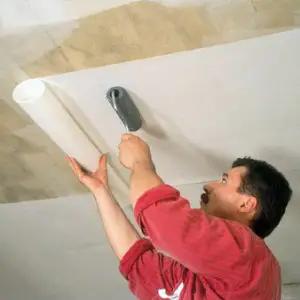
Photo 4 — Wallpapering a Ceiling
One drawback of these repair types is that it’s harder to clean up after neighbor flooding.
Tensioned CeilingTensioned ceilings look very attractive and original. However, they cannot be installed on your own. The PVC film used is quite fragile, so DIY attempts are not recommended.
Suspended CeilingsA great option for renovation—suspended ceilings. There are various types suitable for different rooms. For example, a recessed ceiling can be installed on a balcony, in a bathroom, or in a toilet. In a living room, you can use gypsum board or parquet flooring. They can hide issues like sagging ceilings, pipes, and other flaws.
Suspended ceilings consist of a metal frame attached around the perimeter of the ceiling and to the concrete base, and the covering material (GK boards, laminate, aluminum strips, plastic).
Like in tensioned ceilings, you can create multiple levels (including various shapes) and install a unique lighting system.
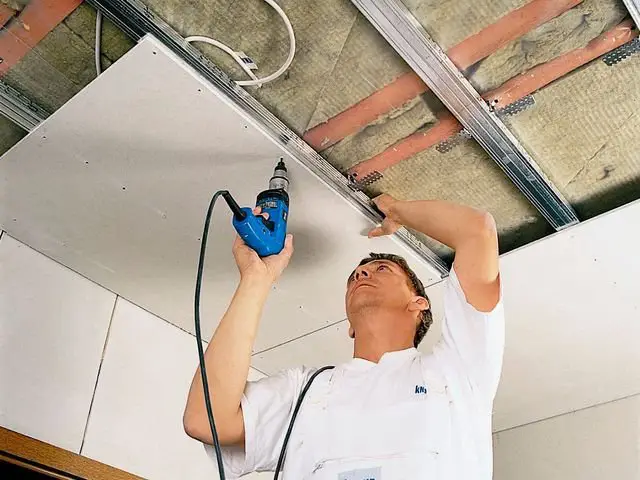
Photo 5 — Installing a Gypsum Board Ceiling
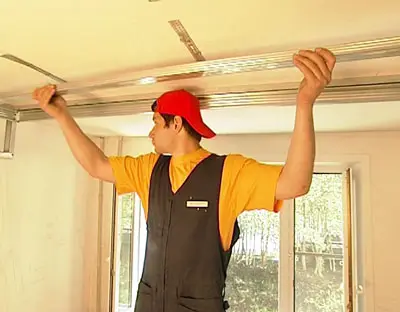
Photo 6 — Installing a Gypsum Board Ceiling
Ceiling Repair Costs
Repair costs depend on the type of work, region, and materials used. To find out how much a specific service costs, simply search on specialized websites where rates are usually posted.
In Kyiv, ceiling painting costs from 25 UAH per m², gypsum board installation from 70 UAH per m², wallpapering from 30 UAH per m², tensioned ceilings from 90 UAH per m², and plastering from 80 UAH per m².
In Moscow, plastering costs from 500 RUB per m², suspended ceiling installation from 600 RUB per m² depending on material, and tensioned ceilings from 700–800 RUB per m².