Installation of Gas Boilers. Difference in Installation in Private House and Apartment
Gas Boiler Installation in a House: Basic Regulatory Documentation
Want to set up an autonomous heating system in your house?
Gas Boiler Installation in a House: Basic Regulatory Documentation
Want to set up an autonomous heating system in your house? First, familiarize yourself with the requirements imposed by the state on gas boiler installation. Perhaps you'll change your mind? By the way, a common reason for rejecting the idea of autonomous home heating is not so much the high cost of the project as the paperwork hassles.
Firstly, SNiP 42-01-2002 "Gas Distribution Systems". The main norms and provisions are written down in this document. However, the SNiP "Gas Supply" 2.04.08-87 also contains many valid requirements. This document is no longer in use today, but it still holds a lot of useful information.
Additionally, there are supplementary regulations for gas boiler installation listed in related SNiP: for boiler rooms, heating, ventilation and air conditioning, internal water supply and sewage systems in buildings, noise protection, construction safety standards, fire safety of buildings and structures, etc.
Gas boiler installation in a basement or on the ground floor in a private house is permitted only in single-family block residential buildings.
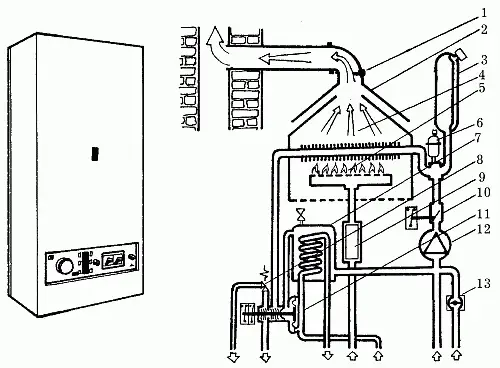
Photo 1 — External view and device diagram of a gas boiler
Photo 1:
- control unit;
- draft inducer;
- expansion vessel;
- heat exchanger;
- gas burner;
- automatic air valve;
- heat exchanger of hot water supply system;
- pressure relief valve;
- gas supply valve;
- water loss protection device for heating water;
- control valve for circuits;
- circulation pump;
- filling valve.
Gas Boiler Installation in an Apartment: Installation Coordination
Technical Conditions
You must obtain technical conditions for connecting your apartment or house to the municipal gas supply system. To get such a document, write an application and clearly indicate in it the expected hourly gas consumption volume. The document is issued by the local gas service. It will take about 1-2 weeks to process. If your application is approved and you receive the technical conditions for gas equipment installation, consider it an official permit to carry out such works.
IMPORTANT! Installing a heating boiler yourself is not only illegal but also unsafe, especially when it comes to changing utilities in multi-apartment buildings.
Installation Project
After obtaining the technical conditions, you can begin developing the installation project. The "Gas Supply" project is a schematic layout of gas boiler installation, as well as a schematic route for laying the gas pipeline from the connection point in an apartment to the municipal gas pipelines, and in case of private sector connection, also a schematic for laying gas pipelines on the plot with marking the entry point into the residential building. This section must be developed in accordance with the provisions of GSN by licensed engineers who are authorized to design gas pipelines.
Coordination with GorGaz
After revising the project, it is submitted to GorGaz for approval or to any other competent authority responsible for maintenance of your plot. Depending on the project's complexity, the approval process can take from one week to three months.
In addition to the "Gas Supply" project, the following documents must be provided to the inspection:
- technical passport of the boiler you selected;
- manual for its operation;
- certificates (sanitary-hygienic, compliance with technical requirements);
- expertise conclusions confirming that this boiler meets all necessary requirements.
This list of documents is not prepared by you: they must be provided by the boiler manufacturer.
If the project does not pass the review, in addition to an official document indicating the reasons for refusal, you must also receive a list of corrections needed to revise the project.
If the project is completed in compliance with requirements, it is certified with a seal and can be considered as "green light" to begin the installation works.
Gas Boiler Installation in a Private House or Apartment: Restrictions
Boilers, like any other gas appliances, cannot be installed:
- on combustible surfaces;
- in hallways;
- in bathrooms;
- in dormitories;
- in rooms without windows;
- in basements;
- on balconies;
- with LPG supply - on the ground floor.
Requirements for Gas Boiler Installation
General conditions for installing household gas boilers can be summarized as follows:
- the room area for boiler installation must not be less than 4 m²;
- the entrance door in the room must not be less than 0.8 meters wide;
- the room must have adequate lighting (0.3 m² of window area per 10 m³ of room volume);
- the ceiling height must not be less than 2.5 meters;
- a grounding circuit must be installed;
- the cold water supply pipe must be installed;
- the chimney cross-section must match the power of the installed boiler;
- the room walls must be flat and plastered.
Based on this, two-circuit boilers are best installed in the kitchen, where the gas stove is also located. Kitchens in most cases are designed according to the layout of a boiler room, so installing a wall-mounted gas boiler in the kitchen will not only comply with established standards but also significantly reduce costs for connecting cold and hot water pipes.
Heating boilers can also be placed on the floor. Installing a floor-standing gas boiler, unlike a two-circuit wall-mounted one, requires a dedicated room exclusively for the boiler room.
If it's about installing a boiler in a wooden house, the installation conditions remain the same. However, for boilers with power up to 60 kW, the room volume must be at least 27 m³. For such boilers, installation in a kitchen on a wooden wall (or any other room if all necessary technical conditions are maintained) is also possible. For boilers with power up to 150 kW, the unit must be installed only in a separate room. The wooden wall surface on which you plan to mount the unit must be protected from high temperatures and flames.
Trusted Companies
BAXI (Baxi) - a Dutch company that is part of BDR Therma, holds leading positions in sales volume in six European countries, including Germany, Italy, Great Britain, Spain, France, and the Netherlands. It produces a wide range of heating appliances, including floor-standing and wall-mounted boilers. Among floor-standing units, the BAXI SLIM series stands out with power range from 15 to 62 kW, featuring built-in electronic flame modulation and self-diagnostic systems. BAXI SLIM iN is a single-circuit atmospheric boiler without an expansion tank and pump. Among wall-mounted boilers, the BAXI FOURTECH series stands out with power from 14 to 24 kW, featuring anti-freeze system when operating at temperatures below 5°C and digital control.
NAVIEN (Naveen) - gas boilers from a South Korean manufacturer are attractive due to their compact dimensions (only 695x440x265 mm) and reliable assembly. Naveen boilers can operate at very low gas pressure of 4 mbar. Note that the normal value should be no less than 13 mbar.
VAILLANT (Vaillant) - a German company with official representations in all European countries, manufactures both two-circuit (with room heating function and hot water supply) and single-circuit (heating rooms and supplying hot water, but using an additional boiler for the latter) boilers.
ARISTON (Ariston) - an Italian company that has recently launched a new series of gas boilers with built-in intelligent control system. These boilers from this manufacturer are known for low noise levels during operation, compact size, and relatively economical gas consumption.
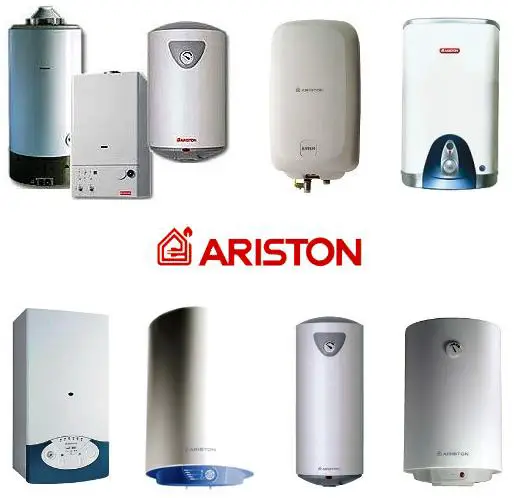
Photo 2 — Ariston Series of Gas Boilers
Danko - gas boilers made in Ukraine. They can serve as a good alternative when choosing between a budget boiler from domestic assembly and a more expensive unit imported from abroad.
ATON (Aton) - another domestic manufacturer that has put into production seven types of boilers. The advantage of this brand is the use of Italian and German components.
Installing a Wall-Mounted Gas Boiler
These types of work, whether installing a wall-mounted or floor-standing gas boiler, must not be performed by yourself.
Preparation Steps:
- Installation must be carried out by specialists who have a license for gas equipment installation.
- The room temperature during installation must be between 5 and 35°C, and air humidity must not exceed 80%.
Main Installation Steps:
- Prepare a hole for the coaxial pipe with a diameter of 100 mm.
- Install the wall-mounted gas boiler on a special bracket (should come in the basic package), secured to the wall with a level.
- Connect the boiler to water pipelines. When installing a two-circuit boiler, to avoid clogging the heat exchanger, install a mesh angular filter in the return line. Install ball valves on both sides of the filter and on all boiler fittings as recommended.
- To connect the boiler to the house's gas network, install a gas valve, meter, thermal shut-off valve, and gas leak detector before the boiler.
- Connect the boiler to the electrical network using a three-core cable with a plug at the end. The outlet for connecting the boiler must be grounded.
IMPORTANT! Detailed installation schematic of a wall-mounted boiler should come with each individual model.
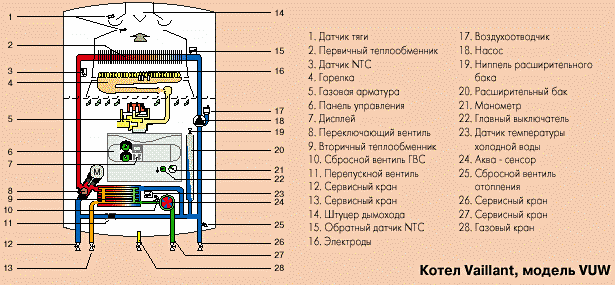
Photo 3 — Wall-Mounted Gas Boiler Design
Installing a Chimney for a Gas Boiler
Connect the coaxial pipe to the boiler and run it through a hole in the wall to the outside. No additional work is required.
Before the first start-up, fill the heating system with water, disconnecting the boiler from the central electrical network. The process of filling the system with water should be gradual, allowing air to escape through special air vents.
Also, before starting the boiler, check it for gas leaks and water supply system sealing. Only after that connect the boiler to the electrical network.
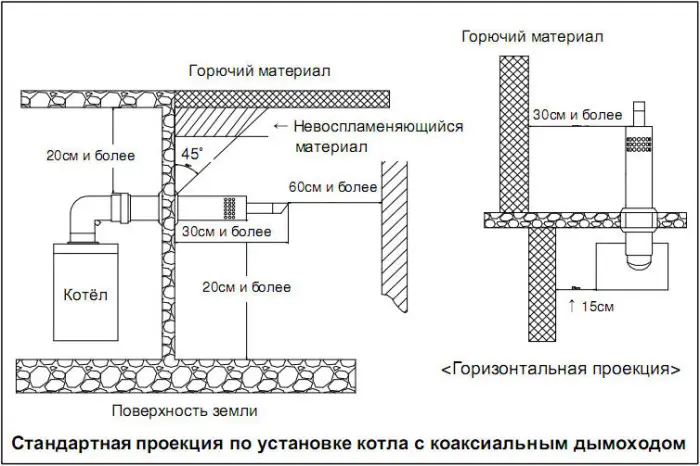
Photo 4 — Standard Projection for Installing a Boiler with Coaxial Flue
Installing a Ventilation System for a Gas Boiler
If natural draft cannot provide adequate removal of combustion products, install "forced draft" systems: install a pipe in the roof or floor space, equip an access panel for soot cleaning, keeping in mind that the entire construction must not be complex - no more than three bends are allowed.
Installing a Floor-Standing Gas Boiler
This boiler is easy to transport and install: most floor-standing boilers come with legs or wheels that facilitate transportation to the installation site. They are also sold already assembled, so all the buyer needs to do is follow the instructions in the manual (the installation manual for any type of gas boiler must contain all necessary diagrams for connecting the boiler to home utilities and explanations).
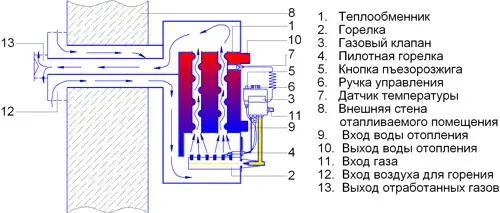
Photo 5 — Installation Scheme of a Wall-Mounted Gas Boiler
Wall-mounted and floor-standing boilers have a decent alternative - a wall-mounted gas boiler. Unlike its peers, this boiler does not require a chimney or high installation costs. This energy-independent heat generator is designed for autonomous heating and hot water supply in small apartments. The maximum power of such units is 16 kW (a typical installation manual for this type of boiler and its device are provided below).
Characteristics and Some Installation Elements of a Wall-Mounted Boiler: VIDEO
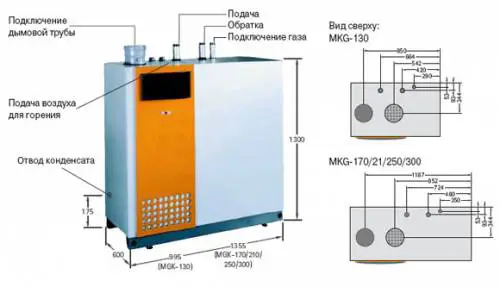
Photo 6 — Floor-Standing Gas Boiler Design
Rules for Gas Boiler Installation: Exceptions
For most houses, installation norms prohibit placing gas equipment in basements or ground floors. However, exceptions apply to buildings that have received official permission from designers and controlling authorities. Permission for installing boilers in basements or ground floors may also be granted to homeowners or apartment owners, if the installation of gas boilers in these rooms was planned in the architectural plan.
Installation Height of a Gas Boiler
The installation height of a gas boiler is determined by the distance from the finished floor to the bottom edge of the boiler casing. On average, this is 0.8 - 1.1 meters.
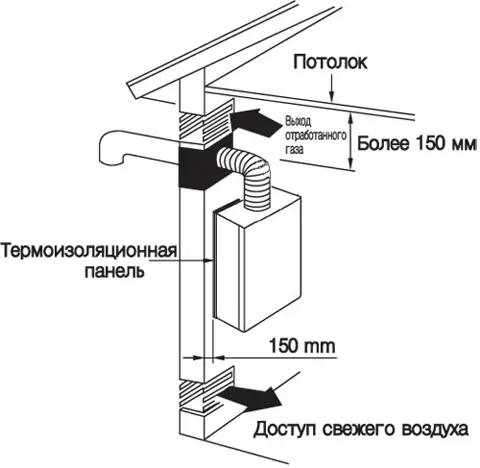
Photo 7 — Wall-Mounted Gas Boiler Placement
Installation of Gas Boiler Rooms
The main distinguishing feature in the technology of setting up gas boiler rooms is that the floor in such rooms must be equipped with a water drainage system.
By the way, apart from boilers installed in internal rooms, there are also outdoor gas boiler units. These units can be used to heat not only an individual apartment or private house but also entire administrative buildings, schools, hospitals, high-rise buildings, etc.
$ Cost of Installing a Gas Boiler
Considering that installation work must be done by professionals, the cost of installation will still hit your wallet. We warn that setting up autonomous heating in a house, despite all its advantages, is not a cheap pleasure.
Boiler cost: Depending on the type of boiler and its power, you will have to spend approximately $400-560.
Installation cost: varies between $130-$250. Plus, add the cost of transportation and purchasing installation components (if not all parts were included with the boiler) - this is another $35-$60.
Ideal option: when the sale and installation of a boiler are handled by the same company. In this case, you will have guarantees not only for the quality of the boiler but also for the quality of its installation. Organizations providing all services (including warranty maintenance) often work at a fixed price: when ordering the service, a cost estimate for boiler and component installation must be prepared.