Floor Leveling. One of the Most Important Steps in Renovation
Dry floor leveling is exactly the case where it's relatively simple to perform floor leveling yourself without hiring professionals. The technology of floor leveling without a screed and cement floor leveling differ from each other in complexity, time, and labor intensity. Choosing the option with a poured floor, you will need to perform a large volume of work quickly - because the mixture sets.
Dry floor leveling
Dry floor leveling is exactly the case where it's relatively simple to perform floor leveling yourself without hiring professionals.
The technology of floor leveling without a screed and cement floor leveling differ from each other in complexity, time, and labor intensity. Choosing the option with a poured floor, you will need to perform a large volume of work quickly - because the mixture sets. Dry leveling without pouring is convenient because you can pause the work when it's convenient, make corrections, and you don't have to wait a month for the screed to dry - you can use the room shortly after laying the floor, and apartment renovation doesn't have to stop. Another advantage is better sound insulation and a less cold floor than a concrete one.
Dry floor installation is performed after all pipe and radiator work is completed in a dry, warm room with normal humidity. The walls and floor must be well dried.
On a dry prepared concrete floor, polyethylene film is laid, which will serve as a moisture and vapor barrier. Separate pieces should be laid on top of each other with overlap, and there should be a good allowance around the perimeter of the room - about 15 centimeters of film.
To create a flat surface on a screed floor, guide profiles (mayaques) are initially installed.
A dry mixture is poured and leveled using a rule along the guide profiles.
A modular dry screed is performed - floor leveling with OSB, MDF, HDF, plywood or particle board. In such spaces as a balcony or kitchen, moisture-resistant materials are used. On the compacted granular base, the sheets are laid so that the joints in rows do not align - they should be offset, and a 20 mm gap is left near the walls. A second layer can be laid on adhesive, also offset from the joints of the first layer and secured to the lower layer with self-tapping screws. All joints and irregularities are spackled, and primer is applied if necessary.
Final floor finishing - tiles, laminate, linoleum, etc.
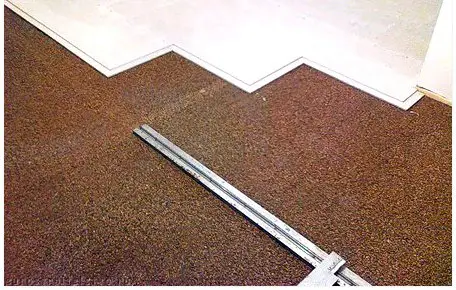
Photo 1 — Dry floor leveling
Adjustable floor using joists
Another option is an adjustable floor, for example, a floor installation using joists. Adjustable floors have a significant advantage over cement screed in that they are lightweight, do not create such load on the floor slabs, but the structure is reliable and can last a very long time.
Leveling a floor using joists allows raising the floor to a greater height. The system of joists is leveled and secured to the slab using anchor bolts through support posts. A plywood or other material deck is laid on top of the joists, usually double-layered and secured to the joists using self-tapping screws.
As an alternative to cement screed service, you can perform floor leveling yourself using particleboard (CSP). Cement particle boards are laid on levelled joists, secured with screws, and gaps between the boards are filled with universal plaster.
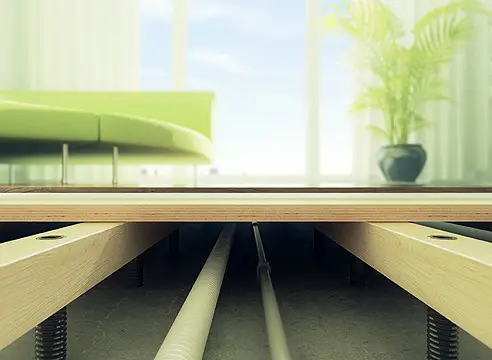
Photo 2 — Adjustable floor using joists
Leveling a floor with plywood
Leveling a wooden floor without joists can be done by yourself. Plywood leveling can serve as an excellent base for various types of floor coverings. The process is carried out using the same principles as joist installation. Holes drilled in the plywood are filled with sleeves and secured with screws. The support posts are screwed into these sleeves, and holes are drilled through the base, securing the structure with anchor bolts.
The first layer of plywood is leveled, and then a second layer is attached with screws.
It is especially common to use plywood leveling for laminate.
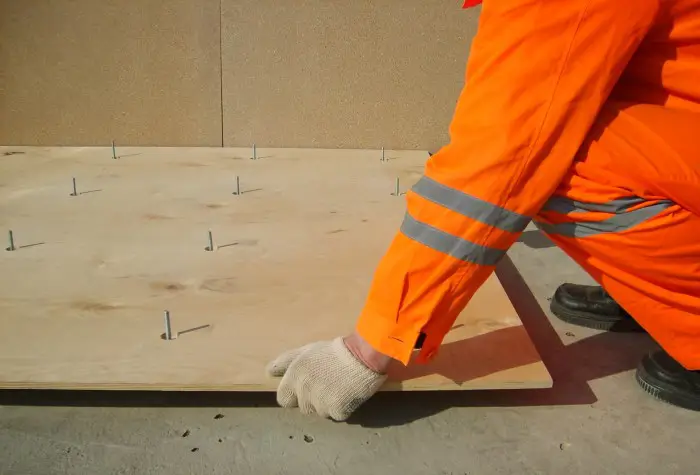
Photo 3 — Floor leveling with plywood
Mixes for Floor Leveling
Despite the abundance of new dry methods for floor leveling, the "wet" method remains equally popular. There are various methods and mixes for leveling floors.
Dry mixes are used to prepare a screed mixture. Floor leveling mixes are produced based on cement or gypsum. They come in types for machine or manual application, designed for thin or thick layers, basic and finishing mixes, special mixes for heated floors, moisture-resistant mixes with reinforcing, polymer, and other additives, etc.
Self-leveling mixes are becoming increasingly popular. Their name speaks for itself. The main advantage of such a poured floor is that the plastic, fast-setting mixture spreads under its own weight and thus creates a flat surface. Performing work with such mixes is within reach even for amateurs - the key is to prepare the mixture according to the instructions.
This screed dries faster, resulting in a much flatter surface than cement screed. You can walk on it after half a day, and start the next stage of floor finishing after half a day. One of the popular dry mixes is UniS Horizont.
The consumption of the mixture depends on its content, but in average it is about 1.5-2 kg/m²/mm.
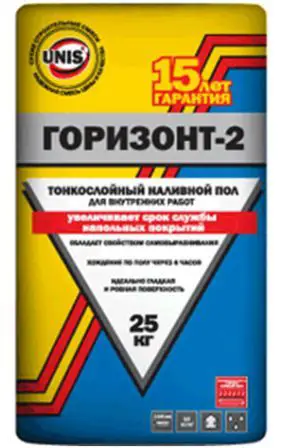
Photo 4 — Pourable floor Horizont by UniS
Leveling a floor in the bathroom
Leveling a bathroom floor for tiles by yourself is quite possible. As with any screed, the bathroom floor must be prepared: cleaned of remnants of old screed and finishing, if there are deep indentations - they can be pre-filled.
The difference in work with a bathroom floor is the special necessity of using hydro-isolation materials.
The base is primed and then coated or painted with a hydro-isolation composition, extending onto the walls. Seams are sealed with hydro-isolation tape. After that, layout is done, guide profiles (mayaques) are installed, and the mixture (preferably based on non-shrinkage cement) is poured and leveled according to the guide profiles.
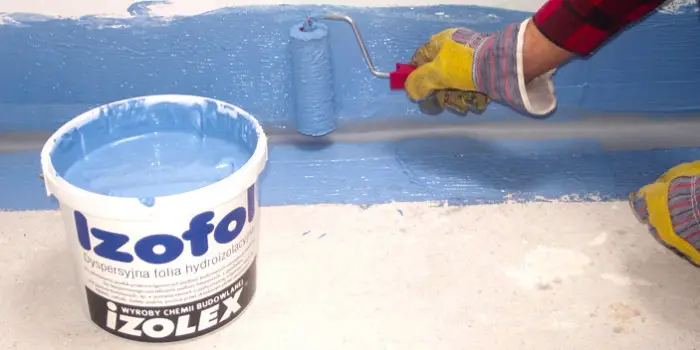
Photo 5 — Bathroom hydro-isolation
Leveling a concrete floor
With concrete, as with a strong but uneven base, you need to work before performing the finishing decoration. Leveling a concrete floor for laminate requires a flat surface. Therefore, leveling for laminate and linoleum is recommended to be done with self-leveling mixes.
Leveling a floor for laminate can also involve OSB or plywood leveling. For linoleum and tiles, a cement mixture is better suited. For parquet and parquet boards, the base can be either a quality screed or a floor leveled with plywood.
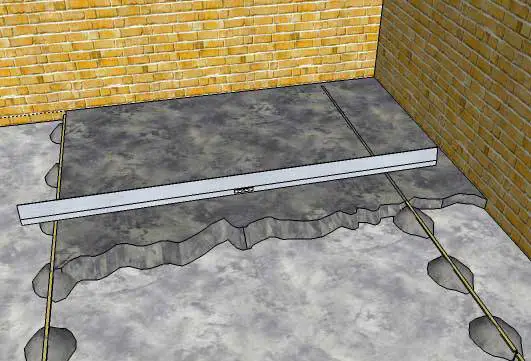
Figure 1 — Floor screed using guide profiles
Leveling a wooden floor
Leveling a wooden floor by yourself can be done in different ways depending on the degree of floor curvature and the covering that will be placed on top. Wooden floors are found not only in wooden houses but also in Khrushchev-era buildings.
To preserve a wooden floor in an interior but still level and repair it, you can do a small diagnostics. Identifying where the wood has rotted, where floorboards are uneven or creaking, you can remove and replace the joists, replace part of the floor covering, or tighten the floorboards more securely. If you don't need to lay another covering on top, you can sand the wooden floor and expose it with varnish.
For leveling under linoleum, mixes based on PVA and wood shavings can be used, which are leveled using guide profiles and covered with a thin layer of plywood. For laminate, the previously mentioned method of leveling with joists and plywood is suitable. An old wooden floor can be prepared for new flooring with a special self-leveling mix for dry bases. For leveling a wooden floor, mastics may be used.
Video: Leveling a wooden floor
Leveling a floor with keramzit
Leveling a floor with keramzit is exactly the aforementioned dry screed. A soft cushion under gypsum board or another material can be filled with sand, or keramzit crushed stone is used for this purpose.
A popular method of dry leveling is the Knauf dry floor leveling. Keramzit is also used in "wet" work: it is added to the cement-sand mixture for screed. While tile adhesive can be used to fill small holes and cracks, a self-leveling compound is better for finishing leveling. A thick leveling layer can be created with a cement mixture containing keramzit.
Leveling a floor by yourself, video
Materials for Floor Leveling
Depending on the method of floor leveling, tools and materials for floor leveling may include: water or laser level, pencil, chalk line, painter's tape, screwdriver, rule, containers for the mixture, dry mix for leveling floors called a leveler, keramzit, sand, guide profiles and маяки (mayaques) for leveling floors - metal profiles, wooden joists, particle board, OSB, HDF, gypsum board, plywood, film, mastics, anchors, screws, hydro-isolation materials and others.
$ Cost of Work and Materials
Wanting to level a floor yourself, at least you should know how much the floor leveling mix costs. For example, Ceresit CN 178 (25 kg) in Moscow costs 441 rubles, and in Kiev - 73 hryvnias.
It's also useful to know the cost of work. Floor leveling costs in Moscow from 300 rubles per square meter.
Leveling a floor costs in Kiev from 55 hryvnias per square meter.