City Crown - Dragon Lake Public Art Center, Studio A+ Project in Zhengzhou, China
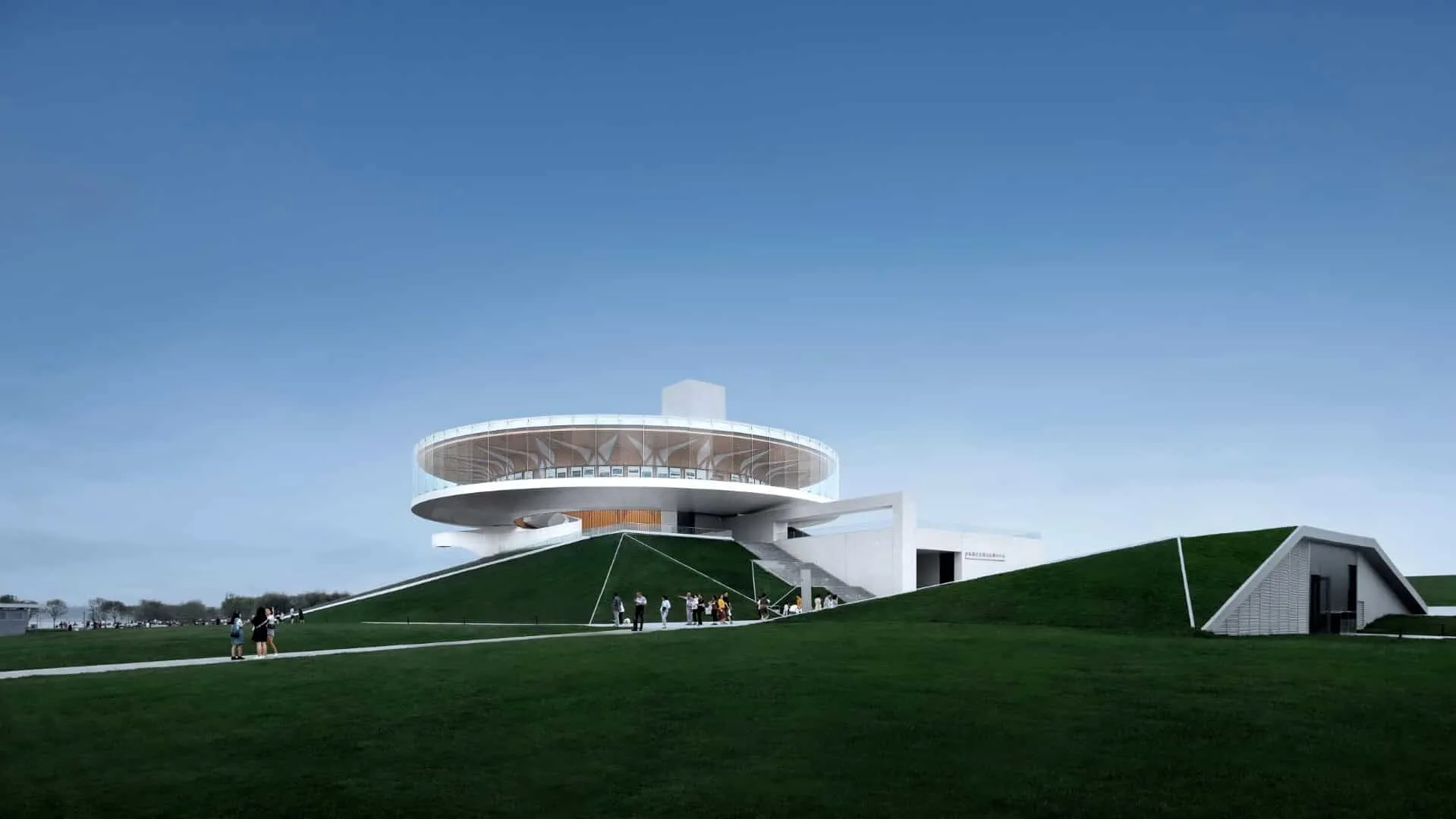
Project: City Crown - Dragon Lake Public Art Center Architects: Studio A+ Location: Zhengzhou, Henan Province, China Area: 176,572 sq ft (site), 228,428 sq ft (floor) Photos: Provided by Studio A+
City Crown - Dragon Lake Public Art Center, Studio A+ Project in Zhengzhou, China
As an important part of the new district's public facilities, Dragon Lake Public Art Center will be used for demonstrating urban planning initiatives and exhibitions in the short term, and as a public art center in the long term. Its program will allow easy access to high-level artworks and host live and engaging events for all visitors. Together with surrounding public spaces, the Center will create a vibrant waterfront area that allows visitors to ascend to the top for panoramic views of new development, interact with each other and make their waterfront experience unforgettable.

Reflections
Upon first stepping onto the site, we were struck by how there are no tall buildings in the vicinity – even the financial island complex across the water is not particularly large. Local residents are truly happy to have such a wide public green area available on the shore. The architecture we create here must be sensitive and friendly to the existing environment, while also showing respect for the surroundings in terms of scale and form.
The task of architecture is to seamlessly integrate into the larger landscape context of the park, but also become a recognizable landmark in the area – as requested by the client. Preliminary analysis and intuitive understanding led us to conclude that the building will not be a pure example of either architecture or landscape, but rather a product of their combined interaction. We wanted to integrate the art center into its surroundings so much that it appears as if it grew directly from the site and harmoniously fits into the overall environment.

Strategy
The visibility requirement set by the client became the initial point of design: from the site, important landmarks and new district landscapes are visible from different sides on clear days. The response to these conditions was the form of a glass exhibition hall – a directionless circle that maintains an uniform appearance as a 'ring (art center)' floating above the city, visually effective from all sides.
Outside the exhibition hall, other main functional requirements of the project are placed underground in a green dome shape, as they do not require natural lighting; these include a large cubic multimedia exhibition hall and extensive parking for the adjacent lake park. Over 97% of parking spaces are underground, reducing the visible program volume to such an extent that it does not overwhelm the waterfront environment but rather blends into the surrounding green nature.

The Ring
Unlike the internally rooted functional spaces of the building, the enlarged exhibition hall ring is the most visible architectural volume and symbolizes the Art Center. It separates from the green hills spreading across the site, floats in the air and creates a new visual focal point. Visitors can look out over the lake and surroundings while enjoying displayed art. During the day it is bright, elegant and transparent; at night it glows from within like a glowing wreath, clean and perfect, becoming a bright symbol in Dragon Lake's night sky.
The interior space of the ring has two surfaces: an external ring made of transparent glass from floor to ceiling, providing visitors with a 360-degree view; the inner wall of the ring serves as an exhibition surface. Overall, the ring appears to be floating with its structural trusses expressed as a wreath in honor of the city and its culture.
Three-Dimensional Platform System for Views
By placing two main exhibition halls, we embedded one underground in a square form and elevated the other into the air in a circular form. The 'floating' design redefines typical relationships between interior and exterior spaces of the building: two completely different geometric spaces, clean in form, flowing one on top of another – parallel but not intersecting. As a result, a series of interconnected yet independent outdoor and semi-covered spaces on multiple levels are created that can accommodate various public events.
Though the main internal functional spaces consist of clean geometric volumes, the Art Center as a whole was conceived as an open area for leisurely walks. The project includes walking routes on the site with two main movement lines: one light and one dark. 'The open line' runs along the landscape, while 'the dark line' is rooted inside the building. The 'dark line' leads into the interior of the Public Art Center and can guide any visitor directly to the terrace on top of 'Green Hill'.

There's a circular plaza bounded by the floating ring above it. At the center of the plaza is a small round fountain that enhances the sense of centrality in space. However, the plaza is not strictly internal and its virtual boundary represents a grey area specifically created under the ring to evoke an architectural sense of modesty. In this case, the interior plaza visually expands from the central fountain to the expansive panoramic view of the lake park at a distance.
Located near the lakeside pedestrian path, the Art Center offers numerous viewing opportunities. It will be the highest building in the area and thus a symbolic focal point. Several view platforms are created through the interaction of the building and landscape in the design. The various levels and orientations formed result in connections via large steps, spiral staircases, ramps, elevators and other vertical circulation elements forming a comprehensive walking network that continues the existing lakeside pedestrian corridor.
With a ring floating above the ground, we aimed to make the site easily accessible and appealing as a gift to the city. We planned journeys for different groups of visitors moving through the project. Whether they visit the Art Center or the public park, there are routes that gradually lead visitors to the top of the ring to enjoy distant views and panoramic vistas unavailable from the lakeside walking path.

Structure
The building structure is divided into two parts: the lower part includes a frame structure with load-bearing concrete walls (used in the 'Green Hill' multimedia exhibition hall and underground parking), while the upper part uses a full steel truss structure (in the ring exhibition hall).
The circular steel structure of the upper exhibition space has a diameter of 53.2 meters and connects to the main concrete structure below through three contact points. These three columns are neatly integrated into the landscape wall frame, a small green slope and a large spiral staircase. The spiral staircase serves as vertical circulation (and evacuation) within the circular exhibition hall and its terrace. Structurally, the spiral staircase is connected to adjacent columns and slightly exaggerated at back and front, forming an 'elephant' shape – adding a bold and imaginative element to the strict and rational whole building.
Inside the circular gallery space, all columns around the perimeter are eliminated using a cantilever construction from the inner ring of the Ring to ensure an uninterrupted panoramic view. The glass cladding was designed transparent and continuous – resulting in a floating effect due to the large cantilever span, as well as providing the best possible view from the second-floor terrace.

Materials
The curved and smooth outer wall of the ring is clad from bottom to top using ultra-clear glass for optimal viewing quality. The upper part of the cladding connects with the roof structure through an L-shaped glass angle, emphasizing the lightness and transparency of the construction. This solution provides a clear immersive view from inside to outside; externally, the interior space is rich in layers of various materials forming a satisfactory integrity.
The lower part of the ring consists of a smooth facade concrete surface highlighting its thickness and simplicity.
White and wood-covered colored aluminum panels/grilles are used for the outer cladding of the ring and stairs respectively, sharply contrasting with the raw concrete base of the building which visually appears heavy and earthy.

Night Lighting
The Art Center also includes smart building technologies, and its use and expression will be closely linked to current public events in the park and city. The interior space and light of the circular gallery will be transmitted through a highly transparent glass wall, becoming a bright beacon at night, a new symbol in the city's nighttime panorama. The connected wall and roof of the ring reflect the form of its steel structure, visually creating an effect of a 'City Wreath'. The lighting system has the potential to connect with urban data (such as weather, traffic and other information) through specially developed data processing procedures and then display dynamic illuminated shows from artistic interpretations of real-time data. In other words, the Ring will express different moods defined by regional weather conditions, traffic and more. Moreover, as the core of the Art Center, the ring itself can become a media platform for artists to display any light-related artworks directly.
On holidays and weekends, the Art Center can transform its ring into a large red lantern for the Lunar New Year or a cold white moon for Mid-Autumn Festival, adding festive atmosphere to the city. On ordinary nights, lighting can be simply soft and become a cluster of twinkling stars on the dark sky.

Postscript
Writer Xiaoyu said: 'Public space is the most important organ of a city. A good space possesses healing power, you can experience true pleasure and freedom by immersing in it – but it also creates conditions that allow people to look at their city from a new perspective and help us see our connection with others in a fresh light.'
The Dragon Lake Public Art Center was completed in spring when it transitioned into summer in 2020 – just as recovery from the pandemic was beginning, which was a pleasant surprise for Zhengzhou residents. Although the site had not yet been officially completed and opened to the public, civic enthusiasts made it a recreational landmark and turned it into a live stage for urban events, demonstrating their desire for life and leisure after the period of many difficulties.
-Project description and images provided by Studio A+