Beautiful Garden with Plants on Gravel
Beautiful Garden with Plants on Gravel
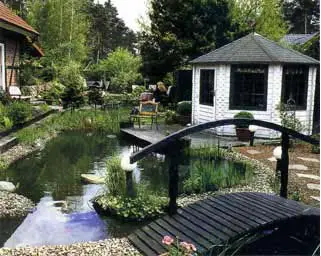
Gravel is a surprisingly versatile material for implementing design ideas. Moreover, it requires almost no maintenance and is not as expensive as one might think. A gravel flower bed can be arranged anywhere in the garden — in a flower border in front of the house, on a lawn, or next to an alpine hill.
Gravel Fantasies
Beautiful Garden with Plants on Gravel
Gravel is a surprisingly versatile material for implementing design ideas. Moreover, it requires almost no maintenance and is not as expensive as one might think.
A gravel flower bed can be arranged anywhere in the garden — in a flower border in front of the house, on a lawn, or next to an alpine hill. Even a small one can produce a very strong decorative effect. For example, a square or rectangular flower bed can be divided by gravel strips in the form of a cross, and a large plant in a ceramic vase can be placed in the center. But you can also go the opposite way: surround the flower bed with a platform made of light-colored gravel, and this background will beautifully accentuate the color and shape of the plants.
If the area is large, try dividing it into separate flower beds with soft outlines and lay wide winding gravel paths between them — such a garden will look like a colorful pattern from the upper windows of your house.
On the Lawn as if Dry
If a grass lawn has exhausted you with constant care, replace it with gravel. The appearance of such an area (by the way, they are currently very popular in landscape design) is distinguished by a special sophistication. Here you can let your imagination run wild: create a flower bed, scatter bright plants in pots artistically across the surface, or place several large stones-erratics according to Japanese art principles. Moreover, turning a lawn into a 'stone' area is not so difficult; it does not even need to be dug up. Simply clear the ground of weeds and lay a 5 cm layer of gravel on top.
To prevent grass and weeds from growing on the gravel lawn, lay polyethylene sheeting over the soil first: the stones will flatten the remnants of grass, and without light and air, they won’t sprout.
But if you prefer green grass to all other garden decorations, you can add another stylish touch to the landscape. For example, create an original flower bed by sprinkling gravel over a small part of the lawn. In this case, the gravel is also spread over the polyethylene sheeting. When planting, make cross-shaped cuts in the sheeting, but in this case, the flowers won’t be able to reproduce themselves through seed dispersal.
This flower bed, 'inscribed' into the emerald lawn, looks particularly effective if it has an irregular shape with smoothly curved edges. Placing several large stones along its contour will create the illusion of a dried-up streambed. The effect can be enhanced by leaving the central part of the 'bottom' free from planting, with plants placed closer to the edges.
Who Lives on Gravel?
Many alpine plants can be grown on gravel, but it's better to start with hardy and vibrant ones that will comfortably thrive among stones even without regular care.
Sea Thrift (Armeria maritima) — a perennial flowering in early spring and early summer. Depending on the variety, flowers can be white, pink, red, and look great against gravel in muted tones.
Myrsinopsis (Euphorbia myrsinites) — an evergreen plant with beautiful bluish-gray leaves and creeping stems. Yellow flowers appear in early spring, but the foliage can decorate the gravel flower bed all year long.
Annual Phlox (Dianthus deltoides) — a very vibrant perennial with small pink or red flowers (depending on the variety), which will delight you all summer long.
Missouri Evening Primrose (Oenothera missouriensis) — a low-growing perennial with purple creeping stems and large bright yellow flowers. One of the most striking alpine plants, blooming from early June to the end of summer.
Garden 'Pearls'
Compared to static coverings (brick, stone, or concrete), fine gravel has a dynamic form — its appearance changes depending on lighting and moisture. For example, flower beds and lawns can be laid with gravel that sparkles white in sunlight and takes on a moist sheen and pearl-like shimmer in wet weather. In general, gravel as a decorative material offers rich color possibilities: it comes in gray-blue, brown, black, white, pink, and many shades of yellow. If desired, one can choose gravel that matches the tone of the house facade or fence, or opt for contrasting colors.
Gravel pairs beautifully with other paving materials. Instead of covering a large area in the garden, leave space for a gravel flower bed or lawn — this will be cheaper and look more beautiful. You can achieve an even stronger effect by leaving symmetrical sections untouched and filling them with gravel in two or three different shades.
No matter what form of gravel design you choose — a flower bed, lawn, path, or just a decorative accent — fill it with at least two colors of gravel. Use one color for connecting paths and another for flower beds. Instead of planting flowers, you can lay patterns on the gravel using large sea pebbles. If you prefer clean, contrasting forms, try creating a checkerboard pattern: outline squares with bricks and fill each 'pocket' with colored gravel. However, always remember to keep it moderate to avoid creating chaos instead of elegance.
Garden in a Depression
If your plot has a depression in the terrain, it can be successfully transformed into a gravel garden. This feature not only adds variety to the familiar landscape but also eliminates the eternal puddle in the hole. Such a garden is convenient because its natural boundaries prevent gravel from spilling onto neighboring flower beds or borders.
Be Mindful
If gravel is adjacent to a lawn, be careful not to let stones fall onto the grass: you might break the mower blades. If you have small children, it's better to use fine rounded pebbles — this will reduce the risk of injury.