How to Paste Fleece Wallpapers. VIDEO
Share on Twitter
Post to Blog
Send by Email
Choose fleece wallpapers for several reasons – they do not deform, tear or swell during application, which significantly simplifies working with them. There is no need to wait for the required soaking time. Fleece wallpapers can be easily removed from the wall in one piece without moistening.
Fleece wallpapers, thanks to their structure, can hide minor surface imperfections, and the larger and more textured the wallpaper pattern is, the greater the imperfections it can conceal. However, do not experiment too much with this and instead prepare the wall surface properly before application.
Surface Preparation
Fleece wallpapers can be applied to any surface, whether it is concrete, gypsum board, wooden or particle board panels, or a plastered surface. However, regardless of the surface type, it is essential to thoroughly prepare it before application. Remove old wallpapers or paint; wash off lime wash; prime the surface, fill cracks and major wall irregularities. If you don’t plan to paint over the wallpapers, ensure that the wall color harmonizes with the wallpaper color, otherwise the wallpaper color may change after application.
Choosing the Adhesive
Adhesive for fleece wallpapers is usually purchased specifically for this purpose or can be used as adhesive for fiberglass fabric. In any case, the adhesive should be mixed with water according to the instructions and allowed to sit for about half an hour. Remember that when applying fleece wallpapers, adhesive should only be applied to the wall, not on the wallpaper itself. However, this is not true for vinyl wallpapers on a fleece base. Before application, the adhesive must be applied to both the wall and the wallpaper sheet. These wallpapers are much thicker and denser than regular fleece wallpapers.
Applying Adhesive to the Wall
It is best to apply adhesive with a roller, and in corners and under the ceiling – use a brush. Carefully spread the adhesive over the wall, do not skimp on the amount. To avoid adhesive seeping onto the next strip – apply it wider than the wallpaper strip by 10-15 cm. If adhesive appears on the seams during application, gently wipe it off with a slightly damp cloth; otherwise, it will be much harder to remove later and paint will not adhere well in those spots.
Applying Fleece Wallpapers by Yourself
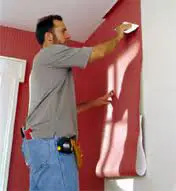 It is best to start wallpapering from the window and move counterclockwise into the room. Avoid drafts, as they can cause the wallpapers to peel off. Use a plumb line or level to mark the edge of the first strip – it should be perfectly vertical. It is preferable not to make any marks on the wall, as they may show through the wallpaper. After applying adhesive to the wall, place the top edge of the wallpaper strip onto the wall and align it along the plumb line. Leave about 2-3 cm at the top and bottom for trimming the edges. Air bubbles can be removed using a soft brush or a soft plastic clothes iron. While holding the top edge, turn over the bottom part and remove any air trapped underneath. Trim excess wallpaper only after the adhesive and wallpaper have dried.
Special attention should be paid to corner application. Do not paste full strips into the corners, as they will peel off when dry. To avoid this, paste corners overlapping by about 1 cm (for vinyl wallpapers on fleece base – 0.5-1 cm). If a center part of the strip accidentally ends up in a corner, it is better to cut and overlap it.
In areas where sockets and switches are located, after disconnecting power and removing the top part, apply the wallpapers over them and then trim around them. Only after that should you reattach the top part of the socket or switch.
Fleece wallpapers can only be painted after 48 hours from application.
When applying fleece wallpapers by yourself, remember that the surface should be generously coated with adhesive, and in some cases, the edges of the wallpaper strips should be slightly moistened with water to make them softer. It is best to apply the wallpaper by folding it in layers and starting to unroll from the top.