How to Choose Paper Wallpapers
When selecting wall covering for a child's room, attention should be paid to it. Wallpapers for children, at least, must meet the following requirements: Wallpapers must be made from eco-friendly materials.
Children's paper wallpapers
When selecting wall covering for a child's room, attention should be paid to it. Wallpapers for children, at least, must meet the following requirements:
Wallpapers must be made from eco-friendly materials. The child's body is sensitive to the influence of heavy chemical compounds and toxic substances - inherent components of most complex wall coverings. Wallpapers in a child's room must be hypoallergenic and as safe as possible. Paper wallpapers are the best choice in this regard. Don't complain that the covering is not durable. You should be prepared for the fact that practically all surfaces in a child's room will sooner or later be scratched, drawn on, covered with stickers, etc. Therefore, in this regard, wallpapering walls with inexpensive, easily replaceable paper wallpapers is quite justified and safe for the child.
Wallpapers must be hygienic. Pay attention to the density of the material you choose: the denser the paper wallpapers, the less they accumulate dust, and accordingly, the fewer threats to the child's health. Dust-free walls will protect the child from the possibility of allergic reactions, and also dust in general.
IMPORTANT! Do not use so-called "dust-collecting wallpapers" for wallpapering a child's room - stuffing wallpapers or stone wallpapers.
Wallpapers must be durable and practical: even the simplest paper wallpapers should serve you at least 5-7 years.
Wallpapers must be easy to clean. Among paper wallpapers, care for which, unlike vinyl ones, will be a bit more complex, you can choose a roll of washable paper wallpapers with an external glossy layer.
Moreover, the best paper wallpapers for a child's room are colorful wallpapers with simple animal motifs, beloved cartoon characters, etc. Keep in mind that when choosing such a bright child's design, the need to replace the wallpapers will arise by itself after 5 years: for example, beautiful pink wallpapers in a girl's bedroom, as the school age approaches, are better covered with more neutral ones - for example, wallpapers with flowers (in the Provence style) or wood-like wallpapers, and machines on the walls of a small boy's room at the same school age are recommended to be replaced with monochrome wall coverings - such wallpapers will be more appropriate in a school-aged child's interior.
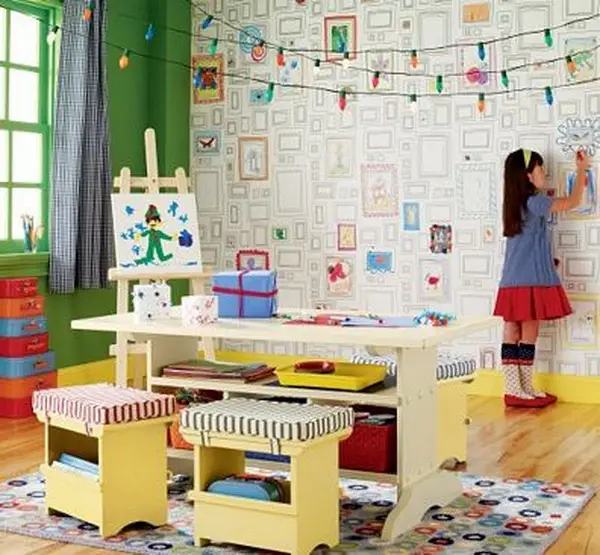
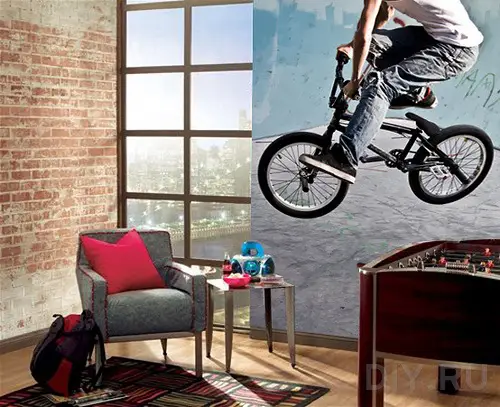
Photo 1 - Wallpapers for a child's room
IMPORTANT! According to GOST 6810-2002 Wallpapers. "Technical Conditions", wallpapers of type M-2 are not recommended for use in walls and ceilings of children's playrooms, as well as bedrooms. Paper wallpapers for the kitchen, by the way, on the contrary, must meet this class.
Class M-2 includes wallpapers with high washability resistance (they withstand a 2% soap solution well). Characteristics of all types of wallpapers, as well as recommendations on using a particular class of wallpapers in rooms of a certain type, are set out in the above GOST.
Paper wallpapers for walls: general selection rules
Each wallpaper catalog is full of various offers: different colors, textures, base materials.
On which variant should you settle?
ColorMany consider this point the simplest. However, do not rush to conclusions. There are certain hygienic recommendations that it is desirable to consider when buying wallpapers. For example, soft tones of walls in most cases create an atmosphere of balance, confidence, and calm, while bright orange or red colors more often have a irritating effect on the psyche.
In addition, special recommendations exist for choosing wall covering color based on the room's orientation relative to the compass directions:
- if the apartment windows face south - the sunlit side of the house, wallpapers with saturated dark tones (blue, coffee, terracotta, chocolate) are appropriate since this color palette can absorb excess light energy;
- if windows face the north side, insufficient natural lighting is better compensated for by wallpapering walls with light wallpapers (purple, yellow-green, light orange, light green colors), as statistics show that this approach artificially increases room illumination by 1.5-2 times.
In addition, color can visually expand the room or conversely narrow it (wallpapering with light and dark wallpapers respectively).
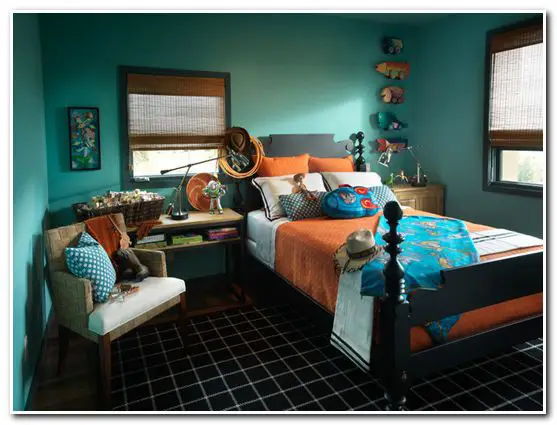
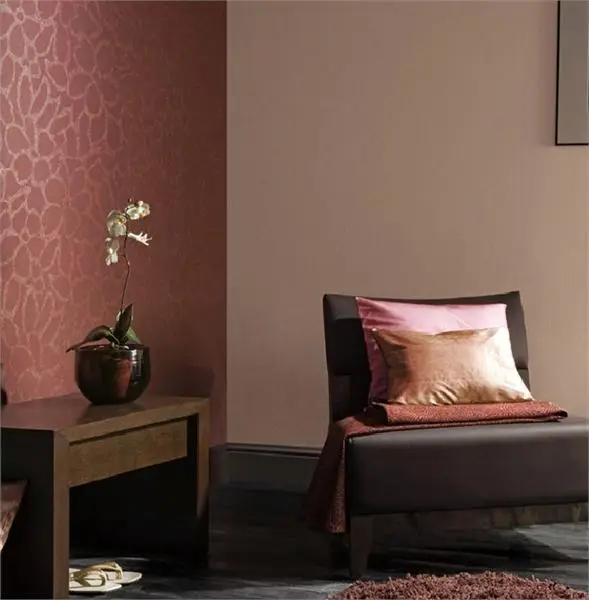
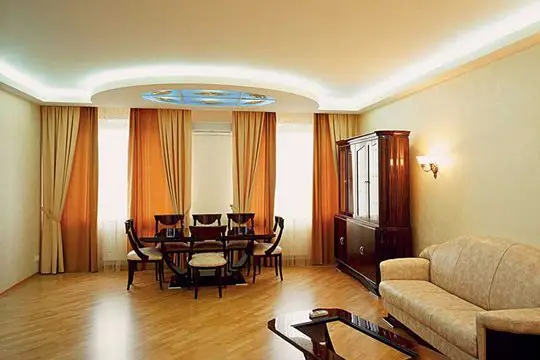
Photo 2 - Wallpapers for a light room
An important factor in perceiving the space is wallpapering walls with monochrome wallpapers or wallpapers with a pattern:
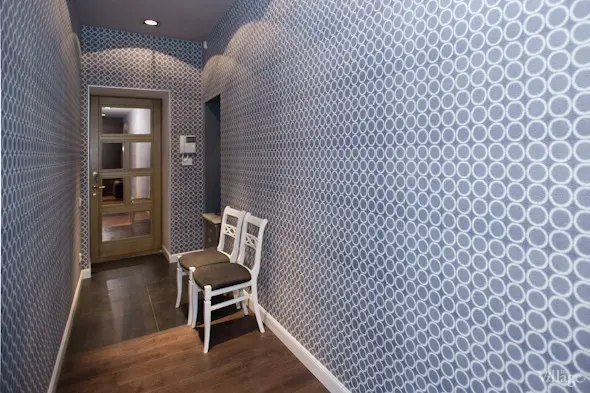
- monochrome wallpapers and small pattern wallpapers visually "push apart" the walls of the room (recommended for use in small rooms);
- large pattern wallpapers - conversely, reduce the space.
IMPORTANT! The larger the pattern on the wallpapers, the softer the material's color should be. Wallpapers in stripes also distort the space the most: diagonal stripes distort perpendicularity of walls and floor, vertical stripes visually "stretch" the room in height, and horizontal stripes distort the room in width.
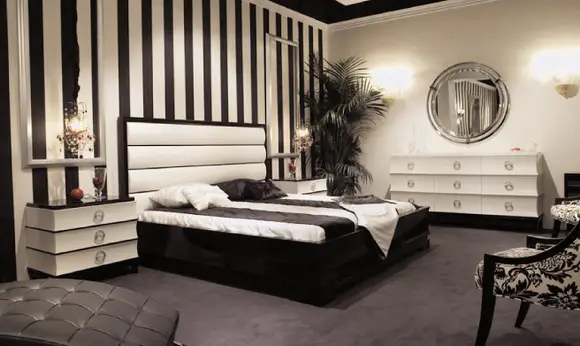
Photo 3 - Wallpapers in stripes
Also, check with the consultant about color changes of the selected type of wallpaper under natural and artificial lighting. Sometimes the difference is so striking that buyers refuse to purchase some varieties of this type of wall covering.
Types of paper wallpapers
Paper wallpapers come in:
- single-layer (simplex);
Usually consist of one layer of paper with a printed pattern.
- double-layer (duplex);
Consist of two layers of prepared paper. They have higher strength and quality indicators, better mask wall irregularities. They are also easier to remove from walls.
- coated (embossed in a pattern);
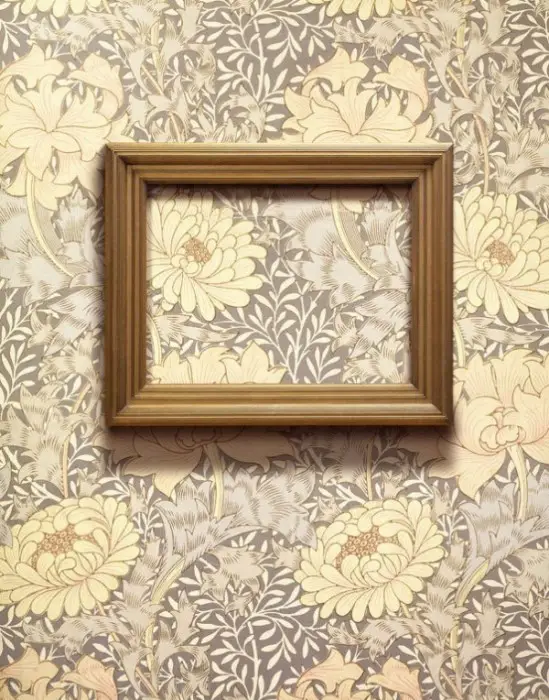
This type of duplex wallpapers is also double-layered: the printed pattern is connected to a special backing. During embossing, a relief is formed that repeats the top pattern.
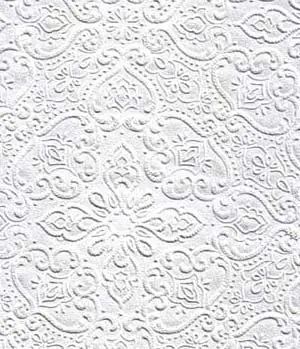
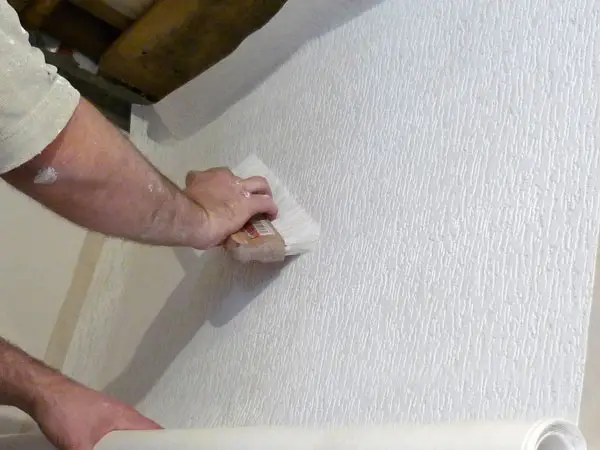
Photo 4 - Duplex embossed wallpapers in pattern
- water-resistant;
A special coating (lacquers or latexes) is applied to the surface of such wallpapers, providing additional protection for the material. The surface of water-resistant wallpapers can be matte or glossy. Despite the use of a protective layer, paper wallpapers of this type remain environmentally clean.
- wallpapers with a structured surface;
This is a two-layer material containing wood shavings in the interlayer, which determine the relief pattern of the surface.
- foam wallpapers.
In terms of production technology, they are similar to duplex wallpapers, but an acrylic polymer is additionally applied to them in a special technology. This gives greater strength and special relief to the coating. Foam wallpapers well hide wall defects.
IMPORTANT! Wallpapers with an acrylic coating do not hinder normal air circulation, as the polymer is applied to the surface not in one continuous layer but point-by-point.
Wallpapers are also differentiated by:
- the texture of the paper used (smooth, embossed, corrugated);
- operational characteristics (regular, water-resistant, washable, fuzzy or sound-absorbing);
- location (wall and ceiling);
- the nature of the pattern, wallpapers can be wall (smooth/relief pattern) and background (matte monochrome paint) and others.
When selecting wallpapers, pay attention to the water-resistance class, density, light-fastness, and permeability.
A separate variety of paper wallpapers - paintable wallpapers.
The best choice for most living rooms is two-layer decorative wallpapers. Embossed duplex wallpapers are good because when wallpapering walls, the roll will not tear apart, and their appearance is orders of magnitude better than single-layer paper coverings.
All necessary information about the type of wallpaper, technical characteristics of this coating, and recommendations on using the adhesive base should be included in a special insert leaflet in each roll of wallpapers.
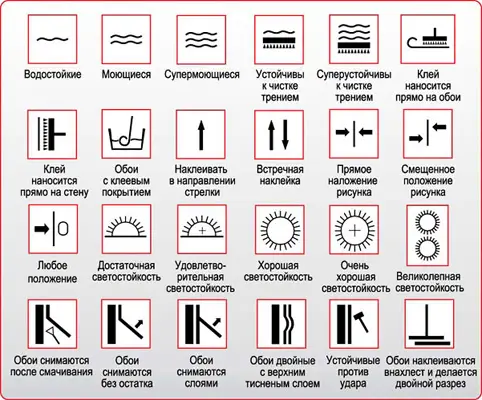
Figure 1 - Icons on wallpapers
IMPORTANT! When purchasing several rolls, pay attention to the batch marking of the wallpapers (it should also be indicated on the stamp in the insert): if batches differ, there is a probability of color variation in the coating. For the same reason, you should buy wallpapers with a surplus to avoid problems finding the necessary batch or matching wallpaper color in case of need.
Best choice: paper duplex wallpapers (VIDEO)
Calculating the required material
The width of wallpapers is usually 53 cm.
To determine how many rolls of wallpaper you need to cover the room, measure the width of the walls in the room, not forgetting about the space above doors and windows. Divide the resulting number by the width of the roll - this will give you the necessary number of sheets to cover the given room.
For example, if the width of one wall is 4.5 m, we will need:
4.5/0.53=8.4 sheets (rounded up to 9 sheets).
To calculate the number of rolls, measure the room height, adding another 5-10 cm (allowance for baseboards).
IMPORTANT! If you plan to wallpaper walls with a pattern, when calculating the amount of materials, you need to take into account the pattern repeat so that the pattern on the seams can be correctly joined. The most problematic in application are wallpapers with colors, as the seams must be perfectly calibrated.
So, with wall height of 2.85 m and 0.05 m allowance for the seams, we get:
2.85+0.05=2.9 (m).
According to standards, one roll should contain 10 m of wallpaper.
Thus, in one roll:
10/2.9=3.4 (sheets).
IMPORTANT! Decimal parts in the resulting number should not be taken into account, as you cannot wallpaper walls with scraps. In this case and all similar cases, only the integer part should be taken into account, i.e. "3".
To calculate the total number of rolls needed for wallpapering, divide the total number of sheets by the number of sheets in one roll:
9/3=3 (rolls).
Manufacturer
If you believe ABARUS Market Research (according to FTS data), today up to 70% of the Russian market is occupied by products from Ukraine. About 12% - wallpapers from Italy, 9% - from Germany, and the share of other countries' manufacturers is also about 9%.
It is easy to explain such figures:
- quality of products from Ukrainian manufacturers;
- significantly lower price;
- wide product range, not inferior to foreign manufacturers.
If we speak more specifically, then the following manufacturers have recommended themselves well:
Ukraine: "Slavic Wallpapers" (Kryukovskaya Factory of Technical Papers), TM "Lanita" (Vinyl Plant), TM "Versailles".
Italy: "Sangiorgio", "Murella", "Zambaiti".
Germany: "Marburg", "Paravox", "Hohenberger", "Rasch".
Belarus: "Beloozhi", "Homel Wallpapers".
Sweden: "Eso".
How to Transform Any Room with Affordable Paper Wallpapers
Let's calculate the budget for finishing work in one room measuring 3.5 m by 4.5 m.
At a height of 2.85 m (including window and entrance door) approximately 8 ten-meter rolls will be needed for wallpapering the room. For example, we take regular monochrome two-layer paper wallpapers (not photo or profile foam), which cost an average of $7-10 per roll.
You will need to buy:
- Wallpapers (8 rolls) - $56-$80;
- Adhesive for wallpapers (for wallpapering walls in a room with an area of 45 m², one 250-gram universal adhesive pack will be enough) - up to $5-$7;
- Tools for applying the adhesive mixture and leveling sheets/seams (painter's roller, brush, rubber roller, wallpaper spatula) - up to $10-$12.
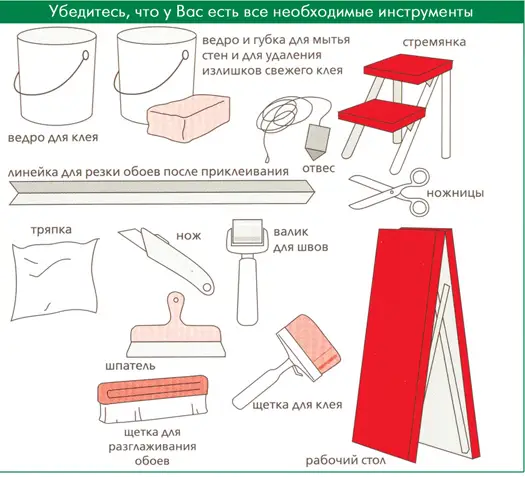
All else - ladder, scissors, tape measure, pencil, sponge - should be at hand for everyone.
As a result, we get: $71-$99 in material costs.
Compare: the average cost of wallpapering walls with wallpapers is $7-10/m².
At our area, for the master's work, we will have to pay approximately $320 (excluding the cost of materials, of course).
Where to Buy Paper Wallpapers from Warehouse and Save Money
Reasonable savings - not overpaying for store goods if the same assortment is displayed on the pages of an online store catalog.
How to buy cheap paper wallpapers online and not make a mistake?
Two simple tips:
Make such purchases only in trusted online stores.
Check the quality of the offered product by finding an analog in local stores. This way, you can assess the quality of the wallpapers and understand how well this particular model suits you, and feel the price difference.
In some cases, you can save up to 25% on wallpaper costs.
What to do if you decide to order wallpapers from a foreign manufacturer not available in any stationary store?
Answer: see point 1.
Foreign wallpapers will certainly cost a lot, so the quality guarantee of the material, as well as the possibility of return/exchange, and reviews from friends/colleagues/acquaintances - these are all that you should guide yourself by when choosing a store selling wallpapers online.
Price of Paper Wallpapers
Let's go through the prices from manufacturers:
Ukraine. We have already said that Ukrainian wallpapers occupy about 70% of the Russian market. And here's why: despite excellent product quality, the same TM "Slavic Wallpapers" asks for $2-3 per roll (10 m). The same prices are observed with two other manufacturers.
Examples: Khолодok 345-02, Era 33602.
Italy. Paper wallpapers from this country are more of a rarity than a rule. Italy is better known for wallpapers on fabric bases. It's not profitable for Italian manufacturers to import cheap materials into the country, so the cheapest wallpaper can cost $40.
Examples: Zambaiti Lilium-2015 or the Souvenir series by the same manufacturer.
Germany. With what - with what, but with the quality of this product there's no dispute. And the price, naturally, is corresponding. For example, in the children's series of Rasch (Rash) wallpapers, you won't find a product under $10 (price per roll).
Examples: Rasch Bambino 139808 or Bambino 140507.
More expensive will be paintable wallpapers: the price here even for domestic manufacturers' products can start at $8-10 per roll (e.g., Lanita Gera 1-0484 or Bukle 1840166 by the same manufacturer).
Price of Paper Wallpapers for Walls
- in Kyiv - from 16.90 UAH per roll (simplex);
- in Moscow - from 54.98 rubles per roll (simplex).