How to Paste Paper Wallpapers
Wallpapering with paper wallpapers: preparation stage
Preparing the base - 60% of success in performing these works.
All fasteners, protruding nails, brackets and so on are removed from the walls.
Before starting the work, sockets and switches are de-energized at the work site by the craftsmen.
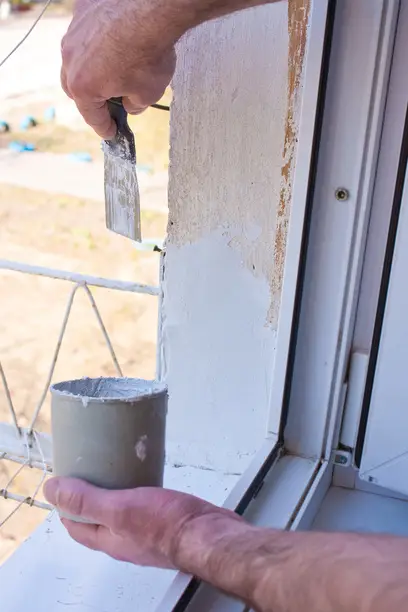
Walls are cleaned of dust, contaminants, mold, old wall covering (paint, wallpapers). After cleaning the surface is dried and, if necessary, leveled.
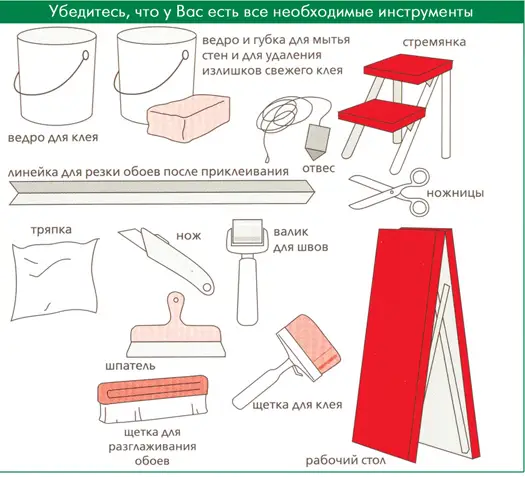
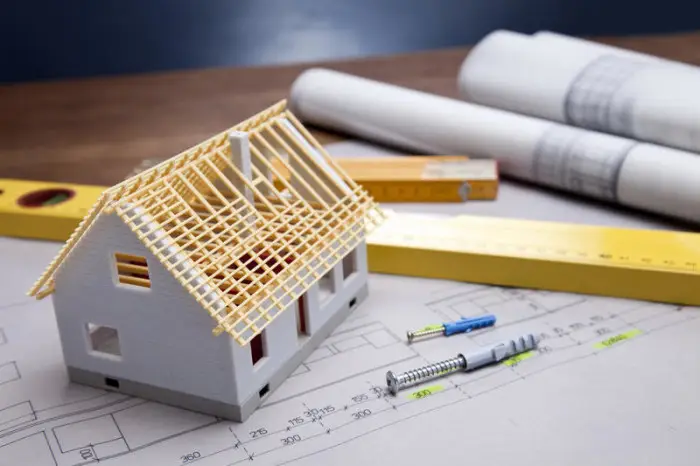
Figure 1 - Everything you need for wallpapering
Leveling different surfaces has its nuances:
- New walls must be spackled and double coated with acrylic primer of deep penetration before wallpapering;
- Painted walls, if the coating is in good condition, are checked for strength of adhesion between paint and wall - the wall is scratched, then damaged areas are covered with tape: if paint remains on the tape upon removal, the wall is sanded, treated with finishing spackle, then again sanded and primed;
- Walls that have had old wallpapers removed are cleaned of old spackle, new spackle is applied to level unevennesses, the surface is sanded and primed;
- If you plan to wallpaper a wooden wall, it should first be coated with a layer of rough spackle, then finish spackle, sanded and primed.
IMPORTANT! When wallpapering with patterned wallpapers, determine the places of seam joints before starting work and place non-matching patterns in wall corners or behind curtains.
When wallpapering, the roll must lie strictly vertically. For this purpose, markings are applied to prepared walls: horizontal lines are drawn at the place of planned wallpapering. Marking can be done not along the entire perimeter, but only based on the first roll, applied strictly according to the markings.
Another 30% of success is correctly selected and properly applied adhesive. The method of applying glue varies for different types of wallpapers: when wallpapering with paper-based wallpapers, the adhesive is applied directly to the wall, but for paper wallpapers, only the roll itself is coated with adhesive.
IMPORTANT! Paper wallpapers must be soaked in adhesive for a while: after applying the mixture, the rolls are folded in half (adhesive side inward) and left for 10-15 minutes.
However, let's not get ahead of ourselves.
How to properly paste paper wallpapers
Details of preparation for wallpapering:
Some manufacturers, such as Zoffany, Graham & Brown, Cole & Son, Sanderson & Morris, Lewis & Wood, Farrow & Ball or Watts Of Westminster, recommend using paper backing (so-called "lining paper") or special carpenter's felt (popularly called "spider web") for their products.
The backing is applied to the wall like wallpaper and dries for at least a day. The seams of the backing paper are spackled, sanded and all wall surfaces are primed with acrylic primer of deep penetration. Only after the primer has dried can wallpapering begin.
IMPORTANT! The seams of the backing paper and the seams of the wallpapers must not coincide!
How to cut the rolls?
Strips are cut with allowance for fitting by height of 5-10 cm.
The required number of rolls for wallpapering a room can be calculated by dividing the total width of the room (subtracting the width of door and window openings) by the width of one roll (standard - 53 cm). If you are using wallpapers with a pattern, the next strip must only be cut after matching it to the pattern. Each cut strip should be labeled and then pasted in order, orienting by this labeling.
IMPORTANT! Some types of wallpapers must be applied using the reverse application method. The manufacturer (in most cases European or American) must indicate this requirement with a corresponding symbol on the roll packaging or in the informational leaflet.
Before pasting American wallpapers, pay attention to the labeling:
- The drop match symbol means that the second strip must be shifted by the full height of the pattern during matching;
- Half-drop means that the second strip must be shifted by half the height of the previous pattern during matching;
- Straight match (straight across) means that the second strip must be shifted not only by the full height of the pattern but also cut with a flip;
- Random match means that the strips can be cut without matching.
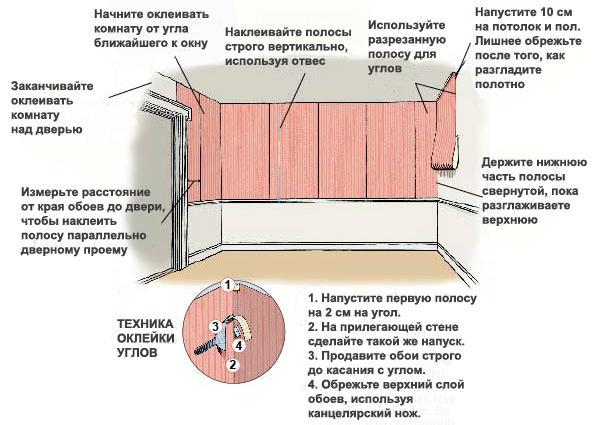
Figure 2 - Brief instructions on the order of wallpapering walls
What adhesive to use?
For foreign-made wall coverings, it is best to use cellulose-based adhesive (e.g., Quelid Express).
The adhesive is mixed strictly according to the instructions provided with the product.
Adhesive is applied to the back side of the roll in the quantity recommended by the manufacturer (individually for each type of adhesive, recommendations on application or mixing of adhesive should be provided in the instructions).
IMPORTANT! The edges of the rolls must be covered with adhesive at least as much as the center of the roll. Using paper wallpapers without properly selected adhesive is a waste of money and effort.
When choosing adhesive for wallpapers, pay attention to the base of the adhesive - CM (carboxymethylcellulose) or MC (methylcellulose), since MC dissolves poorly in hot water, while CM can be dissolved using water of any temperature.
Manufacturers:
- Wallpaper adhesive "Universal TD-2000" is considered one of the most economical. A 200g package is enough for wallpapering a standard room of 3x4 meters. Advantages include antiseptic additives in TD-2000. The adhesive is diluted only with cold water.
Country: England.
Price: from 3$/200 g.
- "Rapid adhesive" (for all types of wallpapers) is ecologically clean, non-toxic and, what's particularly pleasant, has no odor. A standard 250g package is enough for pasting 7 rolls of light wallpapers. The adhesive is diluted with water at room temperature.
Country: France.
Price: 1.7$/250 g
- "Express" (for all types of wallpapers) is good because increasing the amount of water added increases the area covered. Figuratively, it's a "rubber" adhesive: more water - more results. It also has no smell and is ecologically clean.
Country: Germany.
Price: from 3$/200 g.
- "Bustilat-M" - a universal adhesive, but not exclusively wallpaper adhesive. It is mostly used for wallpapering walls by habit rather than by design. It can only be used for wallpapering heavy wallpapers. Remember: this adhesive has a quite sharp odor. It does not need to be diluted - it is sold already mixed.
Country: Russia.
Price: from 5$/2.5 kg.
How to paste?
Adhesive is applied to the rolls from the center to the edges (this minimizes the chance of tearing the edges of softened rolls with a brush).
Earlier, we mentioned in passing that after applying adhesive to the rolls, they should be folded with the adhesive side inward. The rolls are recommended to be folded along one edge to the center by a third, and the remaining 2/3 of the roll is also folded to the center, joining the top and bottom edges.
IMPORTANT! When folding the wallpapered rolls, avoid creases and unevennesses! If you are not going to use any strips for more than half an hour, wrap them in plastic wrap: this way the adhesive won't evaporate.
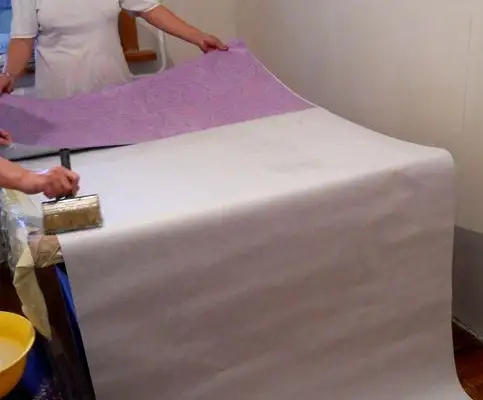
Photo 1 - Back of the roll after applying adhesive
The time needed for the rolls to absorb the adhesive depends not only on the adhesive composition but also on the type of wallpaper. Usually, such data is provided by the manufacturer on a leaflet attached to the roll.
IMPORTANT! At the beginning of wallpapering, close windows, doors and shutters: there should be no drafts in the room until the wallpapers are completely dry.
Start from a corner, previously marking vertical lines on the wall for even application of the first strip.
The roll is unrolled and pasted to the wall from the ceiling, leaving a 5 cm allowance.
Aligned by the marked line and flattened with a wallpaper brush from the center to the edges.
It is not recommended to use a wallpaper spatula for such work!
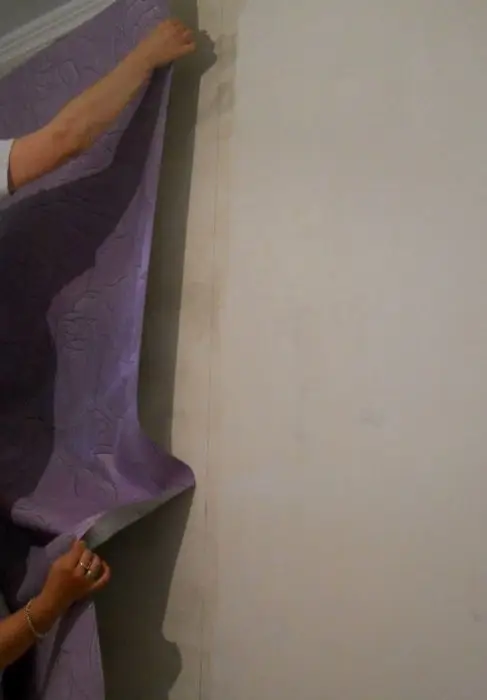
Photo 2 - Applying the first strip according to the marked vertical line
The seams of the rolls are pressed with a rubber roller.
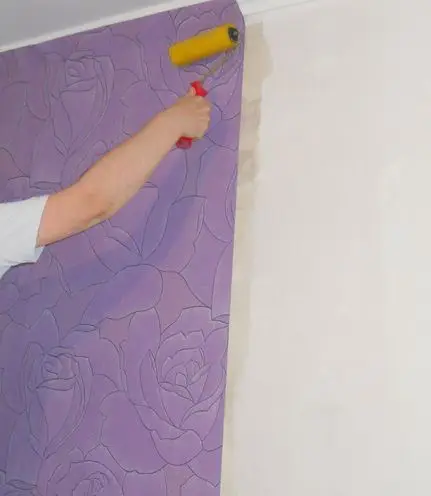
Photo 3 - Flattening the roll with a roller
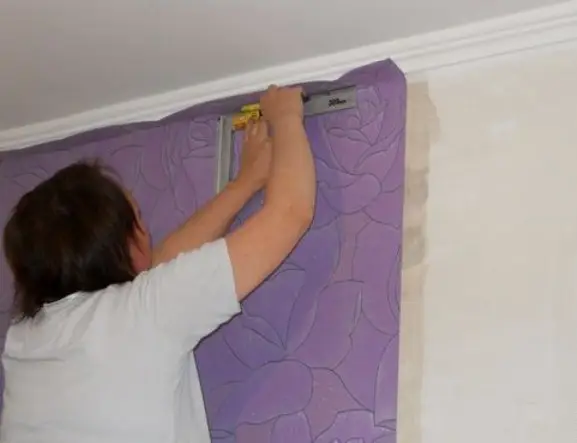
Photo 4 - Trimming the allowance of the roll
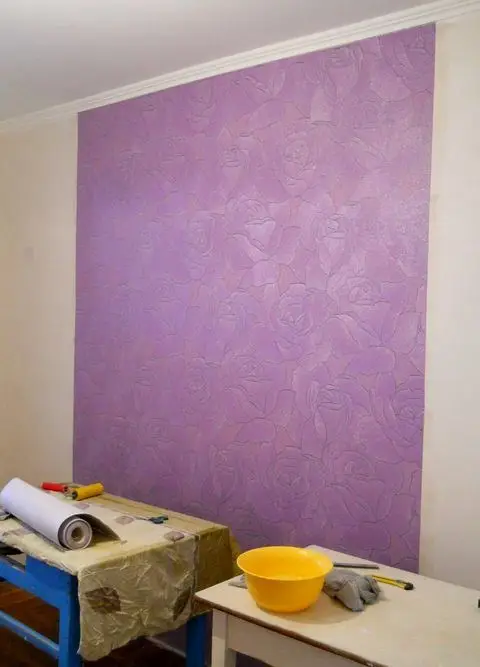
Photo 5 - Final result
How long to wait for drying?
Generally, no less than 12 hours. But the exact drying time is indicated by the manufacturer of the adhesive you used (see on the packaging).
Wallpapering on paper base is a slow process and sometimes can take an entire day (if the wall surface does not need preliminary leveling).
Paper wallpapers for painting
Wallpapers designed for painting are no different from regular decorative wallpapers in terms of application. The only difference is that, for example, washable wallpapers for painting, due to greater density and weight of the rolls, will require a higher amount of adhesive or special adhesive mixtures.
IMPORTANT! Light wallpapers are considered those weighing up to 110 g/m², medium-weight wallpapers are rolls up to 140 g/m², and heavy wallpapers are those weighing 140 g/m² and above.
Wallpapering walls with wallpapers for painting. VIDEO
Choosing a manufacturer of paper wallpapers
As it might seem strange, the leaders in the Russian industry are wallpapers of Ukrainian production. According to statistics, they occupy nearly 70% of the market. Among Ukrainian manufacturers, the products of TM "Slavianskie Oboi", TM "Lanita" and TM "Argo" stand out.
Russian manufacturers are also not bad, but compared to Ukrainian products, they suffer in design from Italian or American wallpaper collections. The quality is fine.
The most reputable companies are considered to be the Russian company "Palette", "Moscow Wallpaper Factory", and TM "Saratov Oboi".
Regarding other market participants, the overcharge is mostly due to the brand of the country of origin: imported wallpapers cost more, although the same quality and suitable design wallpapers can be found in catalogs of domestic firms and factories at least three times cheaper - even Belarusian wallpapers of TM "Belooboi" or "Homeloboi" are no worse than American ones.
Speaking of America.
Probably, the most famous brand of American wallpapers in our country today is York. Slightly inferior to it are Wallquest and Chesapeake Wallcoverings. Indeed, there is no real design or execution in the collections of these brands - they lack even a single branch or wrinkle. However, the price is quite high.
Consider this: wallpapers Chesapeake Coastal Waters cost from 100$ per roll, while similar paper wallpapers of Belarusian production ("Belooboi" - Napoleon S25M-BO) cost (pay attention!) 50 times less - only from 2$ per roll. In the first case, it is a duplex and in the second case too. The conclusion is obvious: why pay more?
Another notable wallpaper supplier on the Russian market is Italy. Indeed, in the segment of paper wallpapers, this country is almost not represented here: not due to high competition, but rather because Italian manufacturers prefer to produce textile wallpapers and VIP-class wallpapers. The starting price for such luxury is 60$. Among the trade brands, Russians are familiar with "Sangiorgio", "Domus", "Murella" and "Zambaiti".
By the class of materials used in the production of wallpapers, by product quality, and taking into account the original designer designs, there are no Italian equivalents in the segment of moderately priced wallpapers. Germany, which accounts for about 9% of the market turnover, is represented in Russia by TM Rasch, Marburg, P + S, Erismann and several other manufacturers.
Distinctive feature of this product is the unwavering brand quality and proportional prices for wallpaper products. For example, Rasch in the Trianon collection offers paper wallpapers from 20$.
The same price range includes the products of TM Casadeco (France). As the manufacturer promises, Paris can be brought directly to your home. And note, at a reasonable price - on average 25$ per roll.
The cost of wallpapering a room depends on the chosen wallpapers or manufacturer: American wallpapers, for example, require not only specific cutting but also specific wallpapering techniques. In case of ordering wallpapers from the USA, you definitely won't manage on your own.
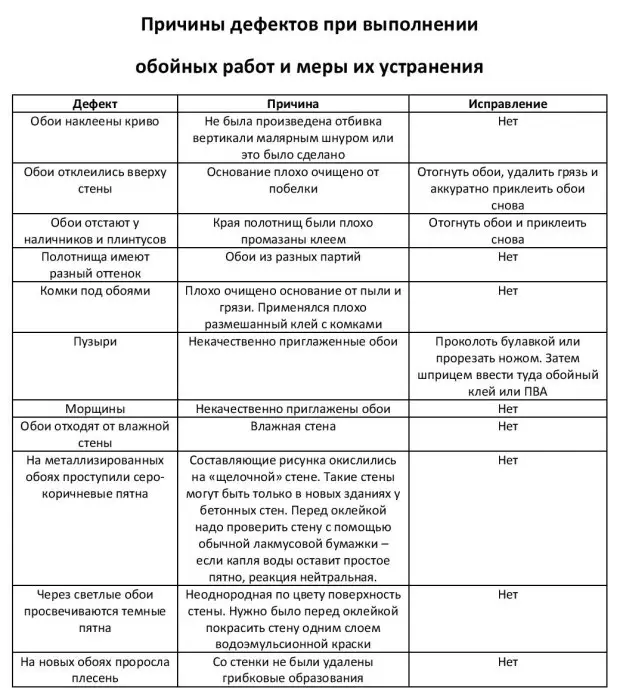
Figure 3 - Reasons for defects during wallpapering and measures to eliminate them
Cost of wallpapering with paper wallpapers
- Kiev - 45-70 UAH/m² (wall cleaning from wallpapers - an additional 25 UAH/m², wall priming - an additional up to 30 UAH/m²);
- Moscow - 200-500 rubles/m² (wall cleaning from wallpapers - an additional up to 40 rubles/m², wall priming - an additional from 20 rubles/m²).