The Seven Sisters: What Stalin's Skyscrapers Hide
We tell you about the most interesting facts of the famous Moscow skyscrapers
Their silhouette is visible from almost any point in Moscow — seven imposing buildings with sharp spires, which foreigners nicknamed the "Seven Sisters". Stalinist skyscrapers became a symbol of the post-war capital and still evoke a mixture of admiration, curiosity, and slight unease. Who built them and why? What lies behind their monumental facades? And why was the eighth "sister" never erected? We explore the most interesting facts and myths about these famous Moscow skyscrapers.
Why Seven and When Were They Built
The skyscrapers were laid down on the same day — September 7, 1947 — when Moscow celebrated its 800th anniversary. According to the plan of Soviet leadership, one skyscraper was supposed to be built for every century of the city's existence. Indeed, the original plan called for eight buildings, but the project of the 275-meter-high tower in Zaryadye was frozen after Stalin's death.
It is strange to imagine, but the grand construction began only two years after the end of the most destructive war in history. The country lay in ruins, people lived in communal apartments and barracks, but the party decided: "Skyscrapers must be!"
The construction of the skyscraper complex stretched over an entire decade, from 1947 to 1957. The last one was the Ukraine Hotel — already under Khrushchev, who soon banned any "architectural excesses" and started building the famous Khrushchev apartments.
The Seven "Sisters": From Tall to Short
Main Building of MGU on Vorobyovy Hills (240 m)
The tallest and most monumental of all. According to legend, special ground freezing technologies were used during its construction, so huge refrigeration units are still located under the building. It is also said that in some university rooms Geiger counters go crazy — allegedly, radioactive materials were used during construction.
Residential House on Kotelnicheskaya Embankment (176 m)
A house for the Soviet elite, where famous personalities such as Faina Ranevskaya, Ludmila Zykina, Andrei Voznesensky and many others once lived. There is even a cinema hall of its own — "Illusion", specializing in classic cinema.
Ministry of Foreign Affairs Building on Smolenskaya Square (172 m)
The only skyscraper without a star on its spire. This gave rise to the legend that Stalin, driving past the nearly completed building with a flat roof, suddenly asked: "Where is the spire?" Architects had to urgently design a lightweight metal structure that couldn't support a heavy star.
Hotel Ukraine (206 m)
The most luxurious of the skyscrapers, with marble columns, crystal chandeliers, and mosaics. At the time of its opening — the tallest hotel in Europe. Today it is a five-star Radisson Collection Hotel, where rooms cost from 15 thousand rubles per night.
Residential House on Kudrinskaya Square (156 m)
Famous as the "Aviator's House" — many apartments were intended for aviation industry workers. According to rumors, on the upper floors there was once KGB equipment for monitoring the American Embassy located nearby.
Building near Red Gates (138 m)
The only skyscraper with a metro vestibule — the Red Gates station (now Lermontovsky). To build the structure on unstable ground, builders used a trick: they deliberately tilted the foundation, calculating that under the weight of the building it would level out. And it did.
Hotel Leningrad (136 m)
The shortest but perhaps the most elegant of all skyscrapers. Famous for its enormous bronze chandelier-garland, hanging down through several floors. The chandelier even made it into the Guinness Book of Records for its size.
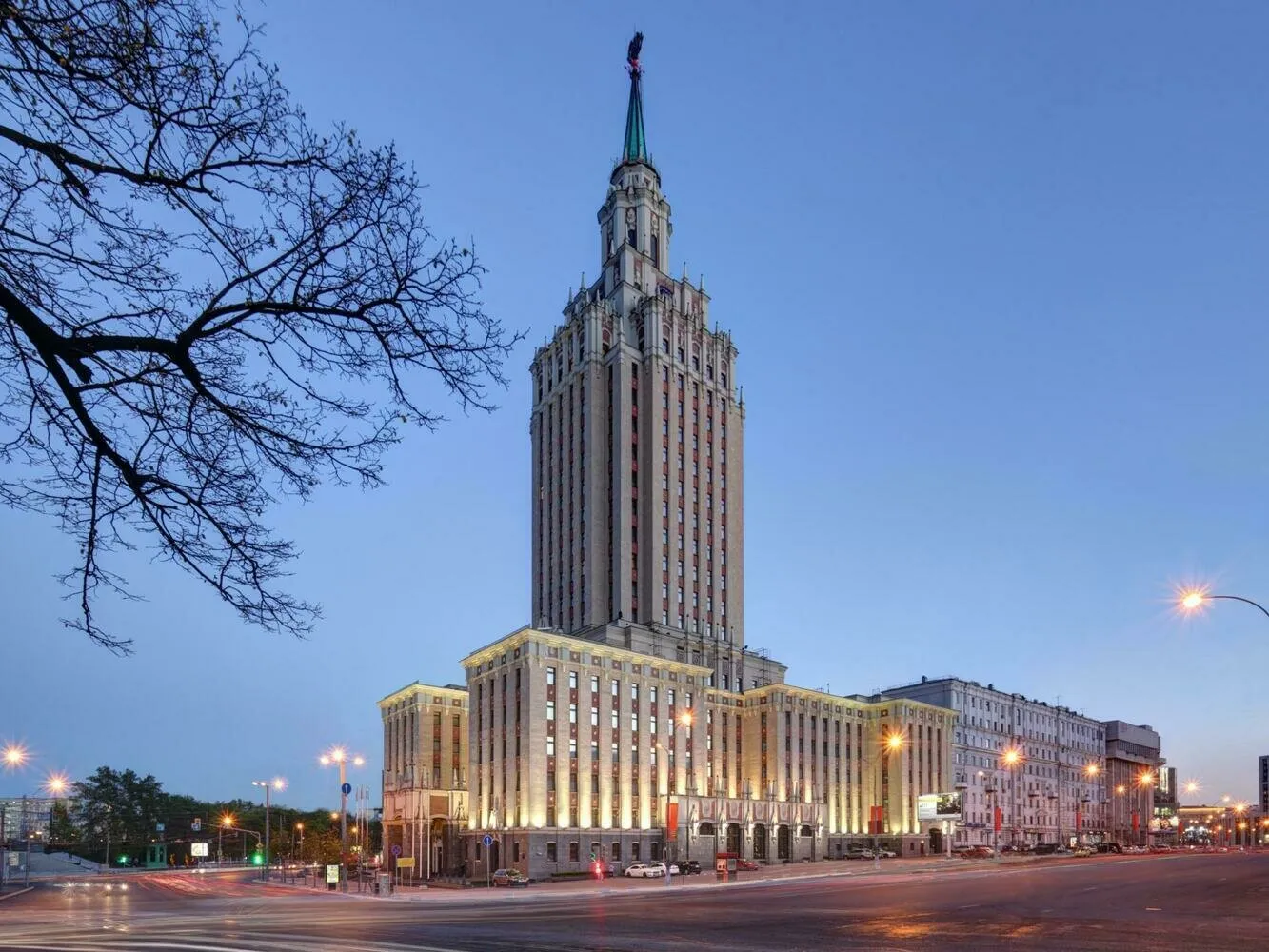 Photo: news.booking.com
Architecture on Steroids: How the Skyscrapers Are Built
All skyscrapers were built in a style often called "Stalinist Empire" — a pompous mix of Soviet symbolism, elements of Russian architecture, Gothic, Baroque, and Art Deco. A kind of architectural cocktail meant to showcase the greatness of the USSR.
Common features of all skyscrapers:
Staircase composition — the central tower is surrounded by shorter buildings;
Spires with five-pointed stars (except for the Ministry of Foreign Affairs);
Rich decoration — reliefs, sculptures, columns;
Massive granite bases;
Lavish interiors with marble, moldings, and bronze.
In essence, each skyscraper is a whole city with its own infrastructure. They have everything: from post offices and dry cleaners to cinemas and restaurants. The main MGU building even has its own swimming pool and film studio.
Who Built Them and How Much Did It Cost
Officially — young Communists. Unofficially — Gulag inmates and German prisoners of war. There is no exact statistics, but according to historians, without forced labor this project would not have been completed in such a short time.
How much money exactly was spent on building the skyscrapers — still a state secret. According to some estimates, the cost of just the MGU skyscraper in today's money could have reached over 200 billion rubles. In the post-war ruins, these were colossal sums.
Secrets, Legends, and Urban Folklore
Basements and Bomb Shelters: There are underground levels practically under every skyscraper. Somewhere they are just technical rooms, somewhere — real bomb shelters. But in popular culture, there are legends about entire underground cities, secret laboratories, and tunnels leading to the mythical Metro-2.
Phantoms and Mysticism: What old building does not have stories about ghosts? Students at MGU tell tales of a ghost of a dead girl wandering the dormitory corridors. In the house on Kotelnicheskaya, one can supposedly encounter ghosts of famous residents. In the Leningrad Hotel, guests sometimes complain about strange sounds and moving objects.
Strange Incidents: In 1953, during the construction of MGU, a mysterious event occurred: in one night, the oak doors in the buildings changed their direction — those that opened inward started opening outward and vice versa. According to the official version, this was an urgent job to meet new fire safety requirements. According to unofficial sources, someone among high-ranking officials had a bad dream and decided the doors needed to be redone.
How the Skyscrapers Live Today
Despite their age, all seven buildings are still functioning in their original purpose. Students study at MGU, diplomats work in the Ministry of Foreign Affairs, people live in residential buildings, and hotels receive guests.
From a technical point of view, the skyscrapers turned out to be very high-quality buildings. Yes, they require regular restoration, but the main structures are still in excellent condition. For example, the spire of the Ministry of Foreign Affairs was recently completely replaced, but the building itself remains solid.
In 2005, Moscow saw an unofficial "eighth sister" — the residential complex "Triumph-Palace" with a height of 264 meters, built in a similar style. But honestly speaking, it's like comparing the Eiffel Tower to its scaled-down copy in Las Vegas.
Self-Guided Tour Route
Want to see all the skyscrapers in one day? It's possible, though it will require good physical condition. Here is the optimal route:
Start with the Leningrad Hotel near Komsomolskaya Square;
Then head to the skyscraper near Red Gates;
From there — to the Ministry of Foreign Affairs on Smolenskaya;
After that — to the Ukraine Hotel;
Then — to the house on Kudrinskaya Square;
Next — to the house on Kotelnicheskaya Embankment;
And finally — to the main MGU building on Vorobyovy Hills.
- The entire route will take about 6-7 hours including transfers by metro and short stops to inspect each building. It's best to start early in the morning to see MGU at sunset — truly an impressive sight.
Remember: although it's not easy to get inside some of the skyscrapers (especially the Ministry of Foreign Affairs), you can freely enter the hotels and MGU. Don't miss the chance to see their interiors!