Tile Laying on Floor
Tile Laying Technology
The existing methods of tile laying are not numerous, but all of them can be divided into wall and floor types. Wall tile laying methods:
• classic horizontal;
• vertical;
• combined.
Floor tile laying methods
• square;
• rhombus;
• carpet;
• parquet;
• patterns from tiles of different sizes.
The design of tile laying largely depends on the selected ceramic tile and the room where it will be laid. It is logical to assume that a more complex laying method requires greater skill.
Modern advancements in construction materials provide numerous opportunities for personal involvement and doing much with your own hands. In this regard, tile laying is no exception, but when using expensive tiles such as ATEM, CERAMICA PARADYZ, REX, AZORI, CERPA, VIZAVI, MARAZZI, it is more appropriate to hire professionals.
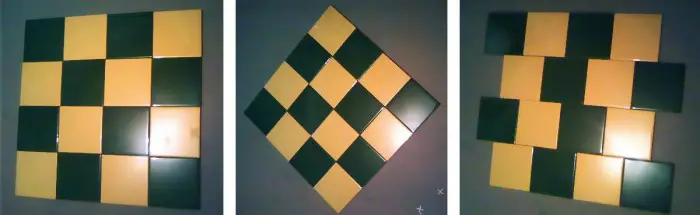
Photo 1 – Wall tile laying methods
Tile Laying Technology
The existing methods of tile laying are not numerous, but all of them can be divided into wall and floor types. Wall tile laying methods:
- classic horizontal;
- vertical;
- combined.
Floor tile laying methods
- square;
- rhombus;
- carpet;
- parquet;
- patterns from tiles of different sizes.
The design of tile laying largely depends on the selected ceramic tile and the room where it will be laid. It is logical to assume that a more complex laying method requires greater skill.
Tile Laying Process
Preparatory works: measuring and drawing up a plan to determine the number of tiles and materials needed. Keep in mind that removing old tiles increases area, while plastering reduces it.
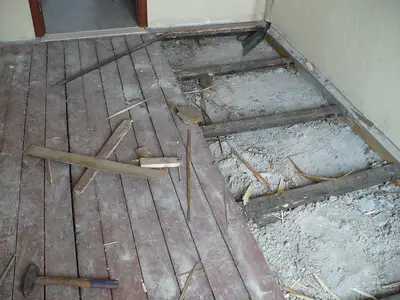
Photo 2 – Preparing the floor for tiling
Preparing working surfaces: in addition to cleaning and leveling the surfaces, it is necessary to identify unevenness of walls, floor, and ceiling so as to know their deviations and take them into account during tile laying. Also check the strength of surfaces by tapping; this is done to ensure that wooden walls are covered with metal mesh before tiling.
Floor Tiling: tiles can be laid and the visual pattern assessed. For diagonal laying, pre-mark the border to ensure maximum number of whole tiles in the design. Tiles are laid along guide strings and then placed after 10–15 minutes of adhesive application on the surface. The width of joints should not exceed 2 mm. The laid row is checked with a level.
Wall Tiling: done when the floor is already ready. Everything here depends on skill level and laying method, with main problems arising from uneven surfaces.
Grouting Joints: joints must first be cleaned of leftover adhesive, and then using a rubber float and grout to fill the joints.
There are many other related activities performed in special cases, for example: installing drainage in the bathroom, coating tile surfaces with special protective compositions and others.
Laying Tiles on the Floor
When laying tiles on a floor (wooden or concrete), the main requirement is reliability and integrity of the floor covering. Also, keep in mind that floor tiles and wall tiles are completely different types with different strength characteristics. Additionally, tile laying methods on the floor do not allow for voids under tiles regardless of room type – kitchen, bathroom, hallway, toilet, etc. Laying tiles on OSB, plywood or MDF is one of the options for laying on a leveled and reinforced floor; but even in this case, ensure that the base under additional coating remains reliable.
Laying Tiles in the Bathroom
In standard bathrooms, an important element is laying tiles around the bathtub and cutting holes for taps and other bathroom fixtures and furniture. Usually, floors and walls of a bathroom are covered with tiles, less often – ceiling. In the bathroom, proper joint sealing is critical to prevent moisture from seeping under tiles and causing them to peel off. For this purpose, use high-quality grouts for joints and thoroughly protect the joints.
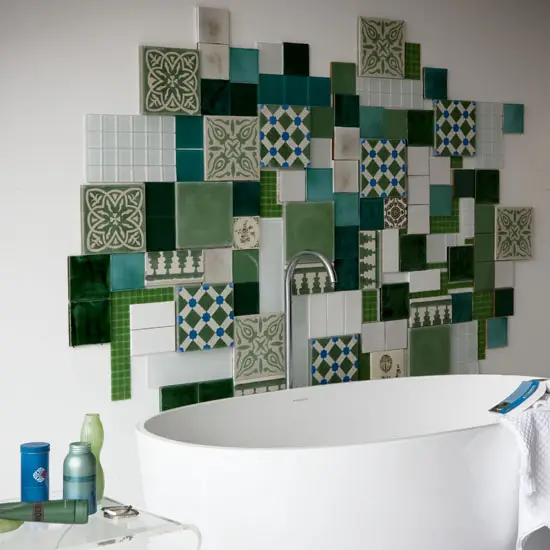
Photo 4 – Bathroom tile laying example
In cases where ceramic tiles are laid on gypsum board, it is necessary to ensure reliable bonding with such a surface. For this purpose, the gypsum board should not only be moisture-resistant but also vibration-resistant; and then a nylon mesh is applied over it. This base ensures proper adhesion and stiffness for wall tiles. There are no particular difficulties in such laying, since these walls are always perfectly flat and tile laying can be done by oneself.
Laying Tiles on the Kitchen Floor
Kitchen tiles are also used for walls and floors, but a simple backsplash is often found where the wall may be exposed to undesirable impacts. Ceramic tiles are sometimes used for work surfaces, but this is more of an exception than a rule.
Tile Laying Video Tutorial
The educational video below explains the entire process of laying ceramic tiles (not only ceramic) with professional involvement. Of course, you can do it yourself if you have experience and the necessary tools.
$ Tile Laying: Service Prices in Moscow and Kyiv
The cost of tile laying services depends on several factors, the most common being: surface complexity where tiles are laid, presence of open pipes and taps, pattern intricacy, and the cost of tiles themselves. The minimum prices per 1 m² are as follows:
- Moscow – from 600 rubles
- Kyiv �� from 30 hryvnia
Of course, more responsible and quality work can only be done by experienced craftsmen, whose work is usually more expensive but undoubtedly better than any DIY options.