Machine Plastering: Key Features and Working Rules
Wall plastering using machine methods: advantages
Compared to traditional techniques, machine plastering reduces material usage, improves final finish quality, increases crew efficiency, and greatly eases the workload.
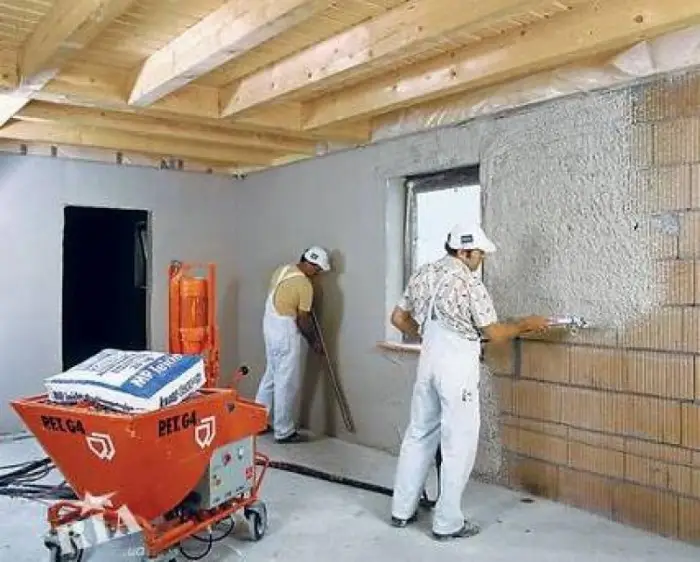
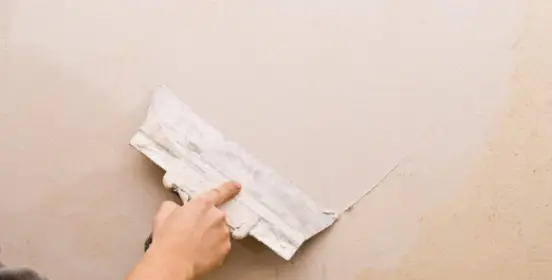
Photo 1 — Automatic plastering with MP75. Workers can cover up to 150 m² per shift.
Machine plastering: principle of operation
Machine plastering with KNAUF MP75 is one of the most popular types for mechanical application. We’ll explain the process using MP75 as an example.
MP75 is a dry mix based on gypsum binder with polymer additives. It can be used equally effectively for plastering walls and ceilings. This is confirmed not only by the manufacturer's instructions but also by user feedback.
MP75 can be applied to any solid surface: brick, concrete substrates, and even cement plaster.
Plastering machine
You can use equipment such as the PFT G4 plastering machine for MP75. The PFT G5 can also be used for applying MP75.
For finishing layers on large surfaces, a sanding or troweling machine may be needed to remove roughness and achieve a smooth, glossy surface not requiring wallpapering or painting. For small areas, a metal trowel may be used.
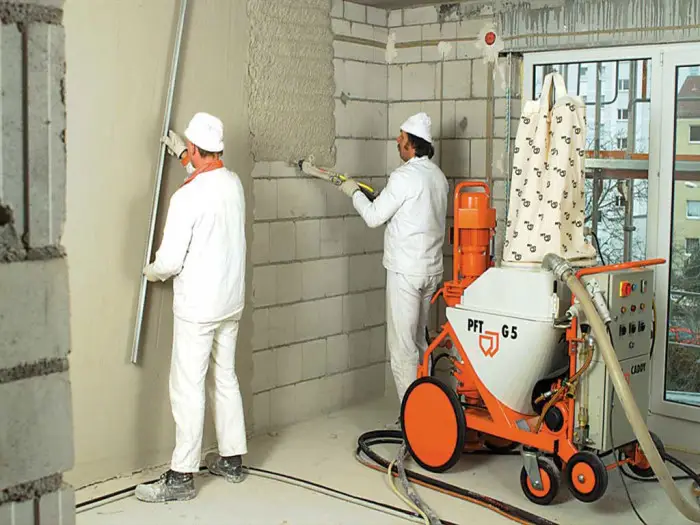
Photo 2 — PFT G5 plastering machine for use with MP75.
Technical specifications of mechanical plastering with MP75- Layer thickness: 8 – 50 mm.
- Material grain size: up to 1.2 mm.
- Output of mixture (per 100 kg dry mix): 100 L.
- Consumption of dry mix (at 10 mm layer): approx. 10 kg/m².
- Drying time for 10 mm layer under normal conditions: approx. 7 days.
- Compressive strength: 2.5 MPa.
Plaster application and working with the mix: required tools:
- plastering machine;
- stainless steel trowel;
- aluminum straightedge;
- wide stainless steel trowel;
- sponge trowel;
- metal trowel;
- plastering rasp.
Machine plastering with MP75: step-by-step procedure
Surface preparation
Surface must be cleaned, dried, and primed. For highly absorbent surfaces such as silicate brick or gas concrete, apply KNAUF Grundirmittel primer (diluted 1:3 with water). Alternatively, use KNAUF Rotband-Grund. For low-absorbency surfaces, apply KNAUF Betonkontakt (for concrete, cement bases, polystyrene). Allow drying time: 6 hours for Betonkontakt, 24 hours for Grundirmittel.
IMPORTANT! The primed surface must not become dusty during drying!
Installation of guide profiles
Apply MP75 as adhesive for guide profiles every 30 cm.
IMPORTANT! Distance between guides must not exceed the length of the trowel.
Installation of corner profiles
Apply MP75 in small amounts on corner profiles at intervals not exceeding 30 cm. Insert profiles into wall corners with light pressure.
IMPORTANT! For properly prepared surfaces, you will need approximately 0.3 kg/m² Betonkontakt, 0.4 kg/m² Rotband-Grund, and 0.15 kg/m² Grundirmittel.
Mechanical plaster application
Load MP75 into the plastering machine hopper. Set water flow according to manufacturer’s recommended consistency for the dry mix.
When applying plaster mechanically, follow these rules:
- Hold the nozzle strictly perpendicular to the surface. Distance from nozzle to surface must not exceed 30 cm (commonly measured by stepping back one foot).
- Layer thickness is controlled by nozzle movement speed: slower movement = thicker layer.
- Correct working direction: left to right and top to bottom. Begin from the upper-left corner.
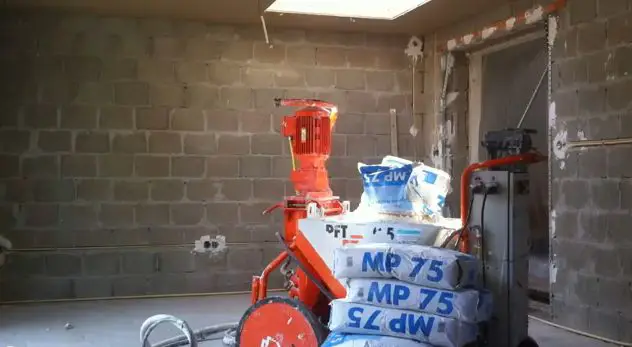
Photo 3 — MP75 consumption at 10 mm layer is approximately 10 kg per 1 m².
IMPORTANT! Coverage width must not exceed 70 cm. Each new pass must overlap the previous one by 5–10 cm.
When working on ceilings, the plaster layer must not exceed 15 mm. Work from the opposite corner to the window.
Remember: the mix must not sit in the hose for more than 15 minutes.
Surface leveling
After 90–120 minutes from mixing, the plaster begins to set. At this point, use a metal trowel to level the surface. Use a small trowel to remove excess material.
Surface finishing
If you plan to paint or wallpaper the surface, after 15 minutes of leveling, thoroughly wet the surface with water and rub it in circular motions using a stiff sponge or felt trowel.
Final smoothing
Smooth the surface with broad strokes using a wide trowel until a matte finish is achieved.
IMPORTANT! To achieve a glossy finish, re-wet and re-trowel the plaster at least 5 hours after mixing.
Machine plastering: material and labor costs
If hiring a crew and equipment seems too expensive, don’t jump to conclusions: the speed of machine plastering often justifies all costs.
Cost of materials for mechanical plastering- dry plaster mix KNAUF MP75 − $11.7 / 30 kg (for comparison, gypsum mechanical plaster VOLMA Sloi-MN costs approx. $6.8 / 30 kg);
- primer KNAUF Betonkontakt − $56 / 20 kg;
- primer Rotband-Grund − $26.4 / 15 kg;
- primer Grundirmittel − $24.8 / 15 kg.
A crew of 3–5 people can complete 70–150 m² per shift. Labor cost:
- Moscow − 350 RUB (only labor, at 10 mm layer);
- Kyiv − 75 UAH (only labor, at 10 mm layer).