Integrated Photovoltaic System: Functional and Aesthetic Enhancement
Modern building with BIPV facade © Sunovation
Energyself-sufficiency is becoming one of the key goals and interests of contemporary architecture. Integrated photovoltaic systems (BIPV) play an important role in this development, bringing challenges but also stimulating creativity and innovative spirit among architects.
NEW REQUIREMENTS, NEW ARCHITECTURE
Architecture is a constantly evolving field, always driven by human needs, such as the need for shelter, safety, and peace. While these basic needs remain relevant today, the set of requirements has expanded in various ways. For example, climate change as one of the major modern problems makes sustainability and energy independence aspects increasingly important, even shaping contemporary architecture.
For instance, solar panels are no longer simply installed on roofs or facades of existing buildings but often become a central element in new construction projects. Early (before construction begins) consideration allows using solar panels as integrated parts of buildings, thus functionally and aesthetically.
BIPV PANELS: MULTIFUNCTIONAL BUILDING ELEMENTS
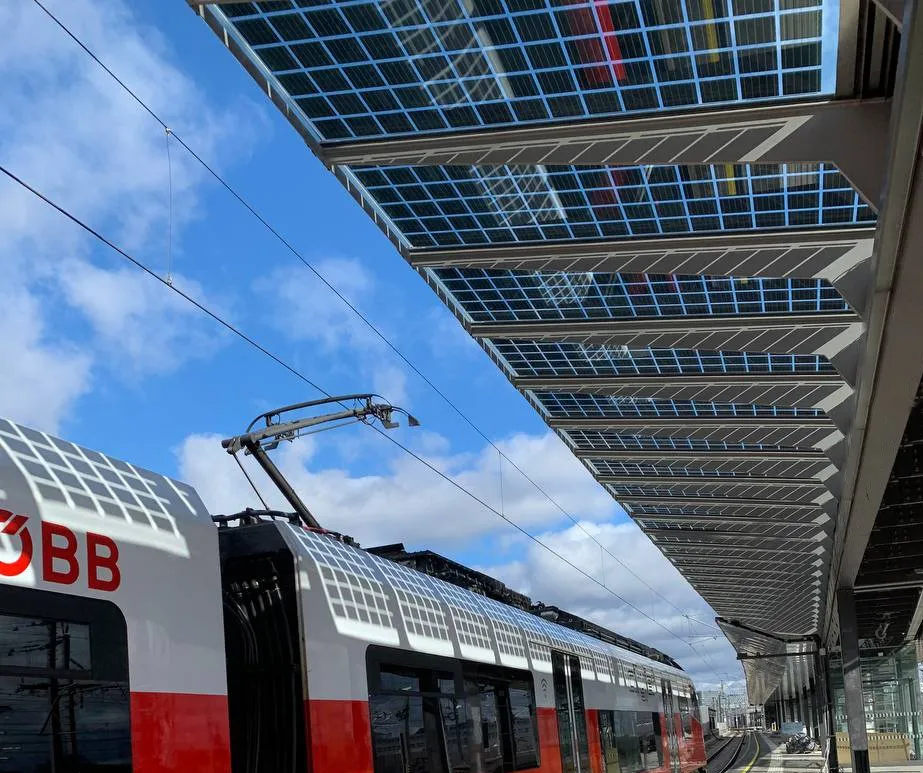
Shaded BIPV roof at railway station © Sunovation
First and foremost, the purpose of BIPV is to collect solar energy, which is a renewable and clean source of electricity. Since the panels are integrated into buildings, electricity is generated on-site without requiring additional space — this makes BIPV, so to speak, a building material with return on investment.
Besides, unlike non-integrated counterparts, BIPV panels also replace conventional materials and building envelope components, such as roofs and facades, both physically and functionally. Consequently, BIPV panels are always multifunctional — some examples:
- Weather protection: Using modules as roofs or facades, BIPV forms a robust protective barrier and serves as protection against rain, sunlight, snow, and wind.
- Shading: Depending on the color of BIPV modules, degree of transparency, and cell spacing, module transparency varies. Fully or partially opaque modules can be used as shading systems, for example, as parts of canopies on train platforms, parking lots, or gas stations.
- Natural lighting: Integration of transparent glass allows sunlight to enter. Thus, covered buildings can be illuminated with natural light, reducing energy consumption for lighting.
- Thermal insulation: BIPV modules consist of at least two glass panels (with a layer of photovoltaic cells between them). For increased energy efficiency and building insulation, closed glass panels can be used on the backside of cells.
- Sound insulation: Like conventional glass facades, BIPV modules represent a strong physical barrier that effectively reflects sound waves and noise.
BIPV Panels as Design Elements
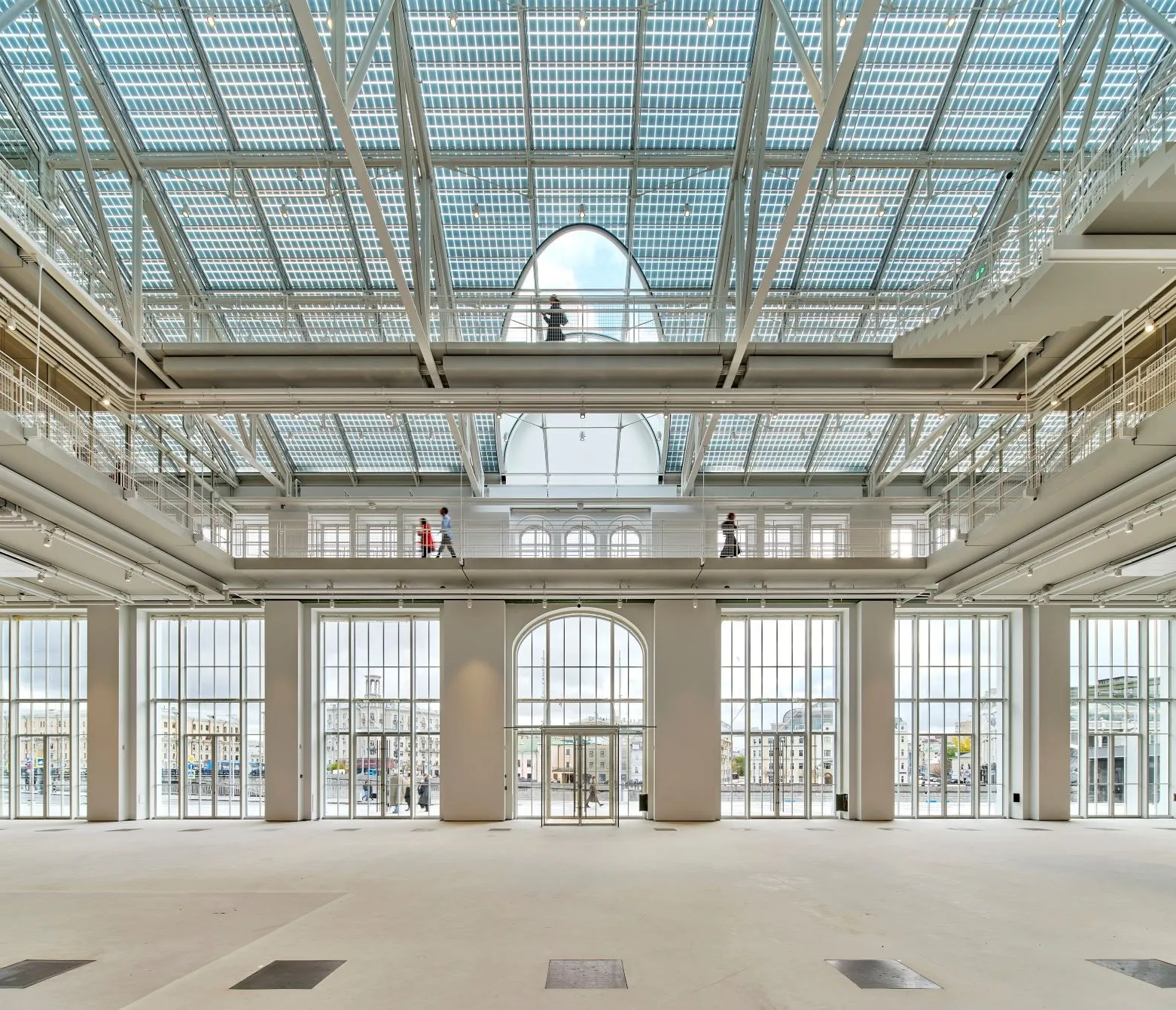
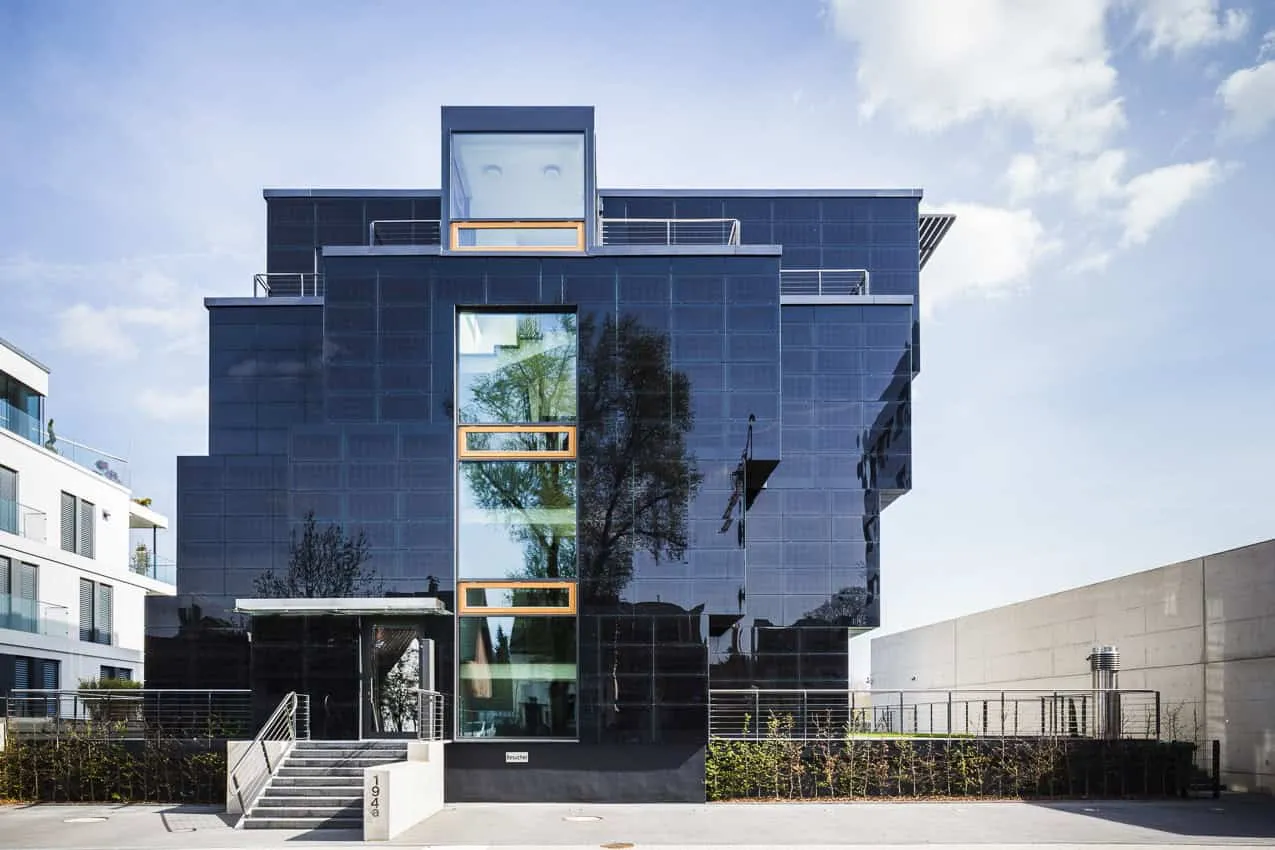
Building with glass module © Michel Denan
Since the development of photovoltaic technology in the 1950s, significant progress has been made. Efficiency has greatly increased, and appearance has also improved. Modern BIPV panels are often custom-made and available in various styles, shapes, and colors. Therefore, they can be easily integrated into architectural structures.
- Shapes: Most photovoltaic panels have a rectangular shape. However, this is not mandatory. Glass panels can be triangular, pentagonal, hexagonal, elliptical, circular, trapezoidal, rhombic, or any other shape.
- Flat and curved: Traditional photovoltaic panels are flat. However, using special types of glass and manufacturing processes, curved panels can be produced. This allows applying BIPV on rounded and wavy structures.
- Colors: Typically, photovoltaic solar cells are painted blue or black depending on crystal content. However, module colors can be easily adjusted, for example, using colored glass, tinted films, or printed glass. Thus, BIPV modules are available in a wide range of colors.
- Invisible cells: Although the appearance of photovoltaic panels fits well with the design of many modern buildings, this is not always the case. However, good news is that BIPV cells do not necessarily have to be visible. To hide them from view, it's sufficient to use semi-transparent glass panels with coating.
Regardless of the specific form and color of modules, BIPV panels certainly enhance the appearance of buildings. Especially since they add an ecological and innovative element to the overall look.
Conclusion
As shown above, buildings benefit from BIPV panels for various reasons. On one hand, due to their multifunctionality — including electricity generation, shading, natural lighting, thermal and sound insulation — which to some extent enhances building energy independence. On the other hand, due to their 'green' appearance and numerous design possibilities that architects can creatively integrate into building envelopes and structures.