Wooden cabinet from gypsum board by yourself
General principles of making cabinets from GKL
There are general principles for making cabinets from GKL or essentially complex boxes from gypsum board.
How to draw up a plan
First, the location of the cabinet is selected, and a detailed project is drawn up not only with measurements of overall dimensions but also with sizes of all, even small details. The thickness of the shelves is determined, drawer and hanging elements are planned, doors.
An idea for creating furniture can be found in furniture catalogs or among photos of ready gypsum board structures.
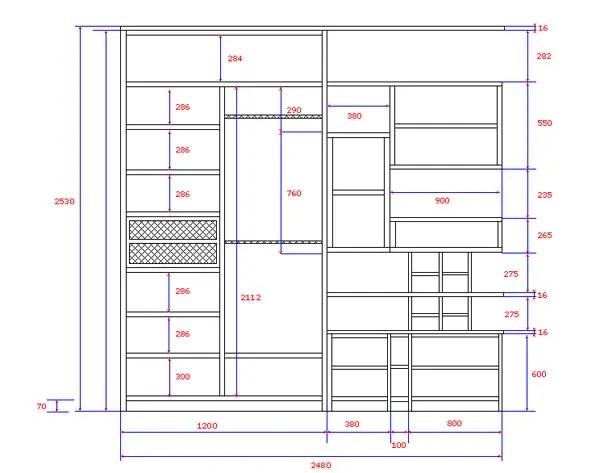
Figure 1 — Example of cabinet drawing
How to make layout
Lines of the frame are marked on the base (floor, ceiling, walls). For this, a level, plumb line, painter's string, pencil, and square can be used.
Frame installation
If lights are planned, the layout for them is done before frame installation, and wiring is done during its mounting.
Guidelines on the floor and ceiling are used to mount guide profiles with anchors, pre-coated with rubber insulation on the side that will be adjacent to the base.
Then, upright profiles are inserted into the guide profiles. The profiles must be secured to the walls with suspensions, and between each other with special screws. Cross beams made from profiles are mounted between the uprights for rigidity. The smaller the spacing between the profiles, the stronger the structure.
The frame can also be made from wood – in such a design, it will be much more solid. However, wood is a more capricious material and harder to install. Shrinkage of wooden slats will ruin the cabinet. If the weight of items stored in such a cabinet is significant, it's better to use wood that has been well-dried.
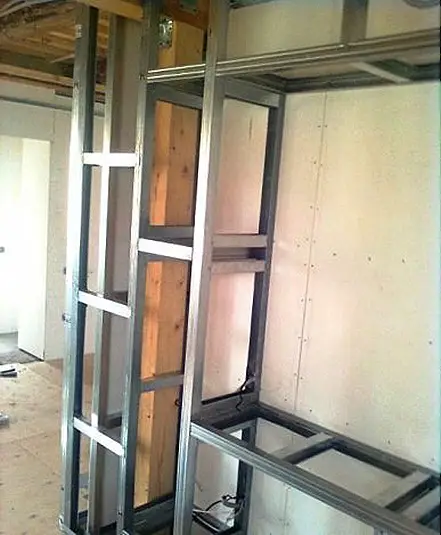
Photo 1 — Frame for TV niche
Gypsum board mounting
Gypsum board is mounted to the frame according to standard rules for wall cladding with gypsum board. Depending on the planned load, shelves are made from one or two layers of gypsum board.
The type of gypsum board chosen depends on the conditions in the room where the cabinet will be placed. Don't forget about the checkerboard pattern of sheet attachment (non-alignment of horizontal joints), beveled edges on non-factory edges, etc.
Finishing
Cabinet finishing is done according to the same technology as gypsum board works: taping joints with separating tape, spackling joints using reinforcing mesh or tape, gluing perforated corner beads on the spackle, spackling the entire surface, and finishing according to taste.
How to hang a cabinet
It might be desired to mount a suspended cabinet made from gypsum board (e.g., in the bathroom for household chemicals). Theoretically, yes, and practically it is possible, but is it necessary? To use it, the weight of the cabinet itself and its contents should be minimal.
Cabinets made from gypsum board must be mounted on some base (floor, wall), usually they are built into existing niches and corners.
Therefore, if there is a desire to hang a separate solid cabinet, it's not appropriate to use gypsum board. Small shelves made from gypsum board can be mounted by securing their frame with anchors on the wall, just like any other gypsum board construction.
A cabinet made from gypsum board can be different: from a shelf to a wardrobe.
Built-in wardrobe from gypsum board
A wardrobe can be made not only on order in a furniture store but also made by yourself from gypsum board. The advantage of gypsum board is that it's fast and cheap to create an entire wardrobe where you can hide most of your belongings.
Installation of such a cabinet proceeds according to the above-mentioned sequence. Finishing of internal surfaces should be wear-resistant and not easily marked.
After finishing the ready cabinet, it's time to install furniture hardware and finish with other materials, for example, MDF. Planning should be done in advance, but purchasing and ordering sliding systems should be done only after installation and cladding of the frame to avoid size errors.
Installation of shelves, hanger pipes, drawers, and other cabinet elements is done just like in a regular wardrobe. However, it should not be forgotten that all parts must be mounted in places where the frame is present under the cladding.
Last of all, profiles are mounted to the ceiling and floor into which the sliding system is installed. The main thing to consider when building such a large interior element is the strength of the structure. Primarily, it will depend on the quality of the frame installation, the degree to which it is reinforced with cross beams, and the spacing between uprights, etc.
Variants of internal cabinet filling: video
Corner cabinet
The advantage of any corner cabinet, whether it's a wardrobe in the hallway for clothes or a bookcase in the living room, is its attachment to two walls. This not only saves material but also makes the structure even more stable, especially if the cabinet extends from ceiling to floor.
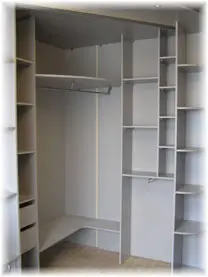
Photo 2 — Corner cabinet variant
Niche and shelves
There is almost no limit to creativity in this area. These improvised cabinets do not require additional details or furniture fasteners – everything is made from gypsum board.
A through cabinet with shelves made from gypsum board can serve as a boundary between two zones in the room, not cluttering it and not blocking light.
Niches and shelves in a wall made from gypsum board are multifunctional – they can be planned for household appliances, library or decoration.
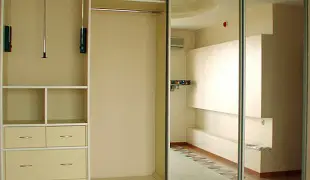
Photo 3 — Built-in wardrobe
All cabinets made from gypsum board, as part of walls and partitions, should be planned and installed during renovation. It is cost-effective to build such furniture by yourself (if you have the necessary skills), as the cost of such work ordered is quite high.
For example, on one construction company website, it is stated that manufacturing and installing a cabinet from gypsum board costs 5000 rubles per linear meter.