Asbestos-cement shingle roof
Shingle roofing is one of the oldest building materials. It belongs to the group of coverings that have survived centuries and reached our time. Traditionally, natural slate was understood as individual tiles made from shale rock.
Roofs made with this material had a look of 'armor' or 'scales'.
Production of natural slate is quite labor-intensive and expensive. Therefore, when demand for reliable roofing materials increased, there was a need to produce a material with similar characteristics and high manufacturing speed. The result of a long research process was asbestos-cement shingles.

Over time, the asbestos-based 'clone' of natural slate completely usurped its name. Now, the term 'shingle' refers to synthetic roofing material, while the original product is referred to as 'natural shingle'.
Asbestos-cement shingles
Key advantages of this new material include ease and speed of installation, as well as low cost of both the material and the labor required for laying. In addition, the following benefits should be noted:
- fire safety;
- resistance to atmospheric exposure;
- low thermal conductivity;
- frost resistance;
- ease of processing (cutting, drilling, etc.)
The main ingredients in the formulation of this shingle, as its name suggests, are asbestos, cement, and water. The mixture of these materials is blended and molded under heat and pressure in specialized presses. Cement acts as a binder, while asbestos fibers reinforce the entire product and give it high strength.
Among relative drawbacks are the high specific weight of the material and low resistance to point impact (e.g., heavy hail of large size can cause serious damage to a shingle roof).
Manufacturers distinguish the following types of shingles:
- Corrugated sheet of standard profile (VO).
- Corrugated sheet of reinforced profile (VU).
- Corrugated sheet of unified profile (UV).
Of all the listed types, the UV type is the most widespread, as it offers strength comparable to the reinforced sheet and larger dimensions than the standard shingle. Therefore, by reducing the total number of sheets on the roof, the length of joints (potential leak points) is also reduced.
Installation of shingle roofing
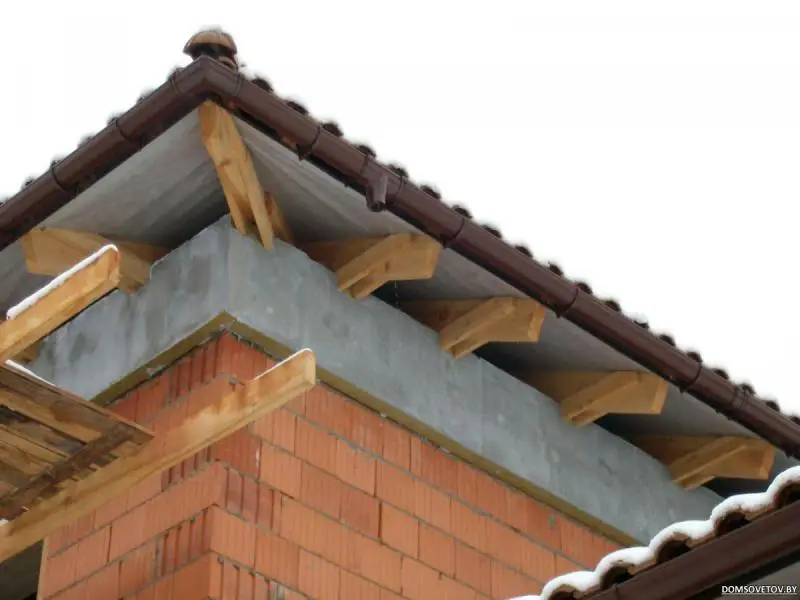
The base of a sloped shingle roof, as always, is the rafters. Perpendicular to the rafters, a wooden battens framework is built on the future roof. The batten size depends on the type of sheets used: 50 x 50 mm for standard shingles, 75 x 75 mm or more for reinforced ones. The batten spacing must match the geometric dimensions of the sheets: 500–550 mm for VO, and 750–800 mm for UV.
Installation of corrugated shingles proceeds from bottom to top, i.e., from the eaves toward the ridge. The overlap of upper-row sheets over lower-row sheets should be 12–14 cm. If the roof pitch exceeds 30 degrees, the overlap can be reduced to 10 cm. Horizontally (longitudinally), each subsequent row must be offset by one wave in either direction relative to the previous row.
Fastening hardware used in these roofs includes screws or nails with a special press washer and a rubber gasket, known as shingle nails or roofing (‘farmer’s’) screws.
Painting shingles
Some manufacturers produce shingles with a pre-applied colored surface in popular roofing colors: brown, red, blue, green. If the roof is made from unpainted shingles, the exposed surface must be treated with special acrylic shingle paint.
Painting significantly extends the lifespan of a shingle roof and gives the entire structure a finished appearance. Additionally, the paint layer greatly reduces the release of harmful asbestos into the environment.