How to Choose Ceramic Tile: A Complete Guide for Renovation
We explore which tile to choose and how to lay it correctly
Ceramic tile is one of the most popular finishing materials that can dramatically transform an interior and last for decades. But how not to be overwhelmed by the huge choice of shapes, colors and textures? Which tile is suitable for a bathroom and which one for a kitchen? What matters more: beauty or practicality? We explore the nuances so that your renovation becomes not a headache but a pleasant home update.
Main points from the article:
For wet rooms, choose tiles with low water absorption (up to 3%) and anti-slip surface;
Large format tiles visually expand space but are more difficult to install;
Pay attention to the wear resistance class: for corridor and kitchen floors, PEI III or higher is required;
It's better to calculate tile quantity with a 10-15% surplus for cutting and possible breakage;
Quality grout and proper installation are just as important as choosing the tile itself.
Types of Ceramic Tile
Before heading to the store, it's important to understand the variety of tile types. Each type has its own features, advantages and limitations.
Ceramic Tile. This is the classic option with a clay base and glazed surface. It's known for its affordable price and wide range of designs.
Advantages: low price, easy maintenance, moisture resistance;
Disadvantages: lower strength compared to ceramic granite, sensitivity to mechanical damage;
Where to use: bathroom walls, kitchen backsplash, interior walls in non-residential spaces.
Ceramic Granite. A more modern and technologically advanced material, manufactured by pressing and firing at high temperatures. It is made from clay, feldspar, quartz and other minerals.
Advantages: high strength and wear resistance, low water absorption, frost resistance;
Disadvantages: higher price, greater weight, difficulty in processing;
Where to use: floor in any room, walls in high-traffic areas, exterior finishing, commercial spaces.
Clay Tile. Made from special types of clay with mineral pigments and fired at very high temperatures.
Advantages: exceptional strength, resistance to frost and chemical effects, natural appearance;
Disadvantages: high price, limited color palette;
Where to use: facade cladding, terraces, fireplace areas, outdoor staircases.
Mosaic. Small-format tile, usually on a mesh base, allowing for creating original patterns and adapting to complex surfaces.
Advantages: decorative appeal, ability to cover curved surfaces, ease of finishing complex areas;
Disadvantages: labor-intensive installation, many joints requiring maintenance;
Where to use: accent zones, shower cubicles, columns, niches.
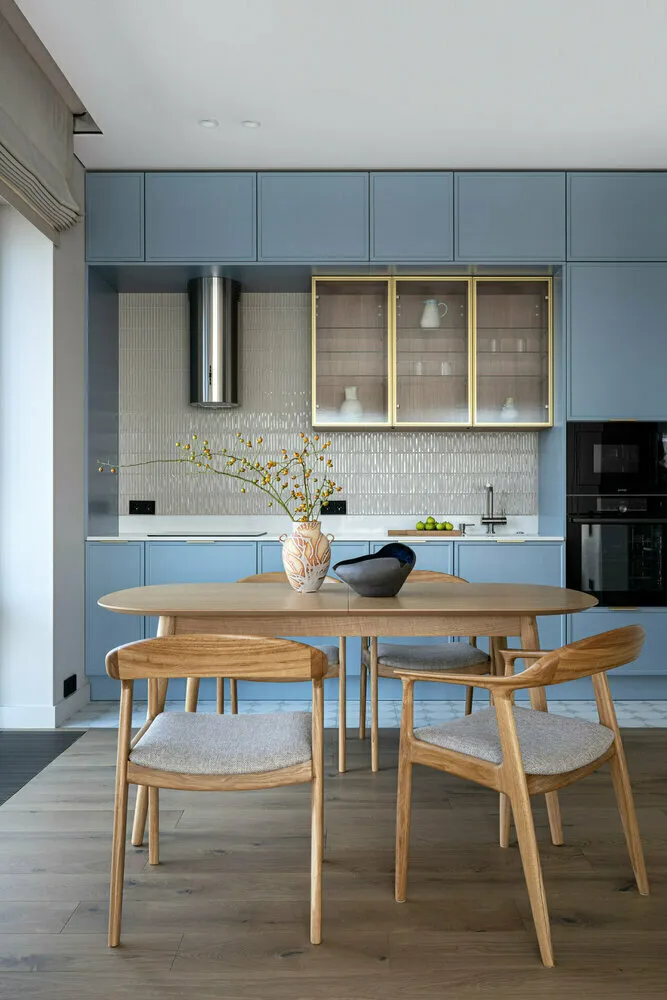
Design: Anna and Dmitry Korobko
Key Features When Choosing Tiles
When choosing tiles, it's important to pay attention not only to appearance but also to technical parameters that determine the durability and practicality of the finish.
Water Absorption. This parameter shows how much moisture tiles can absorb, measured in percentages. The lower the value, the more moisture-resistant the material.
High (over 10%): suitable only for dry rooms;
Average (3-10%): for bathroom walls;
Low (under 3%): for wet areas, bathroom floor, exterior finishing;
Minimal (under 0.5%): for pools, open terraces, areas with extreme humidity.
Wear Resistance (PEI). A scale from I to V showing how resistant tiles are to wear and mechanical impacts.
PEI I: only for walls;
PEI II: for bathrooms with low traffic;
PEI III: for all living rooms, including kitchens;
PEI IV: for entrance halls, corridors, public spaces;
PEI V: for commercial spaces with high traffic.
Hardness on the Mohs Scale. A surface hardness rating from 1 to 10, where 10 is diamond.
1-3: soft materials, unsuitable for floors;
4-5: suitable for living spaces;
6-7: high hardness, ideal for passageways;
8-10: industrial use.
Slip Resistance Coefficient (R). Especially important for floor tiles in bathrooms, kitchens and other rooms where water may fall on the floor.
R9: minimal slip resistance, for dry rooms;
R10: for living spaces, including kitchens;
R11-R12: for bathrooms, showers;
R13: for outdoor use, pools.
Frost Resistance. If you plan to use tiles for exterior finishing, pay attention to the number of freeze-thaw cycles that materials can withstand without damage.
Choosing Tiles for Different Rooms
Each room has its own features and requirements for finishing materials. Let's see which tiles are best suited for different areas.
For Bathroom. Bathrooms are rooms with high humidity and constant temperature fluctuations, so tile requirements here are special.
For walls: glazed ceramic tile with water absorption not exceeding 10%;
For floor: ceramic granite or tile with anti-slip coating (R11 or higher);
Sizes: for small bathrooms, medium formats (20×30 cm, 30×60 cm) are optimal;
Design: light tones visually expand the space, while large patterns can visually "eat up" area.
For Kitchen. The kitchen is a place where tiles are exposed to grease, steam, frequent contamination and mechanical stress.
For backsplash: ceramic tile with glazed surface, easy to clean;
For floor: ceramic granite with wear resistance class no lower than PEI III;
Sizes: for backsplash, medium format tiles (10×20 cm, 15×15 cm) work well; for floor, larger formats (45×45 cm, 60×60 cm);
Design: for backsplash you can choose bright accents or brick pattern, for floor practical tones that hide stains.
For Entryway. An entryway is a high-traffic area with risk of contamination from outside.
Type: ceramic granite with high wear resistance (PEI IV or V);
Surface: matte or structured to reduce slip risk;
Color: practical medium tones, not too light (to avoid highlighting stains) and not too dark (to avoid dust visibility);
Size: medium and large formats for a cohesive look.
For Living Room and Bedroom. In living rooms, tiles are used less often but can be a great solution for heated floors or if you want to create a special design.
Type: ceramic granite imitating wood or natural stone;
Size: large formats to create a sense of spaciousness;
Features: you can choose tiles with sound-dampening properties.
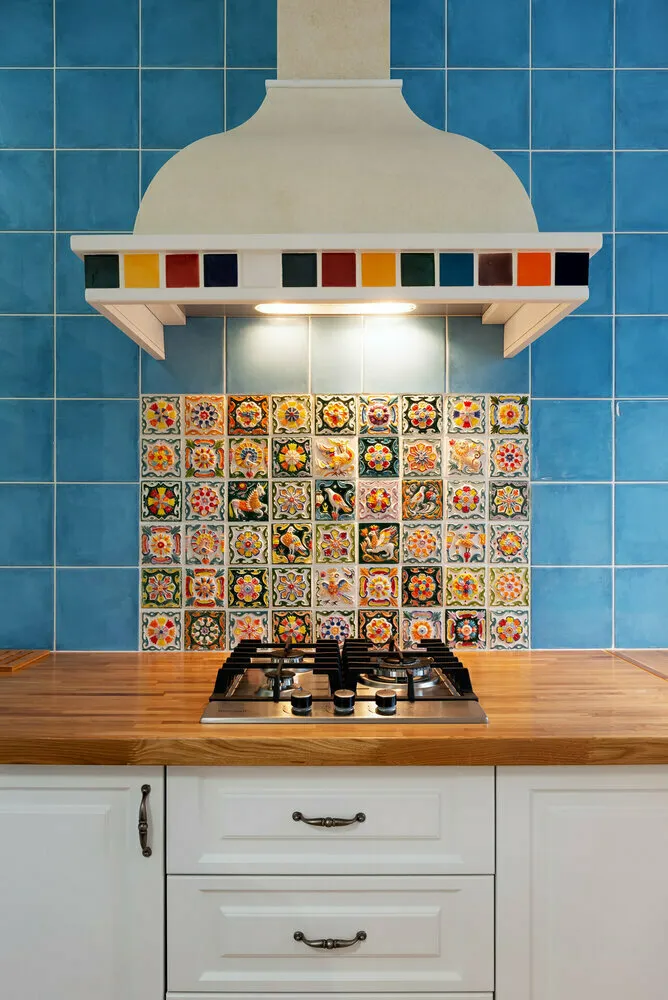
Design: Ekaterina Kholodkova
Price Segments and Major Manufacturers
The Russian market offers ceramic tiles of various price segments and origins. Understanding the price-quality ratio will help you make an optimal choice within your budget.
Ceramic Tile: Price Segments:
Economy segment (900-1500 rub/m²) — basic collections from manufacturers, cheap tiles from Belarus, China, some Indian producers. Usually simple design, standard sizes (20×30 cm, 30×30 cm), fewer texture options.
Mid segment (1500-3500 rub/m²) — premium line products from manufacturers, tiles from Poland, Turkey, India, basic collections from Spanish and Italian producers. More diverse designs, improved technical characteristics, modern production technologies.
Premium segment (3500-7000 rub/m²) — high-quality products from leading Spanish and Italian manufacturers, designer collections. Complex patterns, highly accurate imitation of natural materials, extended color range.
Luxury segment (from 7000 rub/m² and up) — exclusive collections from renowned Italian, Spanish and German brands, often hand-painted or designer-created, use of precious metals and rare technologies.
Ceramic Granite: Price Segments:
Economy segment (1200-2000 rub/m²) — basic collections from Chinese producers, simple monochromatic solutions or basic natural stone imitation.
Mid segment (2000-4000 rub/m²) — quality ceramic granite from Russian, Belarusian production and products from India, Turkey and budget European brands.
Premium segment (4000-8000 rub/m²) — high-quality products from Italy, Spain, Germany with realistic imitation of natural materials and complex surface finishing.
Luxury segment (from 8000 rub/m² and up) — large-format tiles from premium Italian and Spanish brands, exclusive collections with unique design and top-tier technical specifications.
Main Production Countries in the Russian Market:
Russia — after the exit of some foreign manufacturers, Russian factories have significantly expanded their range. Major producers: Kerama Marazzi, Unitile (brands 'Shakhtinskaya Tile', 'Gracia Ceramica'), Cersanit, Keramin, Neft-Keramika, Laparet. Russian tiles offer a good price-quality ratio and are widely available in all segments.
Belarus — occupies a niche for affordable and quality tiles. Major producers: Keramin, Berezakeramika. Good quality at a reasonable price.
China — one of the largest suppliers of budget tiles to the market. Quality range is very wide — from low-grade to quite decent mid-range tiles. Represented by brands like Marco Polo, Graniser, Overland and others.
India — actively increasing its presence in the Russian market. Indian tiles often offer a good price-quality ratio in economy and mid segments.
Turkey — offers products at middle price points with good operational characteristics. Popular brands: Vitra, Ege Seramik, Seranit.
Spain — traditionally strong in producing high-quality ceramic and ceramic granite. Major brands: Porcelanosa, Pamesa, Azteca, Aparici. Present in both mid and premium segments.
Italy — considered the trendsetter in global ceramic tile design. Italian manufacturers (Atlas Concorde, Imola, Italon, Marazzi, La Fabbrica) offer products from mid to luxury segments with excellent design and technical features.
Popular Trends in the World of Ceramic Tile
Ceramic tile is not only a practical finishing material but also an element of design subject to fashion trends. Here are current trends to consider when choosing.
Large Format Tiles. Large tiles (from 60×120 cm to 120×320 cm) have become one of the most notable trends in recent years. They create a sense of spatial unity and reduce the number of joints.
Advantages: visually expands space, simplifies maintenance (fewer joints), creates a modern look;
Disadvantages: difficulty in transportation and installation, requires perfectly flat surfaces;
Application: spacious bathrooms, kitchens, living rooms.
Natural Material Imitation. Modern technologies allow creating tiles that look and even feel like wood, marble, concrete, fabric and other natural materials.
Popular options: marble tiles (especially with large veins), wood imitations (with textures of popular species), concrete or stone;
Advantages: practicality of ceramics with the aesthetics of natural materials;
Features: for greater realism, choose tiles with high-resolution digital printing.
Current Patterns and Motifs. In 2025, the following designs are particularly popular:
Terrazzo — imitation of Venetian mosaic with characteristic color chips in a uniform background;
Calacatta and Statuario — noble marble types with dramatic veins on white or light gray backgrounds;
Tufa and Onyx — imitation of semi-transparent stones with characteristic layered veins;
Green shades — from soft sage to saturated emerald, reflecting the trend towards eco-friendliness;
Geometric patterns — from strict geometry to Art Deco and mid-20th-century styles;
Tropical and plant prints — large images of exotic plants, monsters, palm leaves;
Retro tiles — return of Mediterranean and Moroccan style patterns, subway tiles with beveled edges
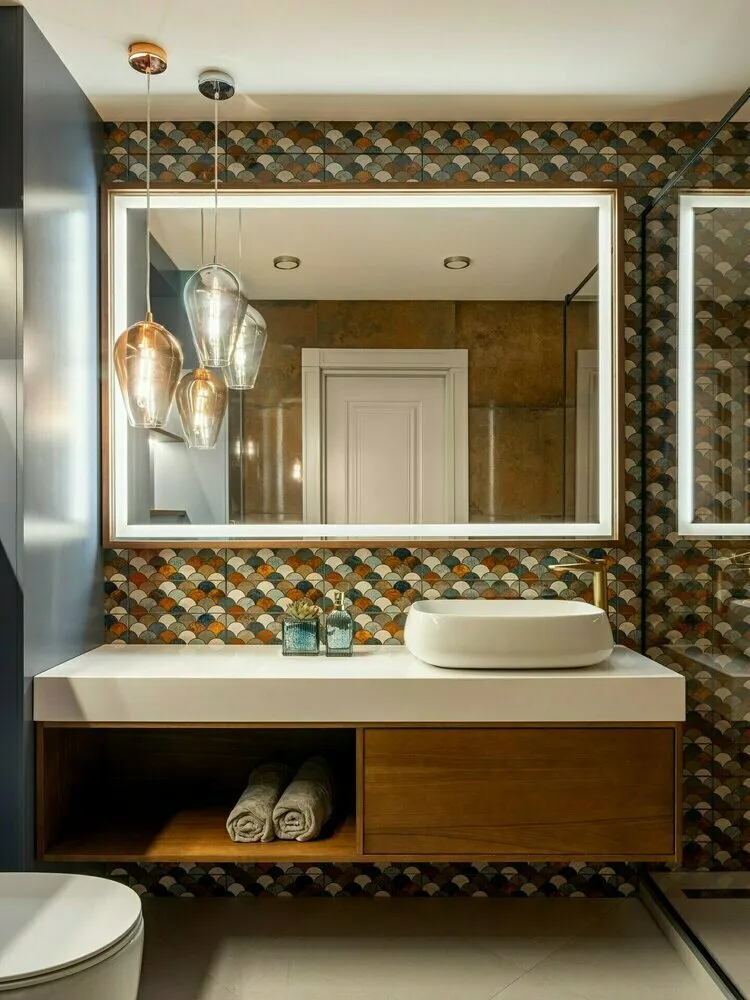
Unusual Shapes. In place of classic rectangles and squares come hexagons, rhombuses, scales, arabesques and other original forms.
Popular shapes: hexagons (hexagons), patchwork (combination of different patterns), 'fish scales', elongated hexagon;
Application: accent walls, backsplashes, decorative inserts;
Tips: complex shapes work best when combined with simple monochromatic surfaces for balance.
3D Effects and Textures. Three-dimensional tiles with expressive textures add depth and tactile interest to interiors.
Options: waves, geometric patterns, fabric fold imitation, textured surfaces;
Features: such tiles look especially expressive with side lighting that highlights the texture;
Application: accent zones, decorative inserts.
Matt Surfaces. Glossy tiles give way to matte and satin surfaces, which look more modern and show fewer stains.
Advantages: hide fingerprints and water smears, create a calmer atmosphere;
Disadvantages: dark matte surfaces may show lime stains;
Application: universally suitable for any room.
Design: Yana Ukhova
How to Calculate the Required Amount of Tiles
Correct calculation of tile quantity is an important step that helps avoid unnecessary expenses or, conversely, unpleasant situations when materials run out and the needed item is no longer available.
Main Principles of Calculation:
Measure the surface area you plan to tile (length × height for walls, length × width for floors);
Subtract the area of openings (windows, doors) and areas that won't be tiled;
Add a 10-15% surplus for cutting, breakage and installation specifics;
For tiles with complex patterns requiring fitting, increase the surplus to 20%.
Example Calculation for a Bathroom:
Room dimensions: 2.5 × 2 m, height 2.5 m;
Total wall area: (2.5 + 2 + 2.5 + 2) × 2.5 = 22.5 m²;
Door area: 0.8 × 2 = 1.6 m²;
Tile area on walls: 22.5 - 1.6 = 20.9 m²;
With a 15% surplus: 20.9 × 1.15 = 24 m²;
Floor area: 2.5 × 2 = 5 m²;
With a 10% surplus: 5 × 1.1 = 5.5 m².
Useful Tips:
Purchase tiles from the same batch to avoid color variations;
Keep collection and article information in case you need to buy more material later;
For complex designs using different tile types, it's better to leave the calculation to a specialist or use special software.
Supporting Materials and Tools
The quality of tile installation depends not only on the material itself but also on the supporting components used.
Tile Adhesive. The modern market offers many types of adhesive, selection depends on tile type and usage conditions.
For ceramic tiles on walls in dry rooms, regular tile adhesive will do;
For ceramic granite, use reinforced adhesive with high adhesion;
For wet rooms, choose moisture-resistant formulations;
For heated floors, use elastic adhesives that withstand temperature fluctuations.
Grout. Quality grout not only gives the finish a finished look but also protects joints from moisture penetration.
Cement grout — a budget option for dry rooms;
Epoxy grout — durable and moisture-resistant for bathrooms and kitchens, doesn't absorb dirt;
Silicone sealant — for filling joints between fixtures and tiles or in room corners.
Installation Tools. If you plan to install tiles yourself, you'll need:
Tile cutter or angle grinder with diamond blade;
Notched trowel for applying adhesive;
Level to check surface flatness;
Crosses for leveling joints;
Rubber float for grouting joints;
Tile alignment system (spacers and clamps).
Practical Tips for Choosing and Buying Tiles
The final step is actually going to the store and choosing a preferred option. Here are several recommendations that will help you make a good purchase.
Before going to the store:
Take accurate measurements of the room;
Determine your budget (considering that material cost usually accounts for 40-60% of total finishing costs);
Gather ideas and references (photos of interiors you like);
Think about how the tile will complement other interior elements.
At the store:
Request samples of preferred options and check them under natural and artificial lighting;
Check the size and color on packaging (should be identical);
Carefully inspect tiles for defects;
Check the tile grade (first, second class) — this affects allowable deviations.
After Purchase:
Don't unpack all tiles at once — check a few boxes for quality consistency;
Store tiles in a dry room at room temperature;
Acclimatize the material before installation (especially if it was stored in a cold room).
Long-Term Perspective:
Keep a small surplus of tiles for future local repairs;
Record information about the manufacturer, collection and article number;
Find out the production date of the collection (some manufacturers guarantee availability for a specific time).
Choosing ceramic tile is an important step in renovation that will determine not only the aesthetics of your interior but also its practicality for years to come. A carefully considered approach to material selection, taking into account all room specifics and following recommendations will help create a durable and beautiful surface that will delight you every day.
Remember, quality tiles and professional installation are an investment in your comfort that pays off over time due to durability and ease of maintenance. Don't cut corners on quality, and your surface will last many years without losing its appeal.