Plastering Stoves
Trends in modern interior design allow creating imitations of stoves and fake fireplaces.
However, those who have this opportunity prefer to equip their homes with a real Russian stove or fireplace. This is laborious but worthwhile. The hearth requires special finishing, including special stove plaster.
The mixture for stove plastering must be heat-resistant. The material component of the plaster must be able to expand slightly when heated, so that when it dries, the plaster does not crack. Decorative plaster for stoves and fireplaces must be resistant to mechanical damage and moisture.
Stove plaster can be made by yourself.
Plastering a stove begins with preparation.
Preparation for plastering
Plaster is not applied to just a stacked stove. By the time plastering is done, the stove should have stood for some time, preferably at least a month, so that the masonry dries properly, the stove does not settle and cracks do not form. Well-dried stove walls need to be cleaned of dust, clay, and mortar that may flake off. For this, in addition to the entire surface, the joints of the masonry also need to be cleaned and deepened.
The next step in preparation is reinforcement. Metal mesh or stove wire is attached to the stove walls with dowels, or stretched on nails, which makes the surface rougher and improves adhesion of the mixture to the masonry. Before applying the plaster, the stove should be thoroughly heated and the walls moistened. The surface should be hot and wet.
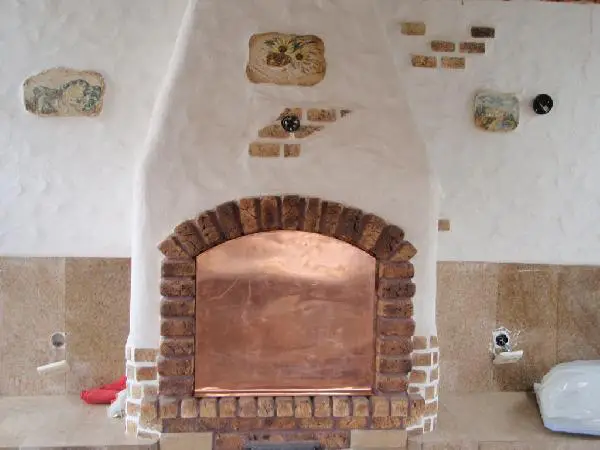
Photo 1 — Plaster mixture for stoves
Plastering mortar
There are many recipes for plastering mortars for hearth finishing. Plastering the stove walls is done by applying three layers: a mist coat, primer, and topcoat. The total thickness of the plaster can reach up to 20 mm, but the optimal thickness is 10 mm. Stove plasters are usually made based on clay or lime with the addition of reinforcing components. In all mixes, the components are first mixed dry, and then water, lime milk or clay milk is added.
All mortars contain approximately one-tenth of reinforcing component – asbestos, straw or fiberglass. Asbestos is the most common additive in stove plaster, but it is harmful to health.
During the drying of the plaster, cracks may appear, which should be carefully cut and filled with the same mixture.
Although in the past the mixture was always prepared by hand, today it is not a problem to buy stove plaster. Heat-resistant mixes for plastering stoves are available, for example, under the name Печник.
Stone plaster
A stove can be painted, but not with oil-based paint, or artificial stone, natural stone or Roman stone can be used in the cladding. The stove can be plastered to look like stone, and decorative plaster with crushed stone in the composition can be used in the final finish of the fireplace.
There are plasters that imitate smooth stone coating, for example, «Stone Flower» – a fairly popular plaster. Stove plaster made by hand can be done using the rust technique.
Decorative plaster for stoves, video
(method suitable for various surfaces, including stoves and fireplaces):