Plastering with Mesh: How to Protect Walls from Cracks
Plastering with Mesh
Mesh for plastering can be:
Metallic
Polymer
Glass-plastic
The general opinion regarding the role of wall plastering with mesh is that the mesh improves the adhesion of the mixture to the wall and prevents the formation of cracks.
Plastering with Mesh
Mesh for plastering can be:
- Metallic
- Polymer
- Glass-plastic
The general opinion regarding the role of wall plastering with mesh is that the mesh improves the adhesion of the mixture to the wall and prevents the formation of cracks. However, some claim that this is just a myth, and all the mesh's capabilities lie in hiding visible cracks rather than preventing them. Whether or not you need the mesh is up to you. The thickness of the mesh depends on the given conditions.
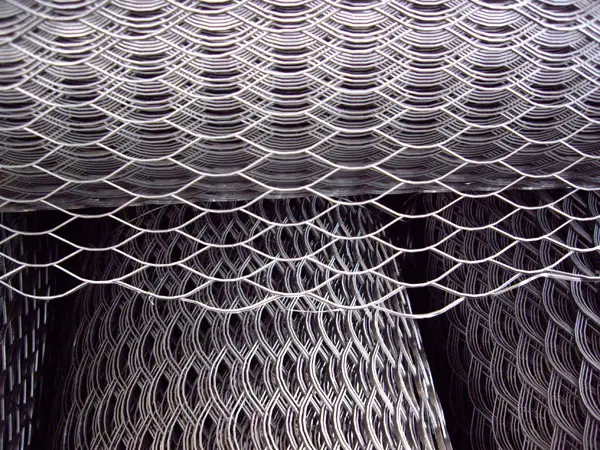
Photo 1 — Metallic mesh for plastering
What is the technology of using metallic mesh?
- Metal mesh should be used when applying a plaster layer of 3 cm or more. If the walls are not prepared for work, rabbit mesh is used.
- Measure the wall height from the roof to the ground if you are working on a facade, unroll the roll and mesh, and cut the pieces to the required height.
- How to attach the mesh to the wall? Spread the mesh and fix it with nails or screws on a primed wall. Adjacent sheets should overlap each other by about 10 cm.
- Mix the plaster solution.
- The first primer layer can be applied with a trowel or spatula, and then leveled with a rule. The second layer should be thinner; carefully spread it with a large spatula or trowel. If the mesh is visible, add a third layer.
- If necessary, you can use finishing plaster to smooth out minor irregularities.
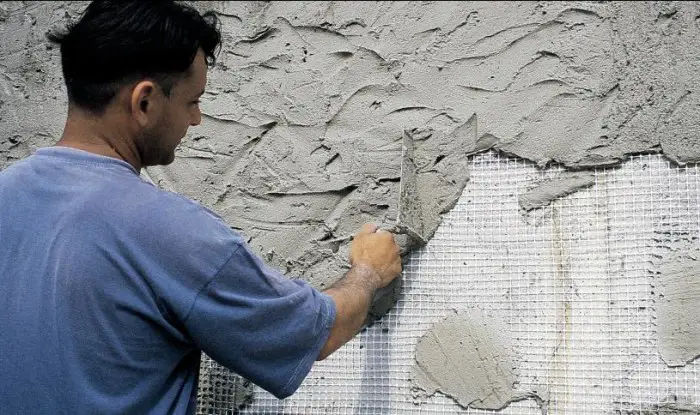
Photo 2 — Plastering with plastic mesh
Specifics of working with polymer mesh:
- Polymer mesh is resistant to chemical effects and therefore does not stain the finish coating. Polymer mesh is often used when applying textured plaster.
- Start the process as described above, measuring and cutting the pieces to size. Mesh attachment can be done in various ways. On a dense base, you can apply a thin layer of solution to the wall and press the mesh into it, or if conditions allow, attach the mesh with a stapler.
- Then evenly apply the plaster so that the mesh is not visible.
- When working with polymer mesh, repeat actions as when hanging wallpaper – from the center to the edges.
- By the way, due to the elasticity of polymer mesh, it can stretch and bubble, so work carefully.
Mesh for Plastering. Types and Features
As we have already written, mesh for plastering comes in three types: metallic, polymer, and glass-plastic. Why is reinforcing mesh even needed? Mesh for plastering is used when applying plaster to wooden, brick, or concrete facades because on such surfaces plaster can crack and peel off. Mesh for plastering facade should be stronger and wider.
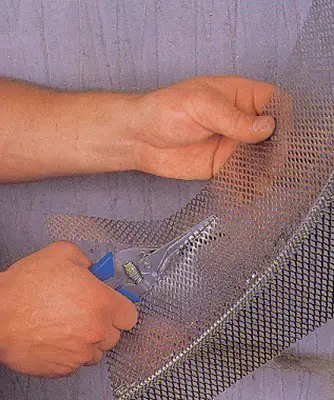
Photo 3 — Cut the required piece of mesh with metal shears
So, metallic mesh is divided into 4 types:
- Fabric mesh. Sold in rolls. The material is thin but flexible and strong, woven from wire of various cross-sections. It has square cells 1x1 cm.
- Rabbit mesh (woven mesh). Cell size – 2x2 cm. Usually used if multiple layers of plaster need to be applied.
- Welded mesh. Square cells, often used to prevent cracking of plaster during active wall settling. Made from galvanized or polymer-coated low-carbon wire. Usually sold in rolls 1 meter wide.
- Punched mesh. Used for small plaster consumption. Rhombic cells arranged in a checkerboard pattern. Sold in rolls.
If you need mesh for plastering interior walls, then polymer or glass-plastic mesh is usually used. The choice of mesh depends on the application area. Plastic mesh is often used inside buildings, while metal mesh is used on facades.
Professionals note that in most cases, plaster reinforcement is done over the entire wall surface, and fragmentarily: on those sections where different finishing surfaces intersect, for example. However, if plaster is applied to a ceiling or in a new building, the mesh should be used over the entire surface.
There are also specific requirements for mesh used for plaster reinforcement:
- The mesh should be resistant to alkaline substances, meaning it must be treated with special solutions. Otherwise, the mesh may begin to decompose soon, and the plaster layer will start losing strength. The sign of this is cracks on the surface.
- The mesh density should be between 150-170 g/m² to maintain elasticity and strength, allowing it to withstand various types of loads.
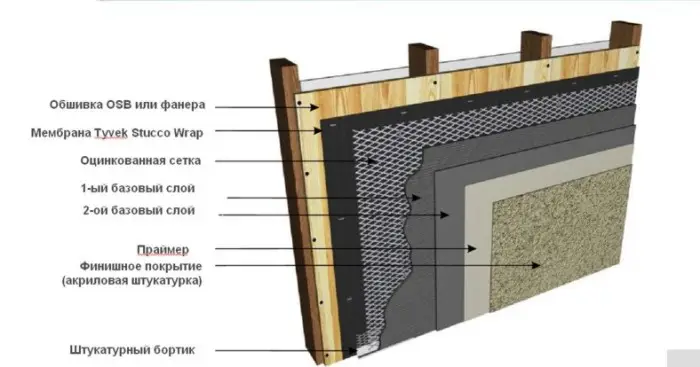
Photo 4 — Facade finishing with mesh
Plastering with Mesh. Cost of Work
- Rostov-on-Don, installation of metallic mesh during plastering with a layer over 40 mm, from 100 rubles/sqm.
- Donetsk, Installation of plastering mesh, from 8 UAH/sqm.
Mesh for Plastering. Price
- Kiev, Blumberg abrasive mesh, price per pack 24.50 UAH
- Saint Petersburg, Plastic mesh for plaster reinforcement TENAX "Armaflex", 39.77 rubles/sqm