Ceiling Design: How to Create a Candy from Nothing
- Tweet
- In the blog
- By email
Ceiling design, especially if you're planning to build a roof over your head yourself, is a responsible and serious task. You must approach it thoroughly. After all, this is the place you’ll look at while falling asleep or deep in thought. Therefore, the finishing of this essential part of your apartment’s interior should be done at a high level.
When designing an original modern ceiling, it’s important not to forget that the ceiling is not a standalone element and must harmonize with the overall style. You can easily find countless ceiling design ideas online, tailored to any taste, even the most refined. You can adopt a ready-made solution if it suits you, or draw inspiration from interesting concepts and adapt parts of them.

Photo 1 — Ceiling design in an office
Depending on the room’s purpose, you can use various ceiling finishes and materials. The widest selection is available for those who own apartments with high ceilings. They have much more creative freedom, as almost any finishing technique or decoration will work in this case.
All will depend on the owner’s imagination, budget, and chosen design direction. Options range from simple whitewashing or painting, wallpapering, to a vast variety of suspended and tensioned structures (made from gypsum board, PVC film, plastic, metal profiles, even wood, etc.).
Gypsum ceilings, for example, offer an almost limitless creative field — with a creative approach, you can build original multi-level structures from gypsum board, combine them with tensioned elements, and experiment with lighting.
Even a simple, strict whitewash can be enhanced with decorative moldings. Those with low ceilings face more challenges in choosing, as not every structure will fit harmoniously without making the already low ceiling seem even lower. Yet, even in this case, you can achieve a truly unique design.
The key point to remember is harmony. The design and materials should match your chosen style.
For example, a glossy tensioned ceiling would look quite odd in a room decorated in the Baroque style.
Ideally, you should already have a clear vision of the final result before starting renovation. Modern ceiling design allows for modern materials, bold colors, and innovative lighting concepts.
If you prefer tradition and elegance, you’ll appreciate classic ceiling design — natural materials, abundant elegant moldings, and a central chandelier. True to the tradition of grand English manor halls. Of course, furniture and the rest of the interior must match.
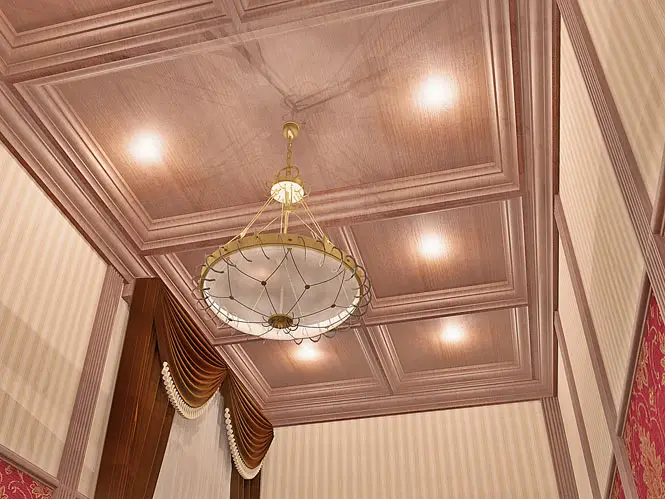
Photo 2 — Coffered ceiling
If you appreciate originality, you’ll enjoy various gypsum board constructions, hybrid ceilings (combining gypsum board and tensioned elements), lighting effects (floating ceiling effect, starry sky). You shouldn’t miss the design of sloped ceilings (tensioned ceiling made to appear as if the ceiling is angled in the room; this not only makes the room unique but also helps hide utilities). Sloped ceilings are common on attic floors.
Attic ceiling design is directly influenced by the roof’s slope. If your attic ceiling is low, use light tones. To achieve a cozy, country-home feel, you can line the ceiling with wooden boarding or even laminate with a matching pattern.
By the way, when considering the advantages of suspended ceilings over simple whitewashing, painting, or wallpapering, it’s worth noting that suspended and tensioned ceilings require no extensive surface preparation and offer far greater possibilities for concealing utilities, ventilation, and lighting configurations.
While in basic options, lighting may only include a chandelier and wall sconces (or floor lamps), suspended ceilings allow you to customize lighting to your taste.
You can use lighting to visually raise or lower the ceiling, zone the room, or turn light fixtures into an interesting decorative element.
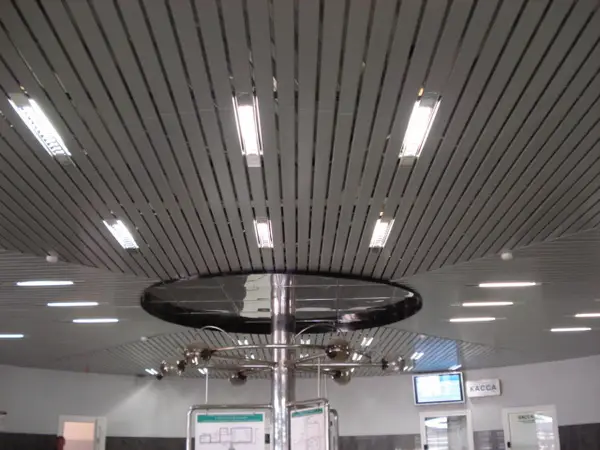
Photo 3 — Recessed ceiling
For cafes or offices, according to SNiP standards, high ceilings are required, as they are public buildings. In cafes, depending on the style, tensioned ceilings, gypsum board ceilings, or wood-paneled ones may be suitable (in a country-style cafe, decorative beams not only hide wires but also enhance the design).
In offices, suspended plastic ceilings are more common.
They are low-maintenance and easily allow access to hidden utilities — just remove the necessary panel section. In offices, moldings, decorative beams, or playful gypsum board layers would be inappropriate.
On a country cottage, a wooden ceiling (clad with boarding or parquet) or one with decorative beams would look especially harmonious. Of course, this suits a rustic design. On a cottage not meant for long-term residence, it’s better to choose ceilings that don’t require constant maintenance.
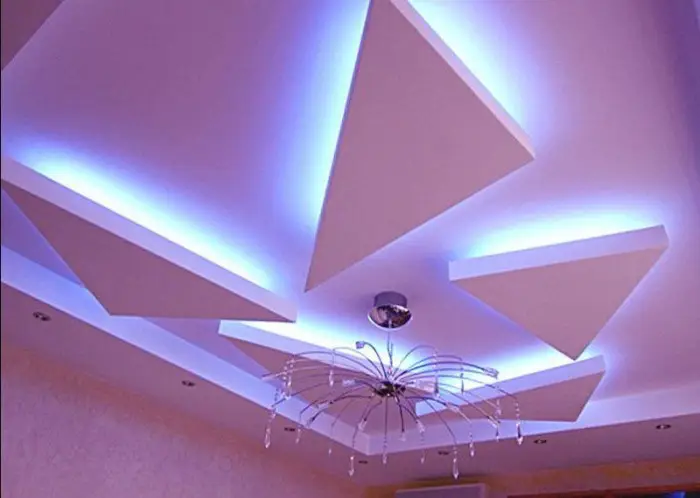
Photo 4 — Floating ceiling
In kitchens, bathrooms, and toilets, recessed or plastic ceilings are recommended. They are often resistant to temperature and humidity changes, prevent mold, and are fire-resistant.
But what about a hallway? The word “hallway” immediately brings to mind a spacious, elegant hall in a manor. In such a setting, a coffered ceiling (essentially, symmetrical square, rectangular, or polygonal recesses in the ceiling surface) would be very fitting.
Of course, such a ceiling is expensive. But if you don’t have a lord’s castle hall, but just a regular room in a typical apartment, a good solution would be a suspended gypsum board ceiling, a tensioned ceiling, or a combination of both.
Keep in mind that installing tensioned ceilings should be left to professionals, as the stretched film is vulnerable to mechanical damage. However, gypsum board structures can be installed yourself.
Ultimately, your chosen ceiling design should bring you joy, as you’ll be living with it every day.
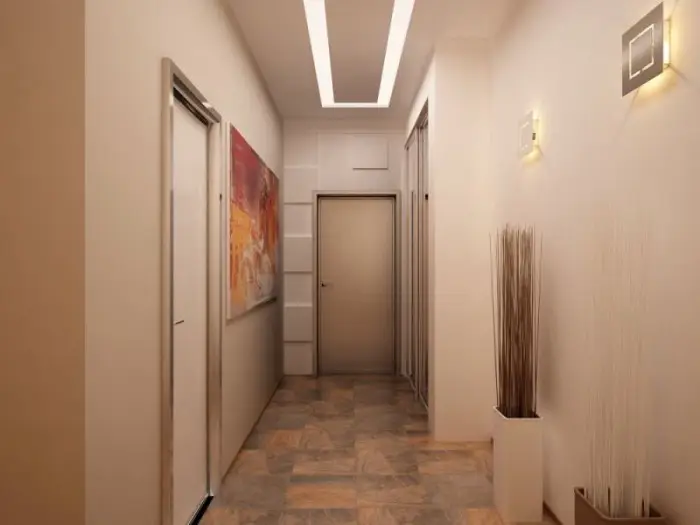
Photo 5 — Ceiling design in a hallway
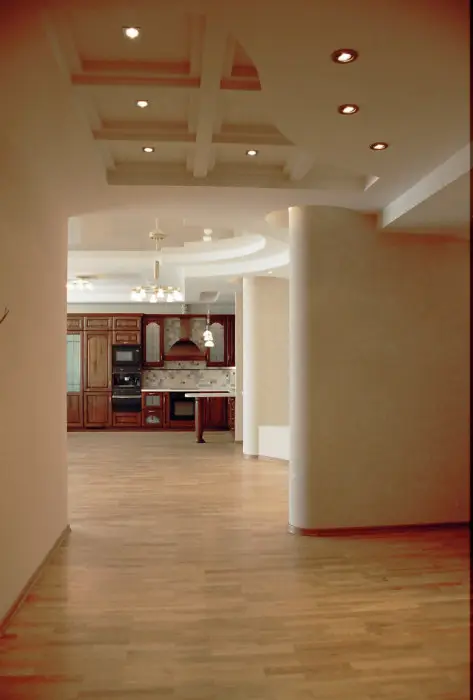
Photo 6 — Ceiling design in a hallway
" "