Log Houses from Timber: Material Selection
Contents:
- Types of Timber
- Standard Timber
- Profiled Timber
- Glued-Laminated Timber
- From Profiled Timber
- Prices for Timber Log Houses
Timber-framed houses are constructed faster than log cabins due to the material's shape. The uniform rectangular or square cross-section allows for efficient assembly, almost like building with a kit.
Timber is a precisely calibrated log processed in a factory to achieve a rectangular or square cross-section.
Types of Timber
Timber used for log houses comes in three main types:
- Standard (common) timber
- Profiled timber
- Glued-laminated (glulam) timber
Standard Timber
Standard timber has no pre-cut notches, grooves, joints, or drilled holes. It requires full on-site preparation.
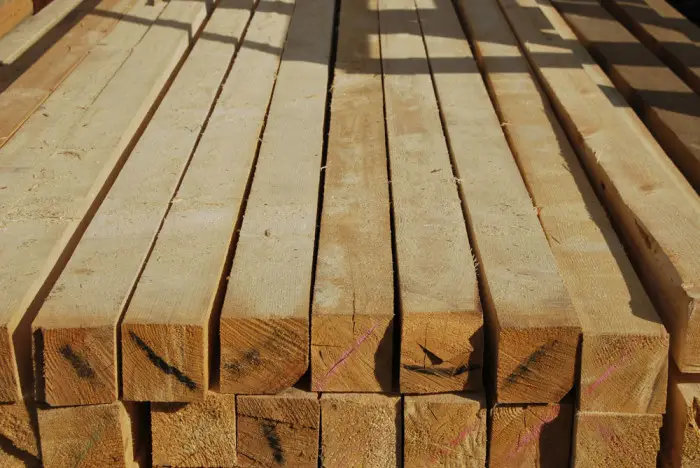
Photo 2 – Standard timber
When purchasing standard timber, you must:
- mark out precise measurements manually;
- label each piece according to the project;
- cut to size based on the house design;
- cut longitudinal grooves;
- drill holes for fasteners;
- cut end or connecting joints (using saws or routers);
- finish with sanding;
- apply protective treatments: antiseptics, fire retardants.
Initial cost starts at $200 per cubic meter.
Profiled Timber
Profiled timber offers clear advantages:
- standardized dimensions (section, length);
- pre-cut longitudinal grooves;
- smooth, sanded surface.
If you order a house from a construction company, the timber is marked, cut, and labeled by professionals.
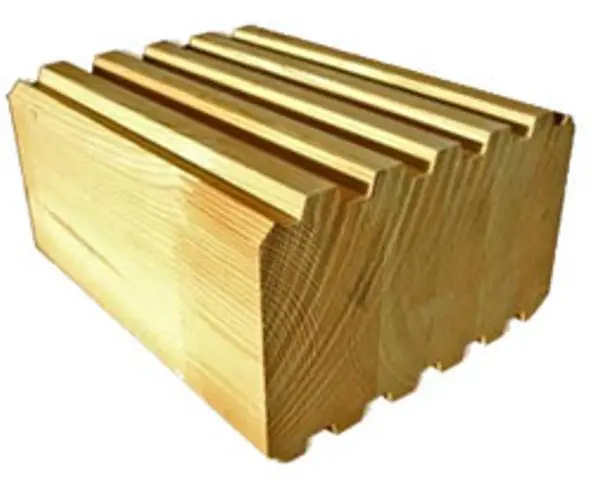
Photo 3 – Profiled timber
Then, end and joint connections are made according to the project’s design. Holes for pegs (nagels) and bolts are drilled. Additional protective treatment with antiseptics or fire retardants may be applied.
Price starts at $300 per cubic meter.
Glued-Laminated Timber
Glulam timber has a non-uniform structure made by gluing dried laminates under pressure. It offers higher strength and durability, though at a higher cost—starting at $500 per cubic meter.
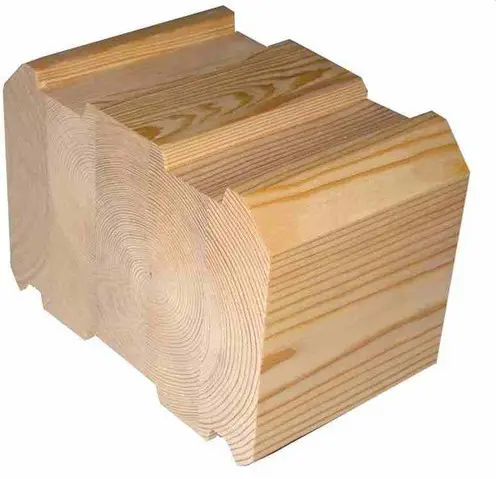
Photo 4 – Glued-laminated timber
Due to its strength and long length capacity, glulam timber allows for large-scale log houses without joints along the length. There are no length limitations.
Like profiled timber, glulam has standardized dimensions, pre-cut grooves, and a smooth surface. The house does not settle after construction, allowing immediate finishing.
IMPORTANT! Timber is sold in two moisture levels: dry or natural. They differ in cross-section size and moisture content. For example, dry timber is 140x140 mm, while natural moisture timber is 145x144 mm. Dry timber shows minimal shrinkage. Natural moisture timber will shrink (dry out) and reduce in size.
Building a single-story house or a multi-story home from processed timber is faster than using logs, thanks to its shape and standardization. This is especially helpful if you plan to build it yourself.
If using standard or profiled timber, the house must be left to settle for 6–24 months. Only after settlement is complete should finishing work begin.
From Profiled Timber
Building an eco-friendly log house from processed, profiled timber means constructing a strong, warm, safe home with attractive architecture.
Today, prefabricated house kits are commonly available—just assemble them on-site.
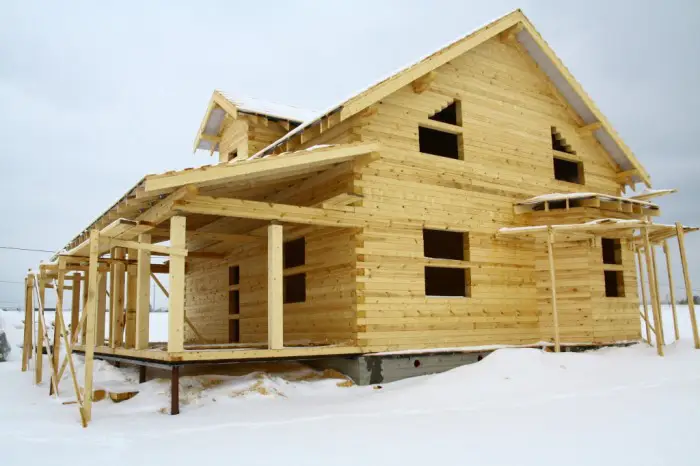
Photo 5 – Eco log house
Standard kit includes:
- timber wall panels and necessary partitions;
- roofing components: gables, ridge beams, rafters;
- floor joists (if the design includes 2+ floors);
- peg fasteners (nagels);
- door and window openings;
- subfloor;
- inter-wall insulation;
- foundation blocks;
- foundation waterproofing.
Kit price includes delivery up to 100 km and on-site assembly.
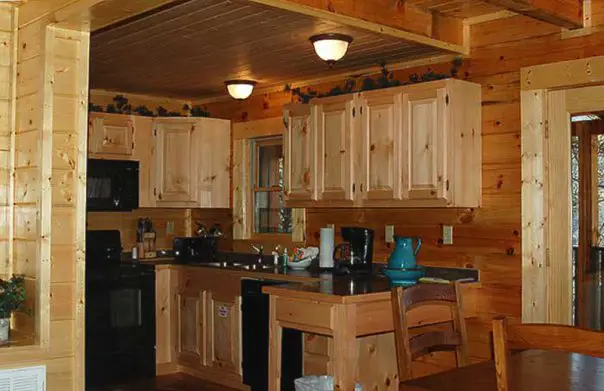
Photo 6 – Interior finishing
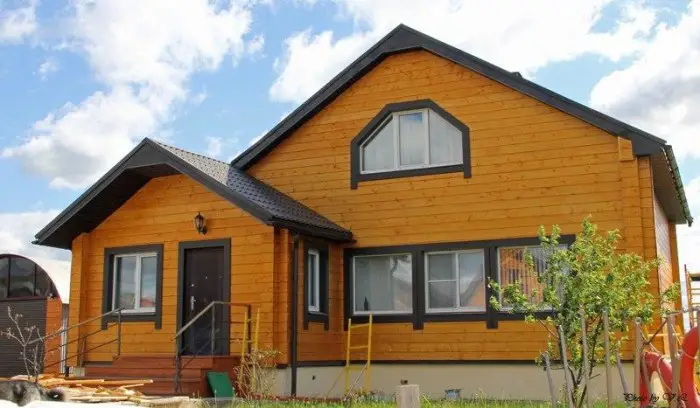
Photo 7 – House facade
Additional 'turnkey' services available:
- finishing works;
- utility installation (plumbing, electricity, etc.);
- building a stove, and more.
Prices for Log Houses from Timber
Basic kit price is typically around 40% of total construction cost, including design and finishing, and utility connections.
Initial cost for manufacturing and assembling a complete kit starts at $170 per square meter. Turnkey pricing increases to $400 or more per square meter, depending on timber size, finishing materials, and other factors.