Villa Extramuros by Vora Arquitectura in Arailos, Portugal
Project: Villa Extramuros
Architects: Vora Arquitectura
Location: Arailos, Portugal
Area: 8,611 sq ft
Photos: Property of Vora Arquitectura
Villa Extramuros by Vora Arquitectura
Vora Arquitectura has completed the design of Villa Extramuros on a small slope of a hill on the outskirts of the ancient city of Arailos in Portugal. The total area of the modern luxurious living spaces is just over 8,500 square feet, providing a peaceful and secluded retreat with spectacular views.
There are important archaeological remains from the Neolithic era, structures from Roman and Arab periods, as well as medieval times to today. Upper Alentejo is one of the most culturally interesting regions of the Pyrenean Peninsula.
Due to the lack of large aquifers, the region features a slight elevation with small hills. Human settlement has always been drawn to higher points of this area, especially for defensive and dominative purposes.
Villa Extramuros is located on a slope of a small hill on the outskirts of the ancient city of Arailos, functioning as a modest tourist guesthouse.
Surrounded by an extensive olive grove, the scale and form of the implementation restore the concept of traditional Alentejo farmhouses. Nevertheless, architectural features also draw inspiration from clean lines of modern and contemporary architecture.
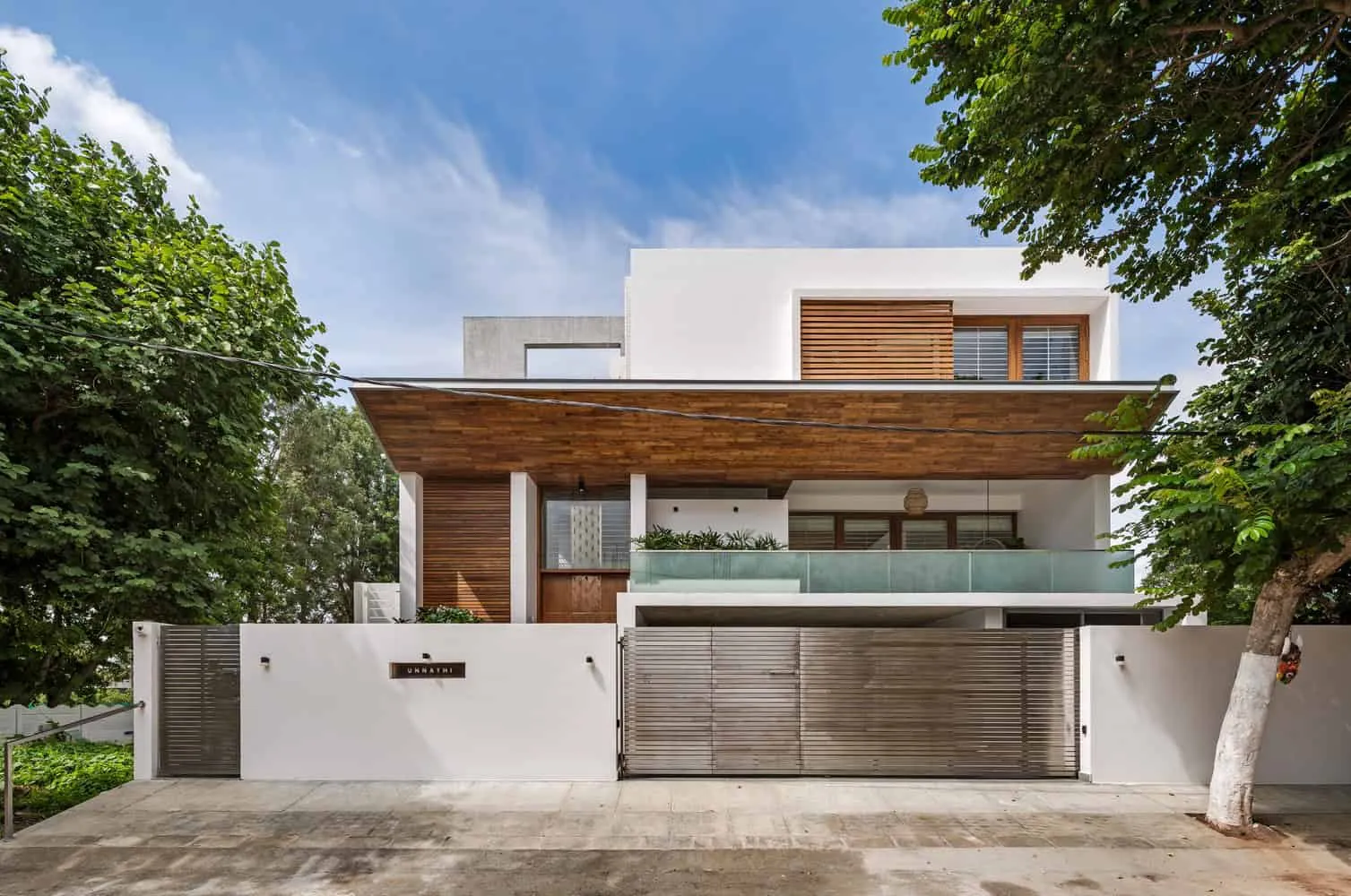
Spanning two floors, the white facade with a small number of windows gives the building a unique and abstract appearance.
Built as housing for owners and a small hotel, two large windows on the first floor, corresponding to the dining room and living room, establish a connection with the outside world. The surrounding landscape of extensive olive groves, nearby pastures and the distant city of Arailos form a fitting rural backdrop.
One of these windows also contains the main entrance. The ceiling, walls and even the door are clad in cork panels, creating a warm and tactile atmosphere at the entrance.
The reception area, kitchen, dining room and living room are organized around a square inner courtyard, at the end of which an external staircase provides access to the second floor.
The construction encompasses a central courtyard, allowing light to penetrate all parts of the building. The main circulation is located outside, wrapping around the courtyard.
This spatial organization also reflects the spatial layout of ancient monasteries in the region, where the dining room, chapter room and kitchen are arranged around a central cemetery.
The upper level is divided into four distinct 'volumes', which give the interiors a more modest perception. White and strict, these volumes are connected by low cork-covered walls.
Four guest rooms are located on two of these volumes, while the main bedroom occupies the third volume entirely. The fourth volume contains the owners' living space.
Each guest room is individually oriented toward a private courtyard, through which one can also enter the room. The enclosed spaces with cork-panelled finishes receive panoramic views of the surrounding landscape through horizontal openings in their outer walls.
The building resembles typical architecture of southern Portugal. It is characterized by formal simplicity, the use of a limited number of materials, volumetric composition and construction details.
The fragmentation of the upper floor into four smaller volumes, their separation by lower walls and the typology of small courtyards find parallels in domestic and folk architecture of towns and villages in the region.
The high level of service offered by their owners, the diversity of available spaces for guests, the small scale of the enterprise and the unique character of modern interiors make this a distinctive venture that complements existing tourism offerings, mainly based on historic buildings.
–Vora Arquitectura