There can be your advertisement
300x150
Drawing a Children's Room. How to Do It Right
Often, while reading articles about DIY children's room design, we encounter the need to draw a children's room plan that not only shows a schematic view of the interior but also fully corresponds to all real parameters.
Often, while reading articles about DIY children's room design, we encounter the need to draw a children's room plan that not only shows a schematic view of the interior but also fully corresponds to all real parameters.
How to Draw a Children's Room Without Making Mistakes?
First, take measurements of the room and write them down in a notebook. You will need these dimensions:
- ceiling height;
- wall length and width;
- window frame height;
- height of the window from the floor;
- window width;
- wall length from door to door;
- door width;
- door height.
Second, choose the appropriate method for drawing. There are several options:
- plan — a schematic representation of interior items in the room in any convenient form;
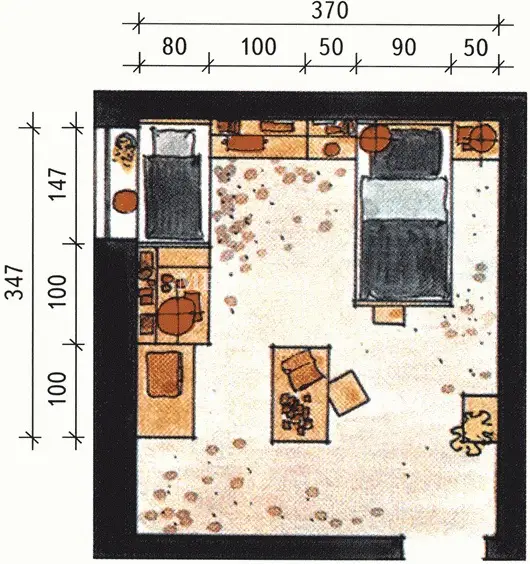
Diagram 1 — Children's Room Design, Plan
- layout — an image of the room shown on walls (not in plan, but flat on them);
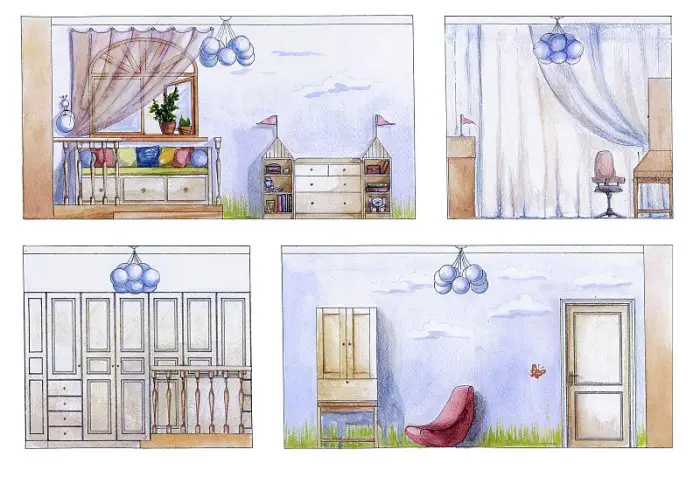
Drawing 1 — Layout of a Children's Room
- axonometric projection — a 3D image of the room (in perspective).
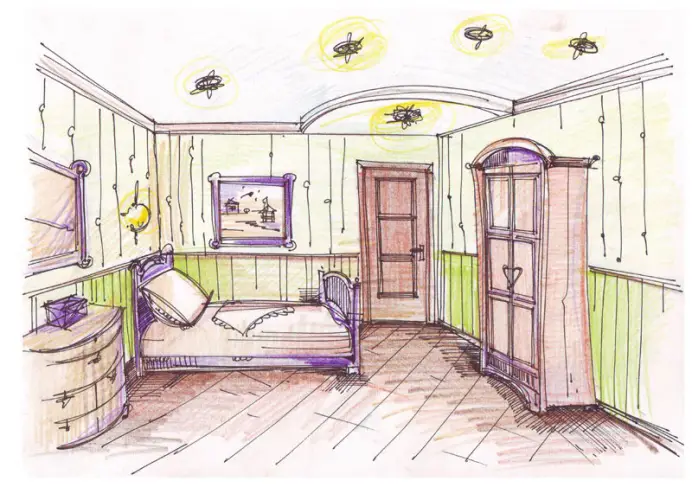
Drawing 2 — Axonometric Projection for Children's Room Design
Keep in mind that before drawing a second or third sketch from the above list, you must scale it: draw the perimeter of the room on paper at a scale that matches actual measurements, and then draw the interior based on real furniture or decor dimensions.
For example, if the walls are 3 meters long, you can scale down to 30 cm for easier calculations.
The first two drawings are best done with a pencil: it’s easier to correct mistakes. The third one can be colored with any convenient tool: colored pencils, markers, paints.
With such prepared sketches, you can consult a professional designer or a furniture factory consultant: visualization helps specialists better understand your desires. Don’t hesitate about what you weren’t taught — it doesn’t matter how well you can draw, what matters is understanding what the client wants — not assessing hidden talents.
More articles:
 Entry Hall Living Room and Several Interesting Ideas
 Design of the Living Room in an Apartment. Functionality and Compactness
 Interior Design of the Hallway. Transforming a Passage Room
 Interior Design Ideas for Living Rooms: Unusual Solutions
 Ceiling Design for Kitchen from A to Z
 Ceiling Design in Bedroom. Considering Room Characteristics
 Ceiling and Wall Design in Living Room. Choose Your Style
 Ceiling Design in Corridor and Hall