Wooden Truss Barn House and Meeting Space by Leupold Brown Goldbach Architekten
Project: Wooden Truss Barn House and Meeting Space
Architects: Leupold Brown Goldbach Architekten
Location: Tuntenhausen, Germany
Area: 7965 sq ft
Year: 2019
Photography by: Jonathan Sage
Wooden Truss Barn House by Leupold Brown Goldbach Architekten
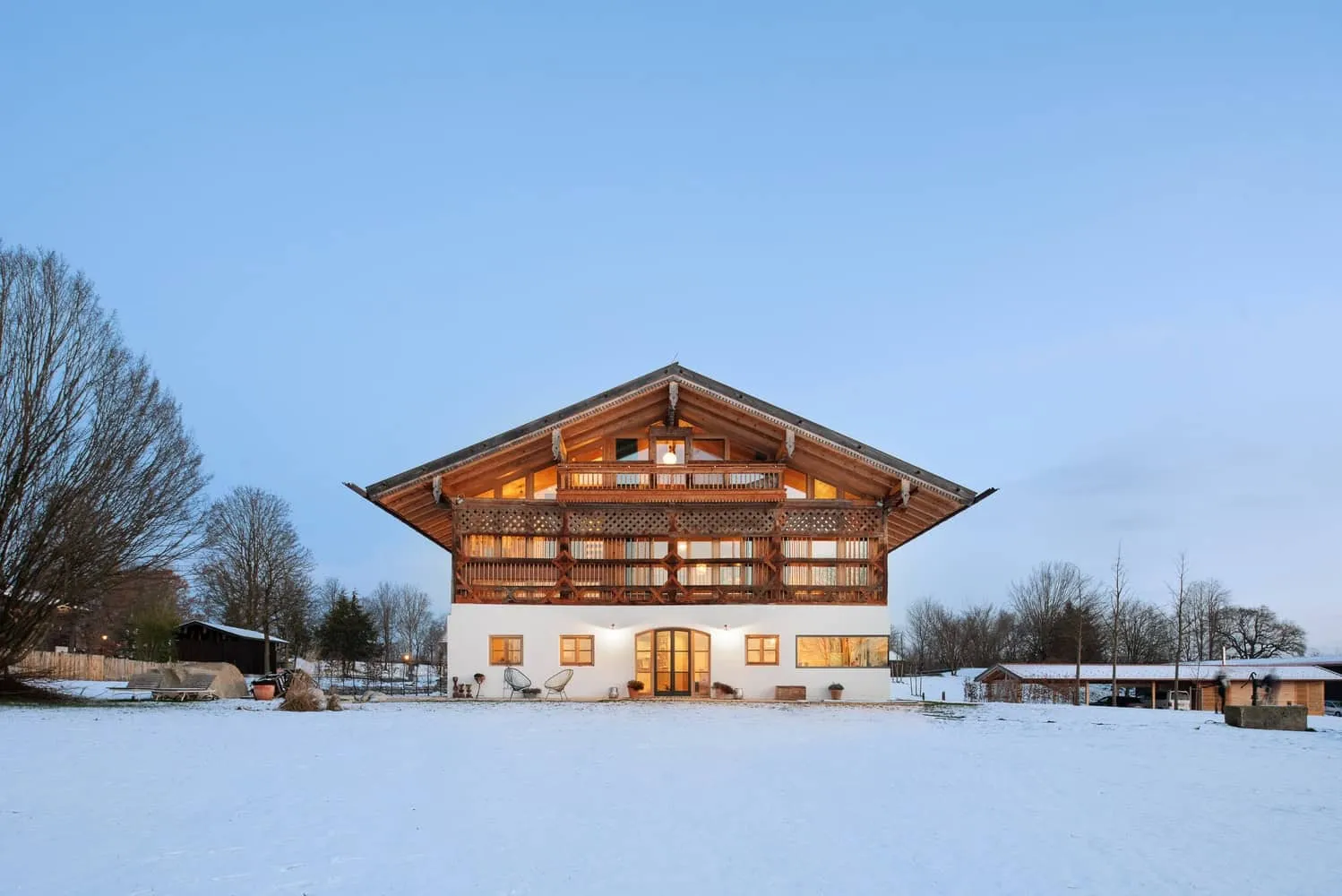
This project from Leupold Brown Goldbach Architekten in Tuntenhausen, Germany aimed to revitalize the 1773 farm by carefully placing a three-level architectural intervention made of wooden cubes, each the size of a room, within the timber structure. The cubes were designed to create a sculptural effect that fills the volume of the barn up to the roof while preserving the original characteristics of the farm.
The project also incorporated natural landscape materials that align with the rural context and an intelligent energy and climate concept using passive measures to provide healthy living and working conditions with minimal energy consumption. By utilizing the renewable timber material, CO2 emissions were minimized. Overall, this project successfully transformed the old agricultural building into a modern residential home and meeting space while maintaining the historical craftsmanship of the original structure.
This project resulted from revitalizing the 1773 farm built with hundreds of wooden elements that were disassembled, stored for over 40 years, and then reassembled. This labor-intensive process required tremendous courage and refined craftsmanship from the carpenters who rebuilt it.
The barn was originally an agricultural building used for storing equipment. Essentially, the interior space represented a single volume without partitions or even ceiling slabs. The beautiful wooden truss with a lattice structure was an open construction where boards were attached from the inside. It was fully ventilated and served only as protection against rain, snow, and sun—not as a thermal envelope. Daylight was not needed inside, so the spaces were quite dark and intimidating. The challenge was to transform this beautiful envelope into a living space and meeting place without destroying the magic of historical craftsmanship.
To divide this historically open volume, a three-level architectural intervention made of room-sized wooden cubes was carefully placed inside the timber structure. The cubes, shifting relative to each other, create an impression of a three-dimensional sculpture filling the barn volume up to the roof. The uniform silver-white surface of the cubes contrasts with the lattice structure of the wooden truss, complementing the historical construction with a modern intervention. Two historic passageways called "tennen" that traverse the barn are kept continuous with light bridges on upper levels. Original double farm doors have long been lost but were replaced by large transparent glass gates. This allows the interior and exterior spaces to be connected, creating a path directly from the first floor to the picturesque lake nearby.
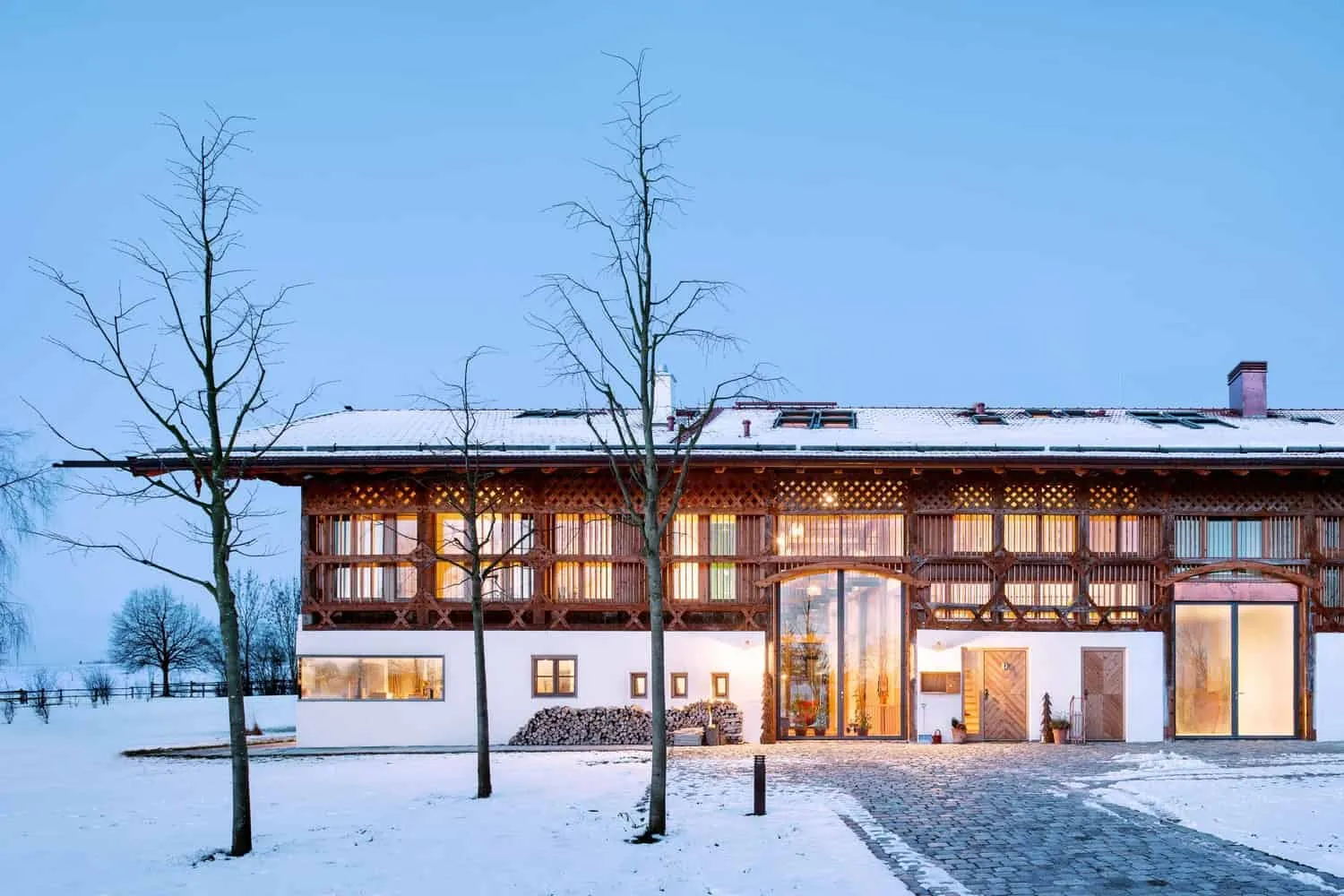
On the inner side of the upper level of the barn, glazing was installed to ensure transparency and create a thermal envelope. As a result, daylight penetrates inside while the beautiful historical elements can be felt both from within and outside. Original small holes in the first-floor stone masonry were replaced with larger ones. These "imperfections" look like modern changes with contrasting formats and minimalist design.
The landscape was realized using natural materials aligned with the rural context. The extensive front addition housing technical rooms, storage areas, and garages forms an entrance zone and creates a courtyard with the barn.
Thanks to an intelligent energy and climate concept, passive measures are used to achieve healthy living and working conditions with minimal energy consumption. Sparkling eaves and integrated external sun protection reduce solar penetration into the building. In summer, the building can be fully naturally ventilated. Large roof windows in the grain threshing room are used for effective nighttime ventilation cooling. Gypsum fiber boards integrated into the timber structure serve as thermal mass and provide pleasant temperatures in rooms even during high outdoor temperatures. In winter, the building is properly supplied with fresh air without drafts through controlled ventilation of living spaces with efficient heat exchange. Heat enters the room via low-temperature panel heating under the wooden floor. The heat is provided by a pellet boiler in an adjacent storage and also serves as a local thermal network for other buildings. By utilizing the renewable timber material, CO2 emissions were minimized.
–Leupold Brown Goldbach Architekten