House OT by DARP — De Arquitectura y Paisaje in Enviado, Colombia
Project: House OT
Architects: DARP – De Arquitectura y Paisaje
Location: Enviado, Colombia
Area: 5,059 sq ft
Year: 2022
Photography: Mauricio Carvajal
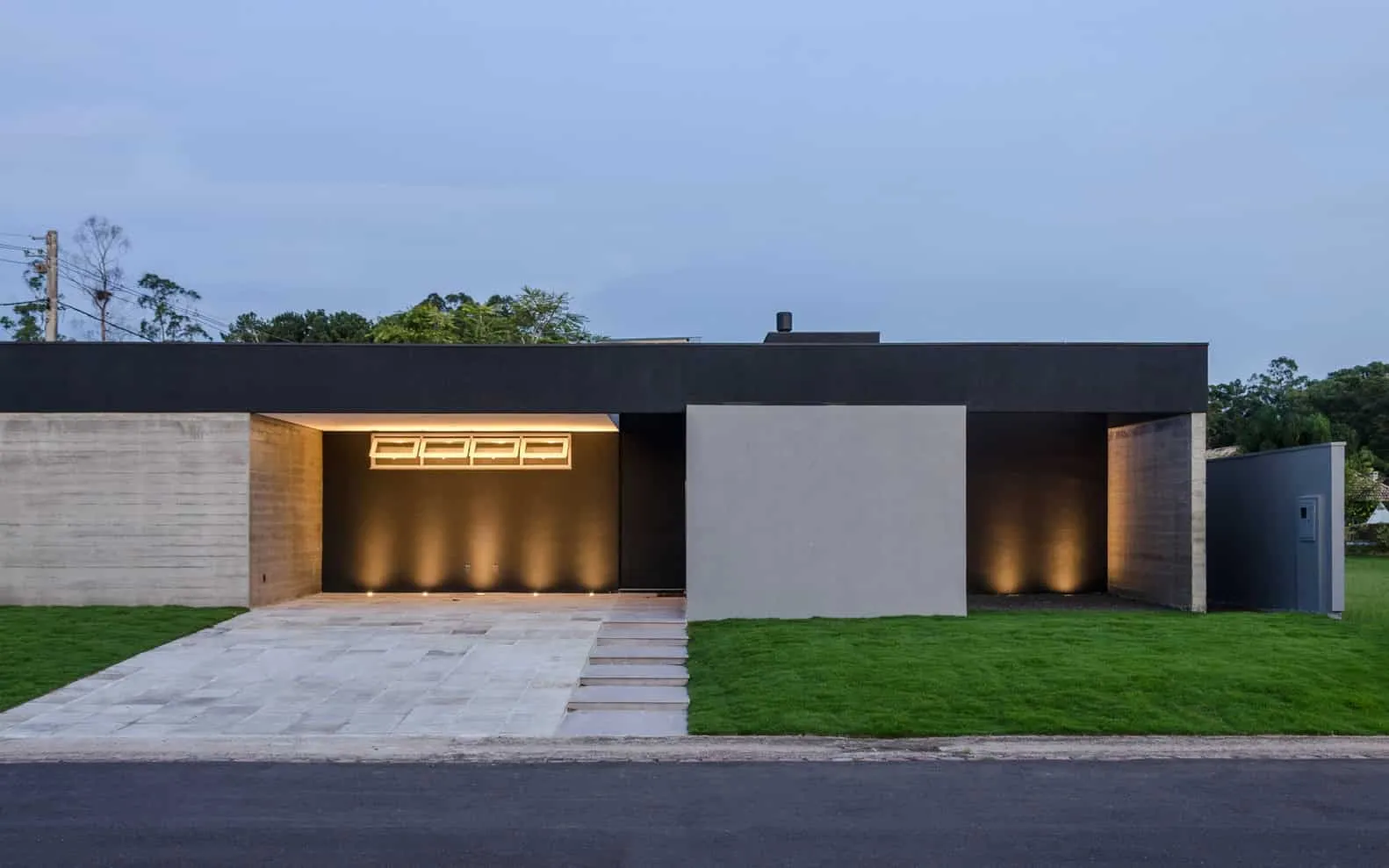
House OT, designed by DARP – De Arquitectura y Paisaje, is located in Enviado, Colombia, on a plateau at the foot of a sloping terrain surrounded by vegetation and a small forest. The design concept is based on a single elongated section that solves all spatial and relational tasks of the house, creating an integrated spatial system.
The project is located in the Municipality of El Retiro (Antioquia), on a plateau at the foot of a sloping terrain surrounded by vegetation and a small forest at the summit. It is proposed as a spatial system based on one elongated section that allows solving all spatial and relational tasks of the house. The entire program is implemented from this simple idea.
Three longitudinal volumes are proposed in the direction of the terrain level, which move and penetrate each other to create various spaces within the house and between it and the surrounding environment. The program is zoned into these three volumes: the first social and service volume, the bedroom volume, and the central pavilion as a connector between the other two. Access is through the last volume — an 'empty' space formed by a vestibule, internal courtyard, and office, spaces without walls but only bounded by glass walls that preserve the continuity of the landscape.
The functional scheme of the house revisits and reinterprets the structure of a traditional patio-house from Antioquia's colonial architecture. The patio consists of a garden with aquatic plants and local flora, acting as the heart of the system that allows visual connections (transparency) and improves lighting and ventilation conditions in the house.
The first pavilion is reached through a vestibule where there's a descent along the terrain and an elevation in social and service zones. These glass spaces fully open to a covered terrace and the external garden.
The last volume houses bedrooms and more intimate zones of the house, sheltered from traffic noise on the perimeter road and in direct contact with the mountains and forest. Rooms extend to the external space via a long terrace lined with vegetation, forming three zones.
The house opens its long facades in a north-south direction and short ones to east-west. Covered terraces are used as a strategy at the western end not only to continue internal spaces but also as a solar protection mechanism, allowing higher-level rooms of the house to open toward the plot with better landscape conditions.
From a material perspective, the project is strict and based on modularizing brick elements (10x15x30) to establish a single spatial module of 1.8 meters in length and 6 meters in width in the short direction. Thus, all construction elements are used rationally, optimizing resources and avoiding waste.
The house offers various ways of interacting with the environment. Brick fabrics act as filters that screen the landscape and help define each space's character.
Brick walls forming each of the three pavilions are defined by thickness, system of recesses and projections that highlight structural modularity and provide textures of light and shadow. Simple materials such as exposed brick, wood, glass, and metal are proposed that ensure their longevity over time and contribute to spatial richness through their colors and textures.
–DARP – De Arquitectura y Paisaje