Dry Plaster: Types and Applications
Types of Dry Plaster
Mixes: dry mix for cement-based plastering (cement-lime plaster, cement-sand plaster); gypsum plaster mixes.
Dry plaster boards:
Types of Dry Plaster
Mixes:
- dry mix for cement-based plastering (cement-lime plaster, cement-sand plaster);
- gypsum plaster mixes.
Dry plaster boards:
- gypsum boards (covered on both sides with soft cardboard);
- wood fiber boards (wood species are crushed and pressed, water-resistant and other reinforcing materials are added to the impregnation);
- gypsum fiber boards (constituted by 88-90% gypsum and 12-10% paper fibers).
It is also possible to distinguish plastering for interior and exterior work, finishing coating, and leveling wall surfaces.
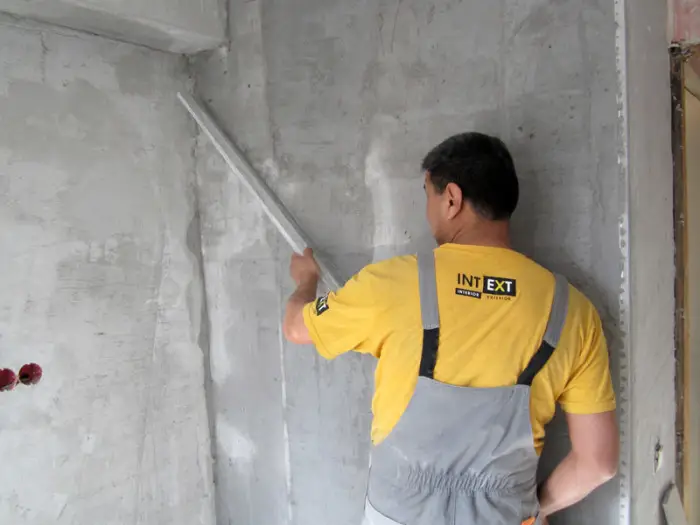
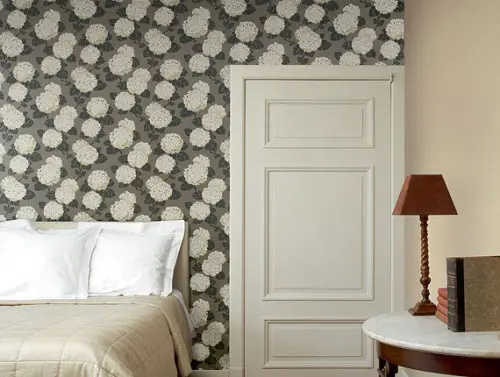
Photo 1 — Wall Leveling
Application Areas of Dry Plaster
Cement plasters are more often used as a material for facade and any other exterior works. These are strong plasters forming moisture-resistant coatings firmly adhering to the wall base. Cement-based plasters can be used in bathrooms and toilets.
Cement-lime mixes can be applied to concrete, gas concrete, brick, ceramic surfaces, and cement plasters.
Producers and brands of dry mix: VOLMA-AquaSlay (light machine-applied plaster, resistant to mold formation), OSNOVIT Startwell T-21 (for use on concrete and brick in rooms of any humidity level), KREISEL Putzmortel 560.
Dry plaster for interior work based on cement-sand mix has enhanced moisture resistance, plasticity, frost resistance, and improved adhesion of the mortar.
Producers and brands of dry mix: KNAUF Grünband (cement-sand, water-repellent plaster with thermal insulation properties), KNAUF Unterputz facade plaster, KNAUF Zokkelputz.
Gypsum plasters can be used for preparing walls for wallpapering, painting, and ceramic tile laying. They lay well on ceilings, concrete, brick, and particle board.
Producers and brands of dry mix: KNAUF Rotband (universal gypsum plaster), KNAUF MP75 (machine-applied), VOLMA-Slayer Universal, VOLMA-Slayer MN (machine-applied).
Dry plaster boards.
Building boards for dry plastering of walls are more commonly known as "gypsum board" (GKL). This finishing building material can be used for room decoration and for constructing load-bearing walls and partitions with dry or normal humidity conditions. It can also be used to make decorative structures.
Producers: VOLMA GKL, KNAUF GKL, KNAUF GKLV (moisture-resistant gypsum board), KNAUF GKL-O (fire-resistant GKL), KNAUF-Acoustics (sound-absorbing boards).
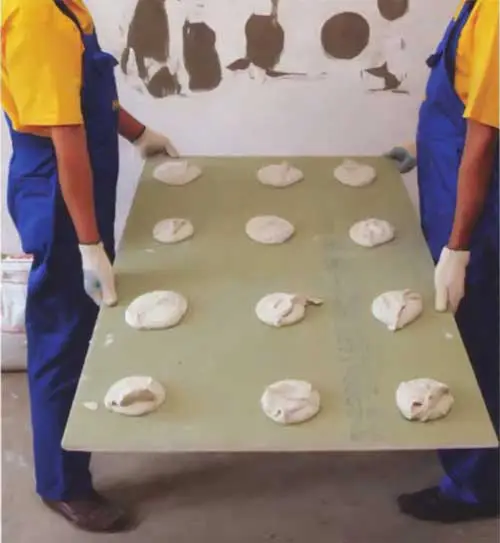
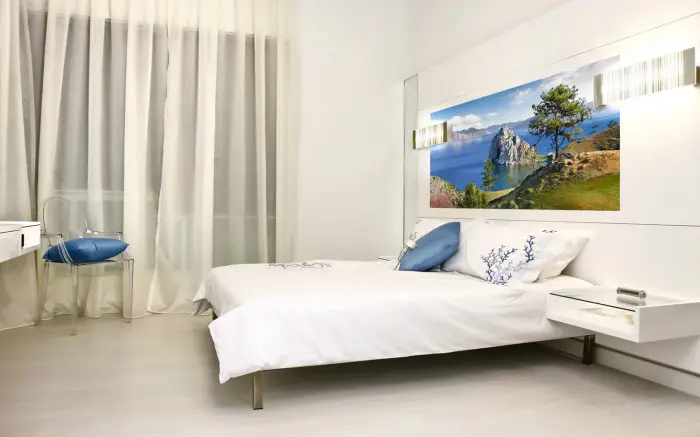
Photo 2 — Wall Leveling with Gypsum Board
Wood fiber boards, oriented strand board (OSB), or simply particle board (DVP) can be used as construction and renovation finishing materials for sound and thermal insulation, wall leveling, building wall partitions, and roofing.
Gypsum fiber boards (GVL), unlike gypsum board, are homogeneous materials without a shell. This material is denser and stronger than gypsum board. It is suitable for constructing walls, ceilings, and floors. It can be used in rooms with elevated fire safety levels.
As mentioned above, most of these materials cannot be used as finishing coatings (unless the surface is prepared for wall painting or dry plaster painting). When talking about dry plastering, it is impossible to overlook the decorative aspect.
Thus, dry decorative plaster can also be used as an exterior (facade) coating and material for interior room finishing.
Producers and brands of decorative plaster: the most popular among dry decorative plasters are "beetle", "wool", and "ram" types, which are offered in catalogs of most specialized manufacturers (such as KNAUF or Ceresit). The surface texture is achieved by incorporating grains of various sizes (from 0.5 to 4.5 mm) into the mix.
Besides their decorative functions, this type of plaster provides excellent protection against moisture and climate changes, UV exposure, and excessive heat loss.
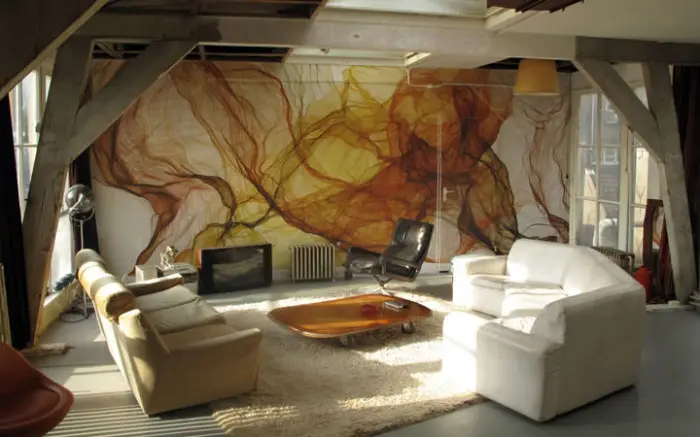
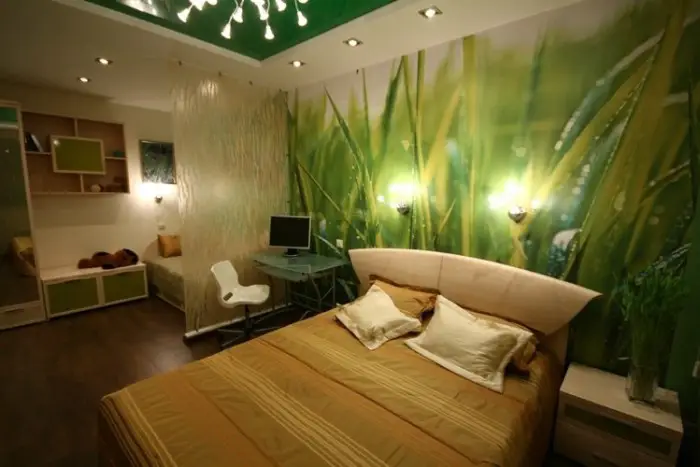
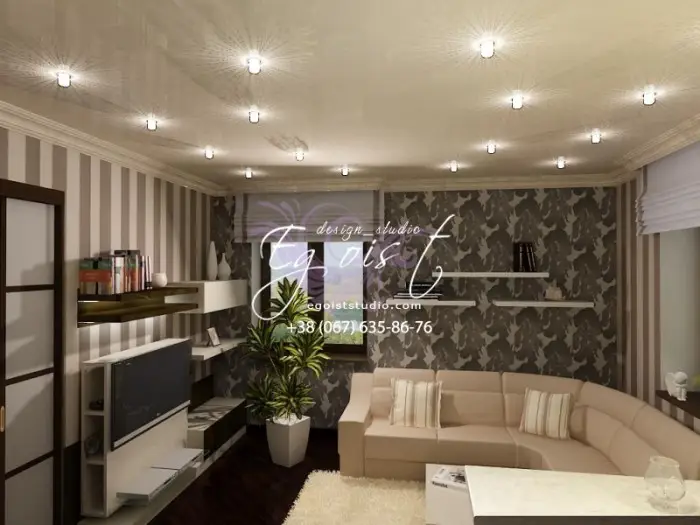
Photo 3 — Painting on Dry Plaster in Living Room Interior
Consumption of Dry Mix for Plastering
All manufacturers on the packaging of dry mix indicate an approximate material consumption per 1 m². However, this is not the consumption of dry material – it is the consumption of ready-made plaster. To determine the consumption of dry mix, subtract the water consumption used for preparing the finishing material from the total consumption of ready-made plaster.
Dry Plaster: Price
Depending on the type of plaster, the material cost is as follows:
- Ceresit CT 24 (cement mix for plastering) – $7/25 kg (consumption of ready mix 1.2 kg/m²;
- NP Start KNAUF (gypsum plaster) – $3.5/25 kg (consumption 1.58 kg/m²);
- TEPLON-Koroed (decorative, thermal protection plaster) – $15.9/25 kg (consumption 1.52 kg/m²);
- VOLMA GKL boards – $6.25 per board 9.5/1200/2500 mm;
- DVP boards – $4.5 per board 25/1220/2400 mm;
- KNAUF GVL boards – $33.5 per board 10/1200/2500 mm.