Create a Wardrobe from IKEA PAX Yourself. How Is It Possible?
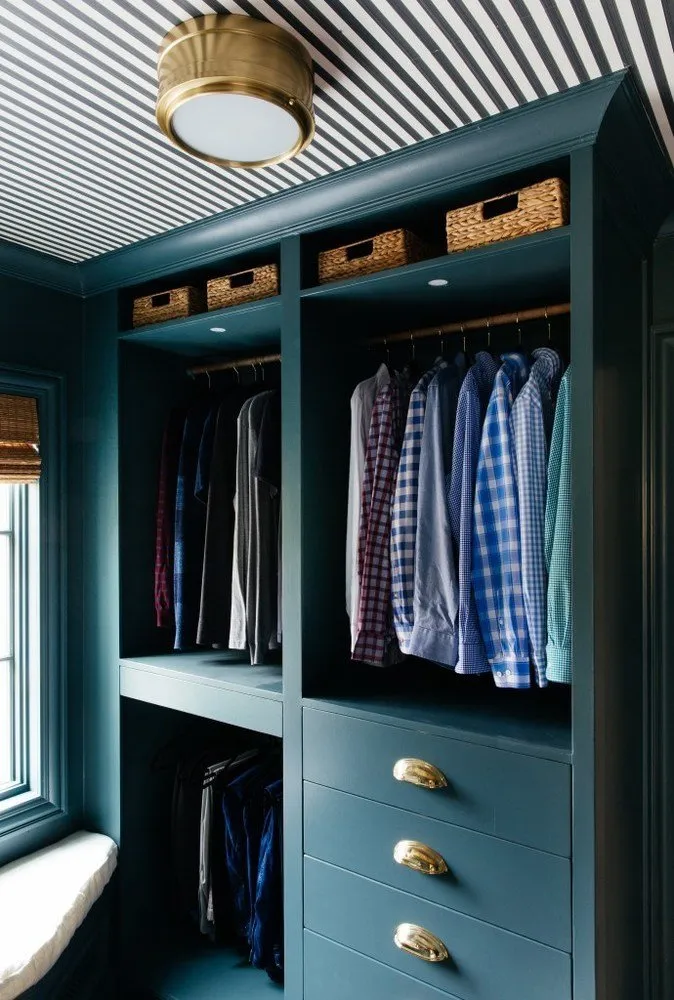
The designer Erin Kestenbaum loves vintage furniture, cozy textures and homes with character. She runs a blog where she tells about all this and shares her own photos of objects. Erin's latest achievement is a fully equipped wardrobe room in an elegant wave color. In her blog, the designer posted a photo report and explained step by step how she managed to transform the IKEA 'PAX' into a full-fledged wardrobe. We present key excerpts from Erin's story.
Step 1: Find an Inspiring Example
When I first started planning the perfect wardrobe, one of Jennifer Wolf's projects caught my eye: I was attracted to the amazing deep blue wave color. I took that image as a general reference point, deciding to make something similar at home but with a much more modest budget.
Initially, I wanted to make everything from wood from scratch, but my husband brought me back to reality: we had never built wardrobes before, not to mention sliding drawers, shelves and other components, and that would have taken forever.
So I started looking for a storage system I could assemble myself and paint in the desired color. Of course, the IKEA 'PAX' turned out to be the most convenient and budget-friendly option. I'm not the first to modify IKEA items, but here there were new conditions: I wanted to install lighting inside and completely redesign the drawers. If we had left them as they were, in our apartment designed in 1940s style, it wouldn't have fit in. Some people cover drawers with doors, but we didn't want to clutter the already small space with unnecessary doors.
Step 2: Create a List of What You Really Need
I wanted the wardrobe to look luxurious. For that, I needed baseboards, moldings, fillets, beautiful handles on sliding drawers and lighting. All of this we added ourselves; the original 'PAX' set didn't include any of that. Then we closed unused holes on the side walls, replaced metal hanging rods with wooden ones, primed everything and painted.
Erin and Cory's wardrobe before and after renovation!
Step 3: Plan Sections and Contents
For this, you can use the 'PAX' planning tool on the IKEA website. We calculated how much space we needed for long clothes (dresses, suits), medium-sized items (shirts, blouses), hanging on separate hangers (pants, skirts), folded in stacks (t-shirts, sweaters, underwear) and how many shelves we needed for shoes. We categorized all storage types by clothing categories in an electronic spreadsheet and checked it as we worked on each section of the wardrobe. For example, I fold my jeans, while my husband likes to hang them. He also prefers business style and has many shirts. All of this needs to be taken into account.
For reference: the wardrobe size is 426x182 cm, so we placed deeper sections (74 cm) on one side and narrower ones (33 cm) on the other. This way, we saved space for comfortable passage between rows.
It's important to ensure that the space for the wardrobe is even. Otherwise, the wardrobe sections won't fit snugly together, and it will be a nightmare.
Step 4: Install Lighting
We ordered these socket lights on Amazon and connected them to the switch. It created a wire chain, with each wire connecting to one of the sections in the chain, and others continuing further. We knew we'd place rattan baskets on the top shelf, so we weren't worried that the wiring wasn't pre-planned. But if you're only planning a renovation, you can include such an option as shelf lighting in your lighting project.
The distance from the floor to the wardrobe, and from the wardrobe to the ceiling should be equal everywhere. Make sure of this. Lighting is installed at the very beginning.
Step 5: Install Baseboards, Moldings and Wooden Trim
We used baseboards from the Fashion Forward collection by Metrie: they perfectly complement moldings and fillets that we also planned during finishing. Baseboards run along the entire perimeter of the room. For trim, we used poplar, sanded it on a machine, making sure the molding aligned with the top horizontal beam. The same poplar was used to form fillets for the side surfaces. We glued them, not using nails. Then we filled all gaps with wonderful Bondo spackle. In the end, we installed the upper molding, which completely covered all seams.
Step 6: Create Dream Drawers
We had a favorite dresser in the bathroom, which we used as a reference point. So I knew how dream drawers looked. The ones in the 'PAX' were completely different. Therefore, we took a poplar board again, sanded it and attached it to the drawers. Now they could be painted without problems. We kept the same gaps between drawers.
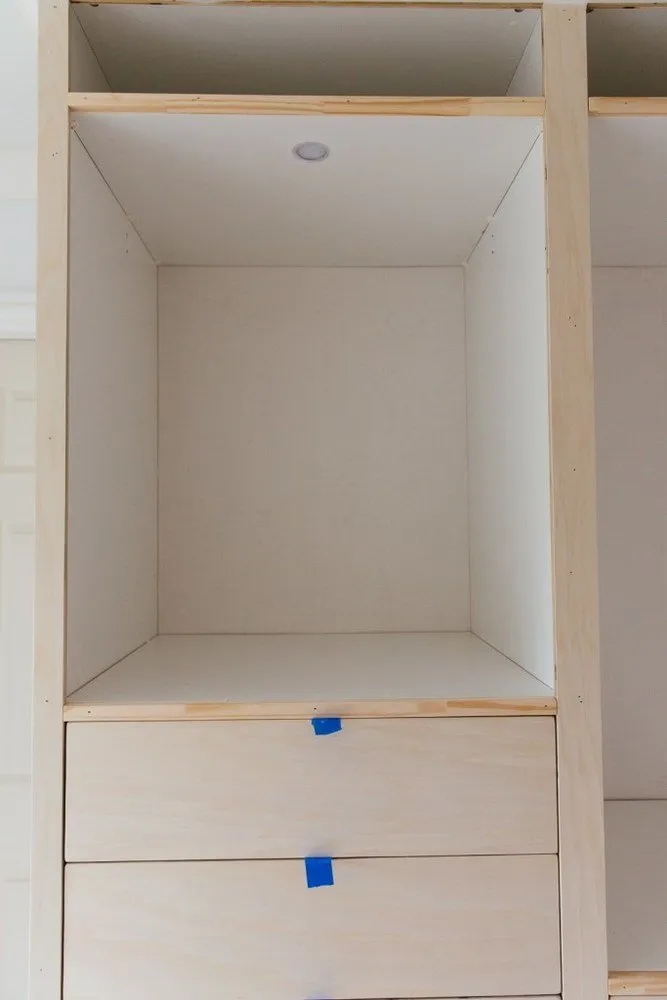
Step 7: Hide Holes and Wallpaper the Wardrobe Inside
An important detail: you wouldn't notice it, but you would definitely notice something was wrong if you didn't close the gaps and unused holes that reveal it was originally an IKEA wardrobe.
For example, IKEA sells packs of plugs designed to hide many holes in the 'PAX' system. Installing them is not easy, but the effort is worth it. We used 12 packs and left holes only where shelves were, so that they could be rehung if needed.
After that, we pasted thick wallpaper for painting to create a perfectly smooth surface with texture.
Step 8: Prime and Paint
The main challenge was painting the laminated surfaces of IKEA wardrobes. It turned out to be fully achievable. The secret is in Zinnser BIN Shellac Primer. You'll have to use a respirator, but that's the only downside: the material covers IKEA surfaces beautifully. In most hard-to-reach spots, we applied primer with a high-density foam roller and brush. The primer dries quickly, and after it dried, we applied a second coat for authenticity.
We painted the wardrobe with a sprayer, and it came out super-professionally. What to keep in mind:
- there should be many light sources;
- stock up on fine-grit sandpaper to remove excess drips and splatters right away;
- be prepared to clean the sprayer periodically, as it will clog;
- check how the paint sprays before starting to better control the process;
- it's better to do several thin coats rather than one thick one.
We used Farrow and Ball Inchyra Blue from the Modern Eggshell collection. This is my favorite color: depending on lighting and time of day, it can change from peacock blue to dark green. Another paint option I can recommend is Benjamin Moore Advance: it holds up well on our bathroom dresser and is much cheaper.
Step 9: Polish the Drawers
The paint should dry in a couple of days. After that, you can install the drawers. Only then the front panels. To ensure they align perfectly with the trim we added, we inserted washers between the 'PAX' drawers and wooden fronts at each screw point so that the facades fit flush.
Step 10: Hurrah, Handles!
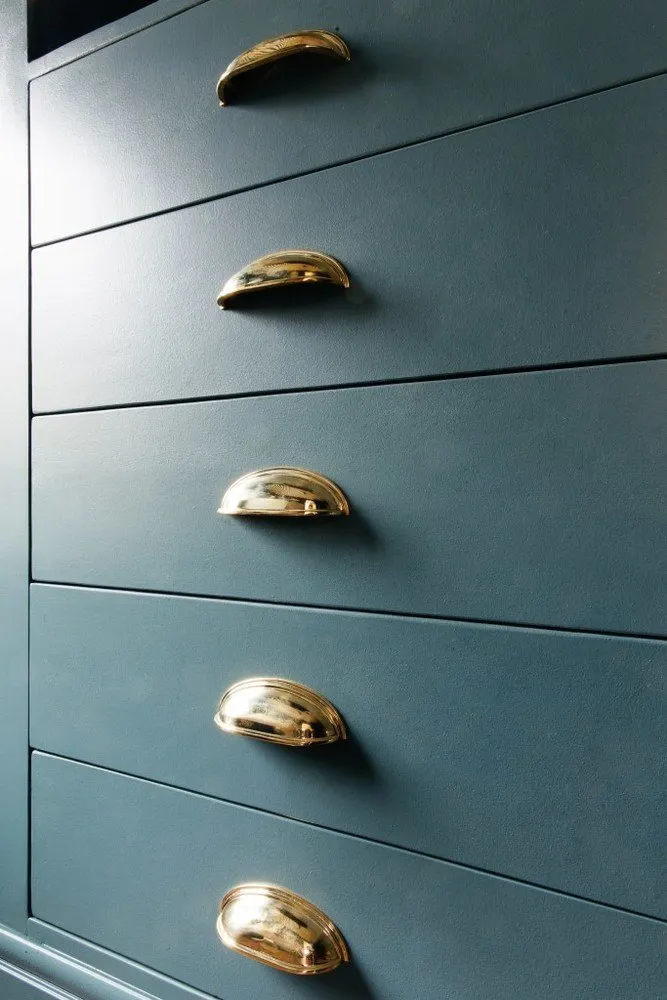
And my favorite part — hardware. I chose the Emtek brand and ordered beautiful heavy aged brass handles from them. We used a laser measure to ensure all handles were the same distance from the drawer edges.