Monolithic Foundation
Foundation tilts, if properly executed, are also excluded.
When it comes to a monolithic base for a house, most people imagine a slab foundation. This perception is partly correct, as a slab can only be monolithic. However, a monolithic foundation can also be strip or even pile-based. Each of these types has its own features and is used in specific cases.
Slab
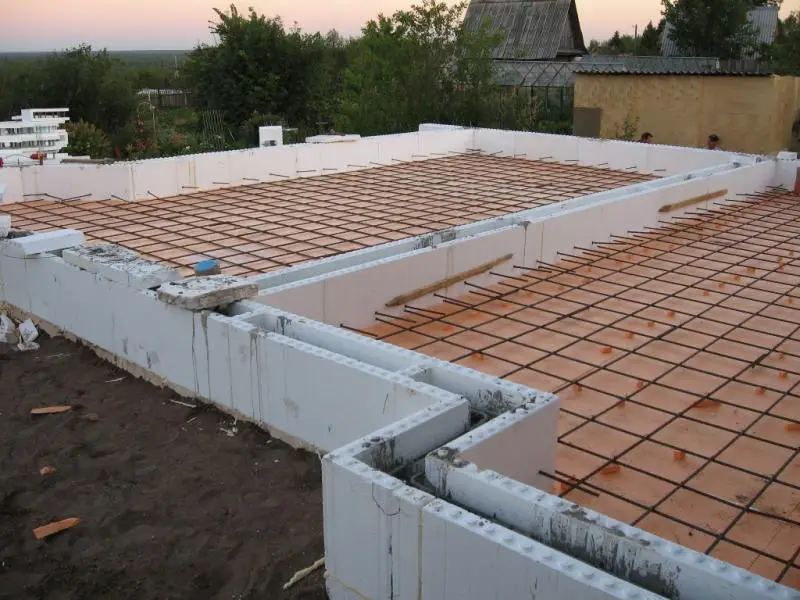
A slab foundation is a single concrete plate embedded in the soil and resting on a sand cushion. This type should be used when the soil beneath the building is heaving, weak, prone to shifting, or has uneven compressibility. It is also advisable to use a slab when groundwater levels are close to the surface.
This type of foundation can be built on almost all soil types. The integrity of the slab allows it to compensate for soil pressure and protect the house from groundwater. Under uneven pressure, cracks are prevented, meaning the load-bearing capacity remains at its initial level.
Slab foundations can be deep (footing below the frost line) or shallow. Deep slabs are used for heavy structures such as large brick houses with three or more floors. For small and lightweight homes, a shallow slab is sufficient.
It is commonly believed that slab foundations are the most expensive, and their construction may consume up to one-third of the house budget. In some cases, this may be true, especially with deep slabs. However, for a shallow slab, labor and material costs are not significantly higher than for a strip foundation, and the concrete volume is comparable.
Strip
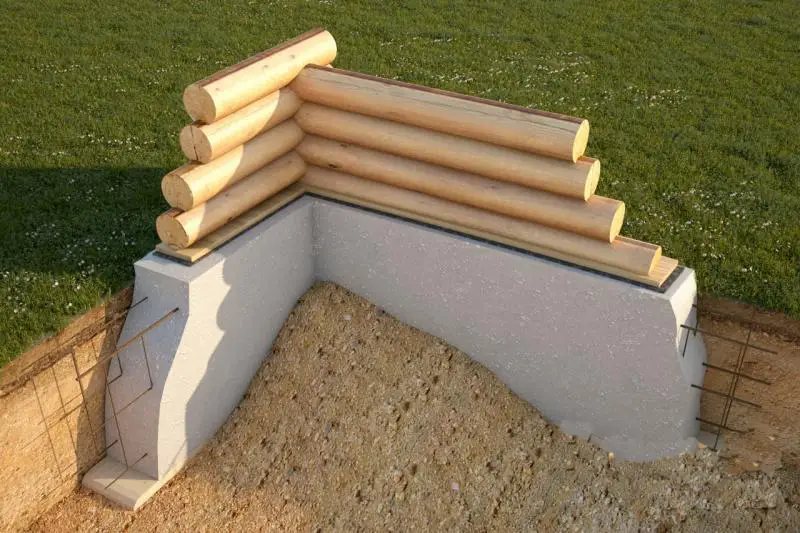
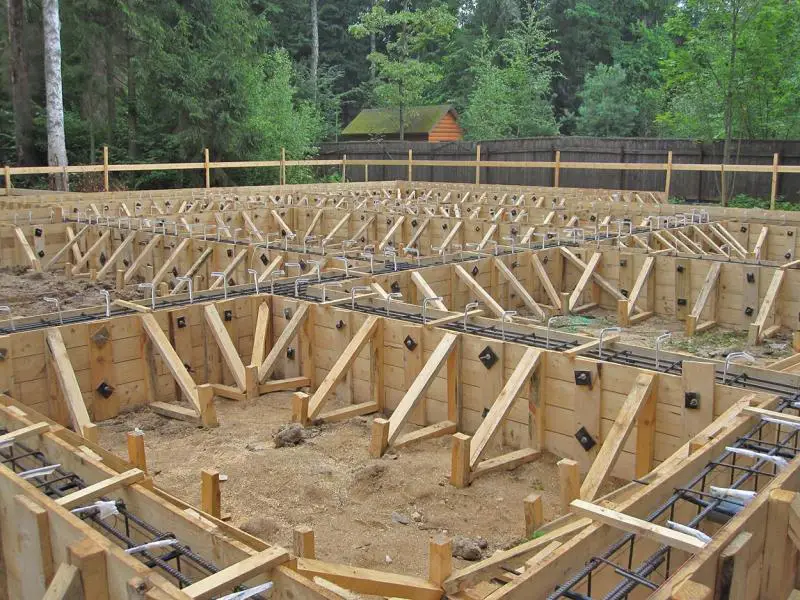
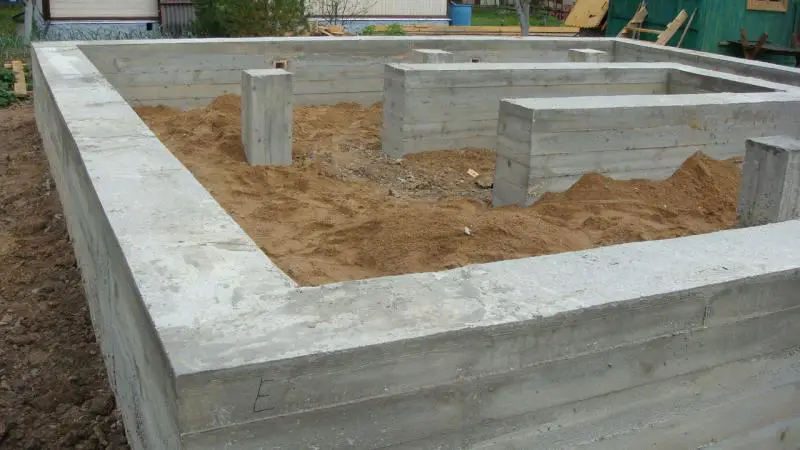
A strip foundation is considered monolithic if poured into formwork rather than built from prefabricated blocks. Its main advantage is monolithic integrity—no joints. Joints are potentially dangerous points of rupture and misalignment in prefabricated elements. Therefore, a monolithic strip foundation is stronger than a modular one.
This type is used for one- and two-story homes, both lightweight frame structures and brick houses with reinforced concrete floors. It is also used when a basement or cellar is planned, as the internal wall of the foundation becomes the wall of the basement.
House weight and soil composition determine the need for deep placement (footing below the frost line). For small, lightweight, or wooden buildings, a shallow strip foundation may be sufficient. However, the final decision should be based on soil data from the construction site.
Monolithic Pile Foundation
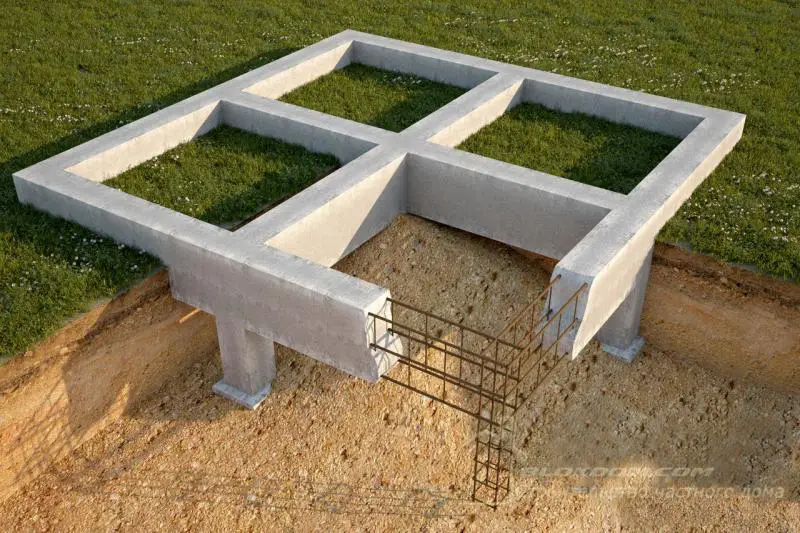
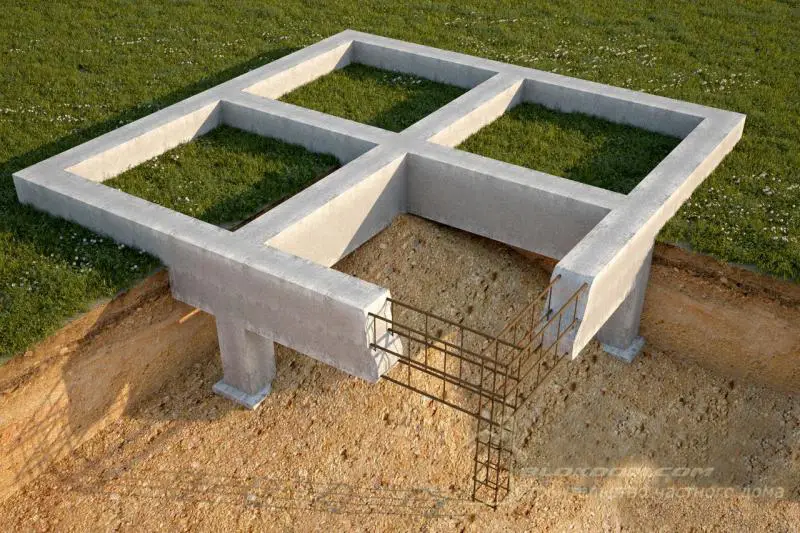
Although it may sound unusual, even pile foundations can be monolithic. These consist of piles connected by a monolithic beam (‘rand-beam’). Visually, this foundation resembles a strip foundation, but its base consists of piles connected by a concrete beam slightly embedded in the soil—known as a rand-beam. This ensures all structural elements are integrated, load distribution is more even than in traditional pile foundations.
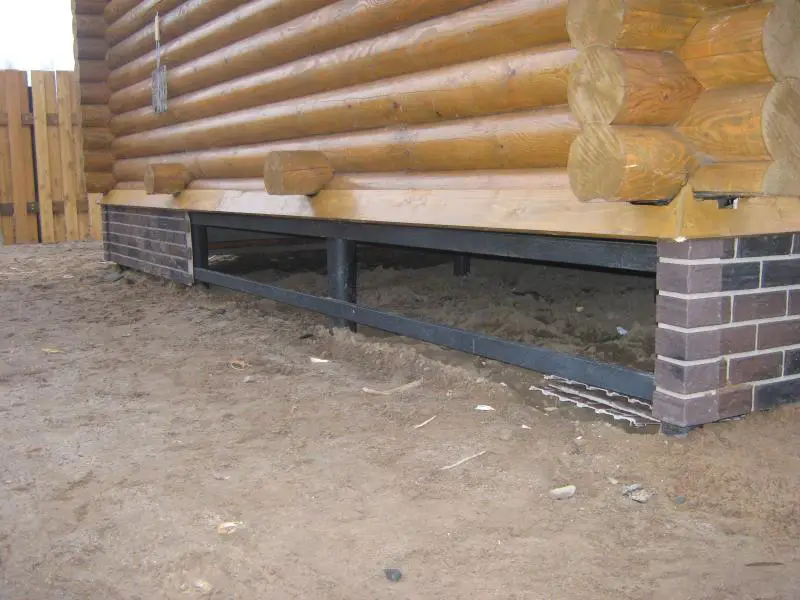
This type is rarely used due to additional costs for connecting piles. Moreover, its cost is nearly equivalent to a strip foundation. A key advantage is that it eliminates the need for additional work to close gaps between piles—open underfloor spaces increase heat loss.
It is often assumed that monolithic foundations are significantly more expensive than prefabricated, pile, or pile-driven ones. While this is true in some cases, such instances are rare. The final cost depends not only on the chosen type but also on additional construction work.
Remember: the foundation is the root of the house. Just as a root holds a tree, a foundation holds a house. A house cannot survive with a weak root!