Foundation Cladding
There is no longer any doubt: you cannot save on the foundation. But this truth applies not only to building the foundation itself, but also to its protection, insulation, and preservation.
For cladding the foundation, more precisely the foundation’s stem wall – the part that rises above ground level – there are many methods and ready-made solutions. The most common is cladding with natural or imitation stone. Perhaps because stone subconsciously represents reliability and durability, which is exactly what a foundation should possess.
Common types of cladding include natural and artificial stone, brick, plaster, plastic panels, and siding.
Natural Stone
Natural stone cladding is the most expensive, but also the most durable and reliable. When properly installed, such cladding will last for many years without causing any trouble to the homeowner, and will not require repairs or replacement. For foundation protection, light (limestone and sandstone) or heavy, but expensive (granite and marble) stones are used.
Stone slabs are attached to the surface using special adhesive. For heavy stones, additional fasteners are used to form a support framework: reinforced mesh, hooks, and stakes.
If such a framework is not provided, heavy stones may eventually detach due to their own weight. Light, porous rock types may absorb water, which not only affects appearance but also damages the bond. To protect against moisture, these stones should be treated with hydrophobic compounds.
Artificial Stone
Materials that mimic the structure and pattern of natural stone, but are significantly lighter and cheaper, have long been popular. Although their durability is several times lower, this does not prevent them from being an excellent choice for cladding a foundation’s stem wall. These materials are made from clay, concrete, or pumice.
Cladding materials for foundations are available in standardized tiles, simplifying installation, or as irregular-shaped slabs, allowing unique patterns to be created.
To ease installation, the backside of the tiles features a textured surface, improving adhesion and allowing attachment only with special adhesive or cement mortar.
Brick-Style Cladding
Cladding that resembles brickwork gives a home a complete, solid look and leaves no doubt about its reliability. But the eye can be easily fooled – there is no actual brick. Instead, for foundation cladding, ceramic or polymer-sand tiles are used, which imitate the color and pattern of real bricks.
Ceramic tiles are thin plates similar to bricks, with corner elements available for seamless corner finishing. They are attached using cement mortar. Polymer-sand tiles are secured with screws, allowing insulation to be placed beneath them.
Plaster
One of the most affordable and popular methods of foundation cladding is plastering. This is due to plaster being widely available, easy to work with, and effective for protection. Additionally, plaster allows for unique designs and can imitate various materials on the stem wall.
However, this method has one major drawback – short lifespan. After a few years of use, the surface will need repair, as it cannot withstand foundation compression and deteriorates under weather conditions. Nevertheless, plaster remains cheaper than stone or brick cladding, even when factoring in repairs.
Siding and PVC Panels
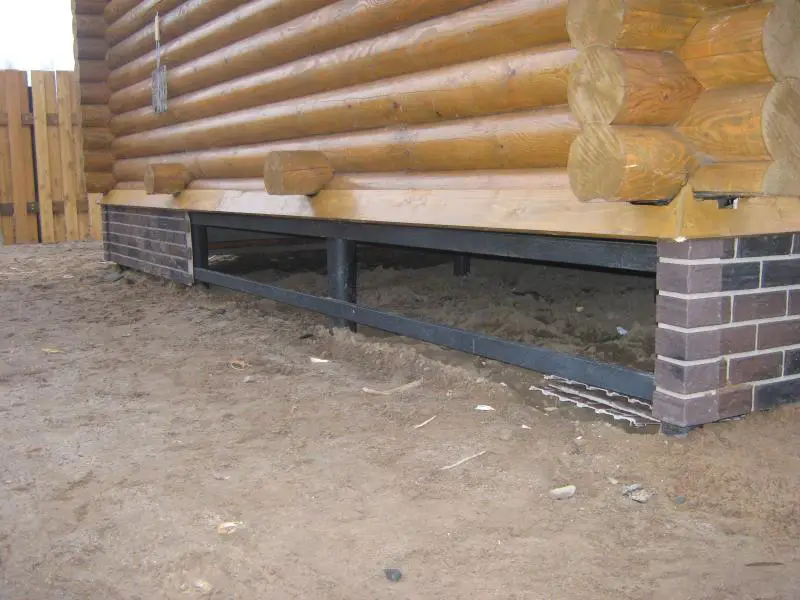
Previous cladding types are better suited for monolithic foundations, but what if the foundation is pile or column-based? In such cases, to clad with, for example, artificial stone, a load-bearing wall must first be built to support the cladding, and only then can the foundation be decorated.
However, a more rational choice in such cases is to use plastic panels, available in various sizes and shapes. These panels form the cladding between foundation piles and only require a wooden furring strip framework.
Relatively inexpensive panels help save on facade cladding due to simple installation and fastening. The downside is their low durability – they do not withstand strong pressure or impacts, but individual panels can be easily replaced.
There are many options for foundation cladding, and the choice depends on personal preference and budget. However, remember that the foundation should match the house. For example, a plastered foundation may look awkward on a large brick house, where stone or brick would be better. With wooden walls, both plaster and natural stone (cobblestone) look good, but not marble, even if it’s imitation.
But most importantly – remember that cladding is not so much about beauty as it is about protecting the foundation.