How to Tie Reinforcement for a Foundation
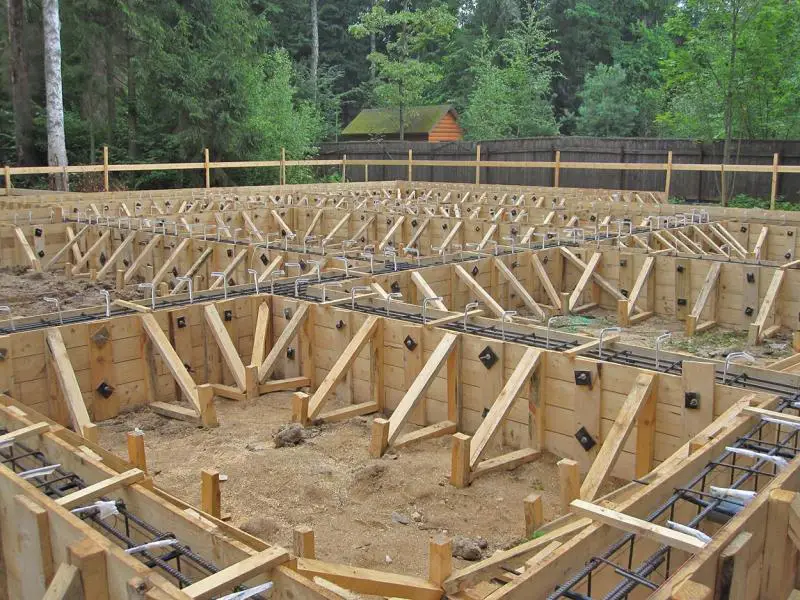
Just as the foundation is the basis of a building's stability, so the reinforcing steel framework is the foundation of reliability and durability of the foundation itself. The reinforcement framework is a crucial connecting element in a reinforced concrete foundation.
Working reinforcement resists tensile loads and strengthens compression zones.
Installation reinforcement is placed according to technical requirements, primarily to position and secure the working reinforcement.
Overall, the reinforcing framework prevents deformation and cracking in concrete due to the weight of the building and frost heaving forces, ultimately preventing foundation and structural failure.
Types of Reinforcement and Materials for Production
Reinforcement for foundations is a shaped steel product—metal rods of standard length from 6 m and diameter from 6 mm. The diameter of the rods directly affects strength: the larger the diameter, the stronger the framework.
Rod profiles are either smooth or periodic, featuring ribs, grooves, notches, and ridges designed to improve concrete-to-metal adhesion. Concrete-to-metal adhesion for rods with periodic profiles is approximately twice as strong as for smooth rods.
For particularly strong foundations, rigid frames made from angles or channels may be used.
Methods of Reinforcement Lashing
Lashing reinforcement is performed to prevent displacement of reinforcing bars from design spacing and to maintain consistent reinforcement pitch.
Reinforcement is secured using several methods: welding and manual tying.
WeldingThis is the primary method of joining reinforcement, although it has several drawbacks:
- reduced strength of the reinforcement bar due to high temperature from electric welding;
- potential failure of welded joints during concrete pouring or compaction;
- for large-scale projects, additional experienced welders are required.
For manual tying, strong steel lashing wire with a diameter of 0.8–1.2 mm is used, supplied in coils or pre-cut into 100–200 mm lengths.
Tying with Cutters (Pliers)The simplest method: tying is done at the intersection of reinforcement bars, tightening the double-folded wire by twisting and securing the ends with reinforced cutters with blunted teeth (to prevent wire breakage during tying) or with regular pliers.
Tying with a Hook and DrillAn alternative method: using a specialized hook (available in construction supply stores or handmade from steel wire). Fold the wire in half, hook the loop, wrap the ends around the bar intersection, and insert them into the hook.
Then twist the wire by rotating the hook. A simple hook must be turned manually. For faster tying, a spiral hook is used, which rotates when pressure is applied to the handle.
Reinforcement can also be tied using a drill—insert the tying hook into the drill chuck. When the tool is activated, the rotating hook twists the wire.
Advantages of manual tying: flexibility and elasticity of the framework.
Disadvantages of manual tying with a hook:
- low productivity;
- lower joint density and risk of joint displacement;
- inconsistent quality of tying.
Special clips (connectors, fixators, clamps) made from round wire are also used for tying reinforcing bars. In this case, tying is done by hand, and no special tool is required.
Advantages of using clips:
- tying speed increases by about three times compared to manual wire tying;
- high density of the reinforcement joint;
- no need for specialized training of the worker;
- simple calculation of required material quantity.
For small-diameter bars, self-tightening plastic clamps can also be used.
These methods are most suitable for tying small reinforcement frameworks during the construction of garden houses and utility buildings.
Tying with a Lashing PistolSince manual lashing of reinforcement is very labor-intensive, automatic lashing pistols may be used for large-scale projects.
The process involves placing the pistol’s attachment at the desired location. Then, pressing the button activates the automatic, tight lashing of the bars.
Electric pistols run on batteries, with lashing wire supplied from a replaceable spool. Manual pistols operate without batteries.
Advantages of using an automatic pistol:
- simplicity and ease of use;
- consistent torque ensures high-quality, reliable joint connections;
- tying speed: 1–2 seconds per joint;
- no wire waste;
- significantly reduced labor intensity.
Disadvantages of using a lashing pistol:
- higher costs due to expensive tools and consumables;
- need for worker training;
- impossible to use in hard-to-reach areas of the framework.
Application of Different Lashing Methods
Spot welding, lashing wire, or connector clips are used to join bars up to 25 mm in diameter. For bars over 25 mm in diameter, arc welding may be used.
At least 50% of reinforcement intersections must be connected during framework lashing.
Given that lashing wire is flexible and may stretch slightly under mechanical stress, it’s best not to move the framework after tying—perform lashing in place.
A properly tied reinforcement framework ensures long-term durability, strength, and reliability of the foundation.