How to Choose the Right Ceiling Fan for Your Room and Decor
Ceiling fans remain one of the most effective, energy-efficient fixtures you can add to a home, bridging the gap between mechanical climate control and everyday comfort. When paired with central air conditioning, according to the U.S. Department of Energy, using a ceiling fan allows you to raise your thermostat setting by about 4 degrees Fahrenheit with no reduction in comfort. In cooler seasons, reversing the blade rotation redistributes rising warm air back into your living space, reducing the workload on your heating system. Beyond energy savings, modern ceiling fans feature sleek profiles, smart home connectivity, whisper-quiet motors, and curated finishes that elevate your interior architecture. This comprehensive guide walks you through calculating the correct blade span, determining hanging height and downrod lengths, evaluating airflow performance (CFM), choosing between motor types, and matching the right style to your room.
Selecting the right fixture requires balancing visual scale against physical airflow dynamics. If you install an undersized fan, it will spin rapidly without circulating sufficient air, looking lost in the room. Conversely, an oversized fan overwhelms the space visually and creates excessive draft. To make an informed investment, you need to understand how blade span, ceiling clearance, motor engineering, and moisture ratings work together. You can explore a wide variety of models when you choose the right fan or fans for your specific layout.
Quick Sizing and Selection Summary
- Select a blade span based on floor area, installing 44 to 50 inch fans in standard 145 to 400 square foot bedrooms and living rooms.
- Hang blades between 8 and 9 feet from the floor, using flush mounts for 8-foot ceilings and downrods for taller or vaulted spaces.
- Target an airflow output between 4,000 and 5,000 CFM for standard rooms, and exceed 6,000 CFM for great rooms or porches.
- Choose a DC motor model to reduce electrical consumption by up to 70 percent and enjoy silent multi-speed control.
- Run your fan counterclockwise in summer for a cooling downdraft and clockwise at low speed in winter to redistribute trapped warm air.
- Opt for damp-rated fixtures in covered outdoor or humid indoor spaces, and restrict wet-rated models to areas exposed directly to rain.
How to Choose the Right Ceiling Fan: A Complete Sizing, Airflow, and Style Guide
Ceiling Fan Size Chart: Matching Blade Span to Room Dimensions
Calculate room square footage before shopping: rooms under 75 square feet need 29 to 36 inch spans, standard rooms need 44 to 50 inches, and spaces over 400 square feet require 60 to 80 inches.
The first and most critical step in fan selection is calculating the square footage of your room so you can match it to an appropriate blade diameter. Choosing the correct blade span ensures balanced airflow distribution across the entire living zone without overwhelming the room visually. To find your room square footage, multiply the length of the room by its width in feet. Ceiling fan diameter, or blade span, is measured from the tip of one blade to the tip of the opposing blade on an even-bladed fan, or from the center of the motor housing to the blade tip multiplied by two for an odd number of blades.
Fans come in sizes ranging from 29 inches to 80 inches or more, accommodating everything from compact walk-in closets to soaring great rooms. Adhering to established sizing guidelines ensures optimal performance throughout the space.
| Room Area (Square Feet) | Recommended Blade Span (Inches) | Common Room Applications |
|---|---|---|
| Under 75 sq. ft. | 29 to 36 inches | Small bathrooms, breakfast nooks, utility rooms, walk-in closets |
| 76 to 144 sq. ft. | 36 to 42 inches | Home offices, guest bedrooms, nurseries, small kitchens |
| 145 to 400 sq. ft. | 44 to 50 inches | Primary bedrooms, standard living rooms, formal dining rooms |
| Over 400 sq. ft. | 60 to 80 inches (or dual fans) | Great rooms, open-concept living spaces, expansive covered patios |
In addition to room square footage, pay close attention to safety clearances. Ensure that the blade tips sit at least 18 to 24 inches away from surrounding walls, door swings, tall cabinets, and sloped ceiling planes. In expansive open-plan spaces exceeding 500 square feet, installing two medium-sized fans spaced evenly often delivers more balanced, pleasant circulation than a single massive unit centered in the room.
Flush Mount vs. Downrod Ceiling Fans: Hanging Height and Clearance
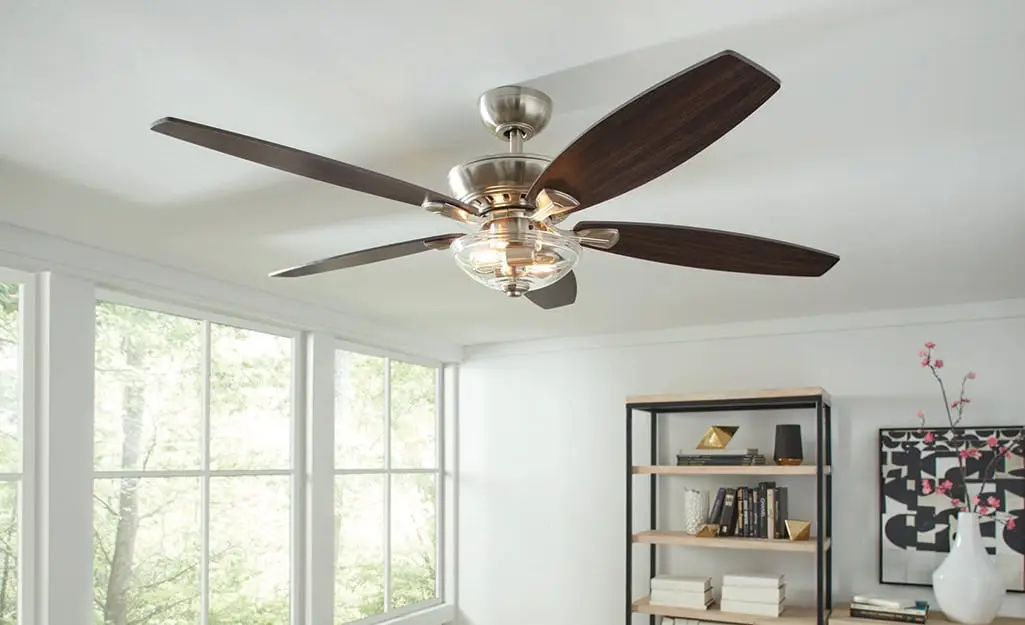
Keep blades between 8 and 9 feet above the floor for peak air velocity, ensuring at least an 8-inch clearance between blades and ceiling.
Ceiling height determines how your fan must be mounted to deliver safe clearance and maximum air velocity. For optimal cooling efficiency, ceiling fan blades should hang between 8 and 9 feet above the finished floor surface. Building codes generally mandate a minimum clearance of 7 feet from the floor to the fan blades to prevent accidental contact, while bedrooms with bunk beds or tight multi-use rooms require even greater caution.
Your mounting configuration must adapt to the vertical architecture of your room:
- Flush-Mount or Hugger Fans: Designed for low ceilings of 8 feet or less. These units mount directly against the ceiling drywall without an exposed downrod, keeping the profile compact so occupants can move safely beneath them.
- Standard Downrod Mounts: Standard for ceilings between 8.5 and 9 feet tall. Most fixtures come packaged with a 3- to 6-inch downrod that positions the blades at the ideal height.
- Extended Downrods: Essential for high, vaulted, or cathedral ceilings. A fan mounted too close to a high ceiling will simply churn air in the upper stratum without cooling the living zone below.
Your new ceiling fans will need at least eight inches of clearance from the ceiling in order to move air efficiently. When fan blades sit closer than 8 inches to the ceiling plane, airflow is restricted, leading to reduced velocity and motor strain. To calculate the correct extension downrod length for taller spaces, subtract 9 feet from your total ceiling height. For example, a 12-foot ceiling benefits from a 36-inch downrod, while a 14-foot ceiling typically requires a 60-inch downrod. For sloped or vaulted ceilings, ensure the canopy mounting bracket supports angled installation or purchase an aftermarket sloped-ceiling adapter kit.
Understanding Airflow: Ceiling Fan CFM by Room Size and Motor Power
A ceiling fan does not lower room temperature like an air conditioner; instead, it cools people directly through evaporative cooling on the skin. Airflow performance is measured in cubic feet per minute (CFM), which quantifies the volume of air the fixture displaces at top speed. Evaluating CFM ratings alongside energy consumption tells you whether a fan provides a gentle whisper of air or a robust, cooling breeze.
Airflow capabilities fall into recognizable performance tiers across modern fixtures:
- Low Airflow (Under 4,000 CFM): Best suited for decorative purposes, small nurseries, or delicate dining areas where strong drafts might disturb papers or cool hot meals too quickly.
- Standard Airflow (4,000 to 5,000 CFM): A good rating for standard-sized bedrooms and home offices, providing consistent comfort during warmer afternoons.
- High Airflow (5,000 to 6,000 CFM): An ideal rating for primary living areas, kitchens, and active family spaces requiring noticeable cooling power.
- Commercial and High-Performance Airflow (Over 6,000 CFM): The strongest fans have an airflow rating of more than 6,000 CFM, making them necessary for expansive outdoor porches, cathedral ceilings, and large open layouts.
While homeowners often assume that adding more blades increases airflow, blade count is primarily an aesthetic design choice. In reality, fans with fewer blades (such as two or three) encounter less aerodynamic drag, allowing the motor to spin faster and generate stronger air movement. Fans with four, five, or six blades tend to produce a softer, quieter breeze and a more traditional visual weight. Look closely at the blade pitch (the angle of the blade relative to the horizontal plane): an optimal pitch ranges between 12 and 15 degrees, allowing the blades to scoop and displace air efficiently without causing motor overheating.
AC vs. DC Motor Ceiling Fans: Energy Efficiency, Control, and Noise
DC motors consume up to 70 percent less energy than AC motors and run virtually silent, making them well worth the higher initial investment for bedrooms and home offices.
The motor powering your ceiling fan directly influences its operational sound, energy consumption, and longevity. Choosing between an alternating current (AC) motor and a direct current (DC) motor represents one of the most critical functional decisions in modern fan shopping. While AC motors have served as the industry standard for decades, DC motor technology has become increasingly popular in residential interiors due to its refined performance.
| Feature | AC Motor Ceiling Fans | DC Motor Ceiling Fans |
|---|---|---|
| Energy Consumption | Standard operational draw | Consumes up to 70% less energy than standard AC motors |
| Speed Settings | Typically 3 basic speed levels | Offers 6 or more fine-tuned speed settings |
| Noise Level | Quiet, but may produce a faint hum at lower speeds | Virtually silent operation at all rotational speeds |
| Reverse Function | Manual mechanical toggle switch on the motor housing | Reversible directly from handheld remote or wall control |
| Initial Cost | Budget-friendly and economical | Higher initial investment, offset by lower electrical usage |
For quiet environments like master bedrooms, home theaters, or studies, a DC motor fan is an outstanding choice because its electromagnetic design virtually eliminates mechanical motor hum. The broader range of speed options allows you to dial in subtle airflow adjustments during sleep. For guest bedrooms, secondary living areas, or renovation projects on strict budgets, AC motor fans remain a dependable, cost-effective solution.
Indoor vs. Outdoor Ratings: Damp Rated vs. Wet Rated Ceiling Fans
Selecting a ceiling fan requires verifying that its electrical enclosure and blade materials can withstand the moisture conditions of its intended environment. Installing an indoor-rated fan in an outdoor or humid setting is a serious safety hazard that leads to electrical short circuits and droop-prone, warped blades. Lighting and electrical certification bodies classify fixtures into three clear environmental tiers.
Understanding these ratings guarantees long-term durability and safety:
- Dry-Rated Fans: Engineered exclusively for climate-controlled indoor spaces such as bedrooms, living rooms, dining rooms, and home offices with zero moisture exposure.
- Damp-Rated Fans: Built with moisture-resistant components and sealed motor housings designed for humid indoor spaces or covered outdoor zones. These are mandatory for full bathrooms with showers, covered porches, screened lanais, and laundry rooms where humidity levels fluctuate but direct water contact will not occur.
- Wet-Rated Fans: Constructed with watertight motor housings, rust-resistant stainless steel or all-weather composite blades, and protected wiring. These fixtures can endure direct rain, heavy fog, snow, and hose-downs, making them essential for open pergolas, gazebos, exposed patio overhangs, and outdoor pavilions.
- Marine-Grade Construction: If you live near the ocean, standard wet-rated fans may still succumb to salt spray corrosion. In coastal regions, look for marine-grade fans built with heavy-duty powder-coated aluminum, stainless steel hardware, and UV-stabilized ABS blades to prevent premature pitting and deterioration.
Ceiling Fan Direction for Summer and Winter
Maximizing the efficiency of your ceiling fan depends on setting the blades to spin in the proper seasonal direction. Adjusting your ceiling fan direction seasonally creates an evaporative wind chill in hot weather and redistributes trapped heat during cold months. Most modern fans include a reversible motor operated either via a handheld remote, a wall-mounted control, or a manual toggle switch on the motor casing.
Set your fan operation according to the current season:
- Summer Direction (Counterclockwise): The fan should rotate counterclockwise when you look up at it from below. This rotation forces air downward, producing a steady downdraft that evaporates perspiration from your skin. This cooling effect allows you to raise your air conditioning setting without sacrificing comfort.
- Winter Direction (Clockwise): Set the fan to rotate clockwise at its lowest possible speed. Warm air generated by your heating system naturally rises and pools near the ceiling. A slow clockwise rotation pulls cool air upward toward the center and gently pushes the trapped warm air down along the perimeter walls, balancing room temperatures without creating a chilly downward breeze.
Matching Fan Styles, Finishes, and Features to Your Decor
While performance and engineering dictate how well a ceiling fan works, its physical appearance shapes the visual character of your room. There are many different ceiling fan styles and designs available to complement architectural details, furniture profiles, and lighting schemes. Treating your ceiling fan as an integrated architectural element rather than an afterthought ties the entire room together.
Different design aesthetics call for specific materials and finishes:
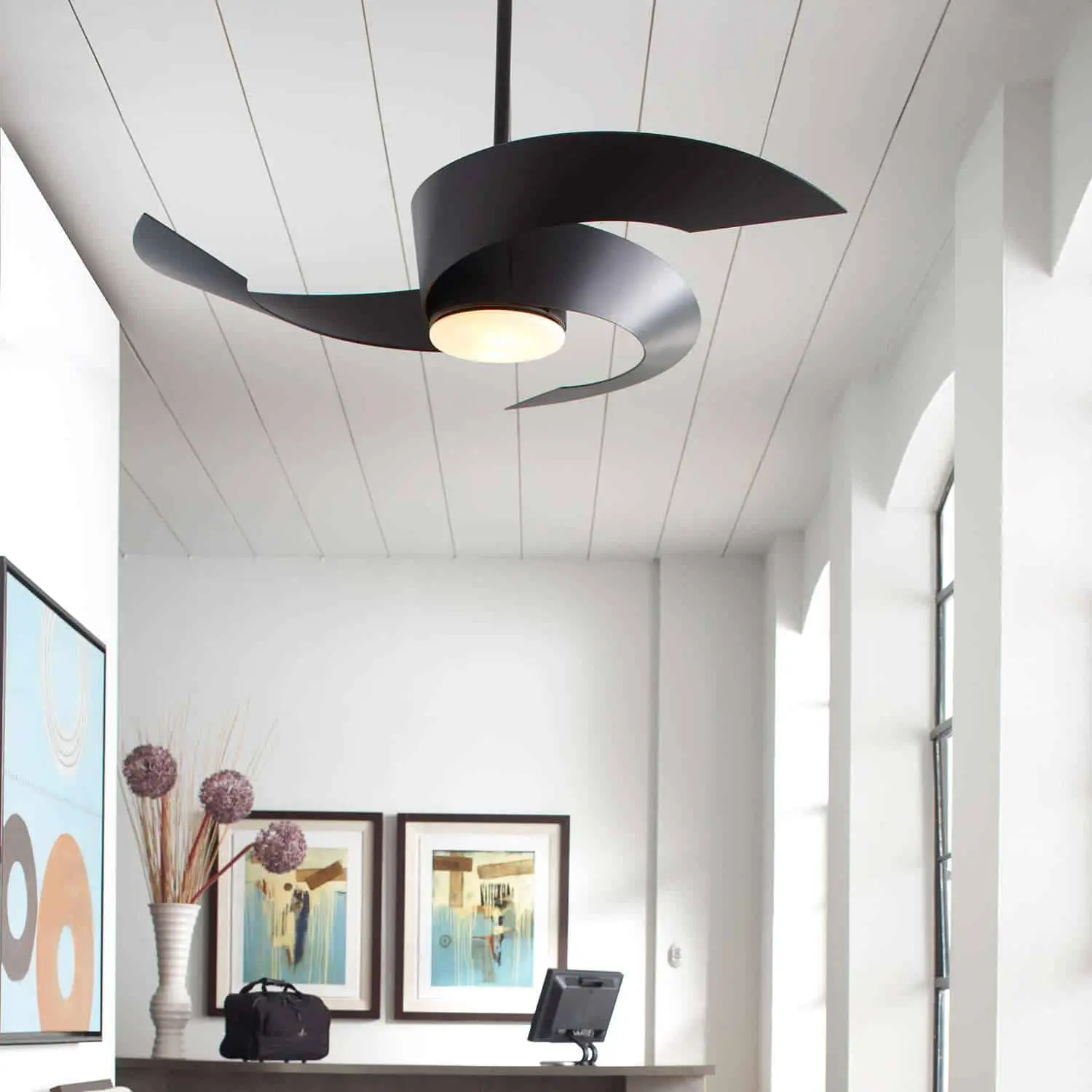
- Modern and Contemporary: Characterized by sleek silhouettes, two or three sculpted blades, and monochromatic palettes. Matte black, brushed nickel, polished chrome, and graphite finishes match minimalist architectural settings.
- Coastal and Tropical: Look for light-toned natural woods like bleached oak, woven bamboo, rattan textures, or clean white finishes that coordinate effortlessly with breezy beach-house palettes.
- Farmhouse and Rustic: Natural distressed wood blades, seeded glass light kits, and matte iron or oil-rubbed bronze accents create an inviting, authentic feel in transitional or modern farmhouse spaces.
- Traditional and Classic: Deep walnut, cherry, or mahogany blades paired with antiqued bronze, brass, or pewter housings offer timeless symmetry and detail in formal living rooms and historic homes.
Finally, consider how you intend to control the fixture and whether integrated illumination is required. Many modern fixtures incorporate dimmable LED light arrays with adjustable color temperatures ranging from warm white (2700K) to cool daylight (4000K). Smart ceiling fans equipped with Wi-Fi connectivity allow you to program automated schedules, set temperature triggers, and adjust fan speeds using smartphone apps or voice commands through smart home platforms. If you prefer tactile controls, select a dedicated multi-speed in-wall switch to avoid misplaced handheld remotes.
Conclusion: Selecting the Ideal Fan for Lasting Comfort
Choosing the right ceiling fan is a straightforward process when you systematically evaluate size, clearance, performance, and style. Begin by measuring your room square footage to select the appropriate blade span, and determine whether your ceiling height calls for a flush-mount installation or an extended downrod. Prioritize robust airflow ratings and efficient DC motors for quiet, energy-saving operation, and always confirm whether your space demands a dry, damp, or wet rating. By aligning engineering metrics with your interior design aesthetic, you can introduce a fixture that enhances your home comfort and visual appeal for years to come.