West Bend House by MRTN Architects in Victoria, Australia
Project: West Bend House Architects: MRTN ArchitectsLocation: Victoria, AustraliaYear: 2021
Photography by: Peter Bennetts
West Bend House by MRTN Architects
MRTN Architects completed the West Bend House project in Victoria, Australia. This stunning family home is a modern dwelling located on a site with views of the banks of the Merri Creek. If you enjoy this studio's work, you'll also love the Covered House project — another residence designed by the same studio but in New Zealand.
The West Bend House was conceived as a journey, a way of moving through a long and narrow site from the street to a spacious backyard with views of the Merri Creek banks. We wanted this family of five, with children who are rapidly becoming adults, to have the ability to be independent and enjoy time alone, but also create diverse spaces for shared living that are not necessarily limited to lounge or dining areas. Provide each family member with space for solitude and spaces for interaction.
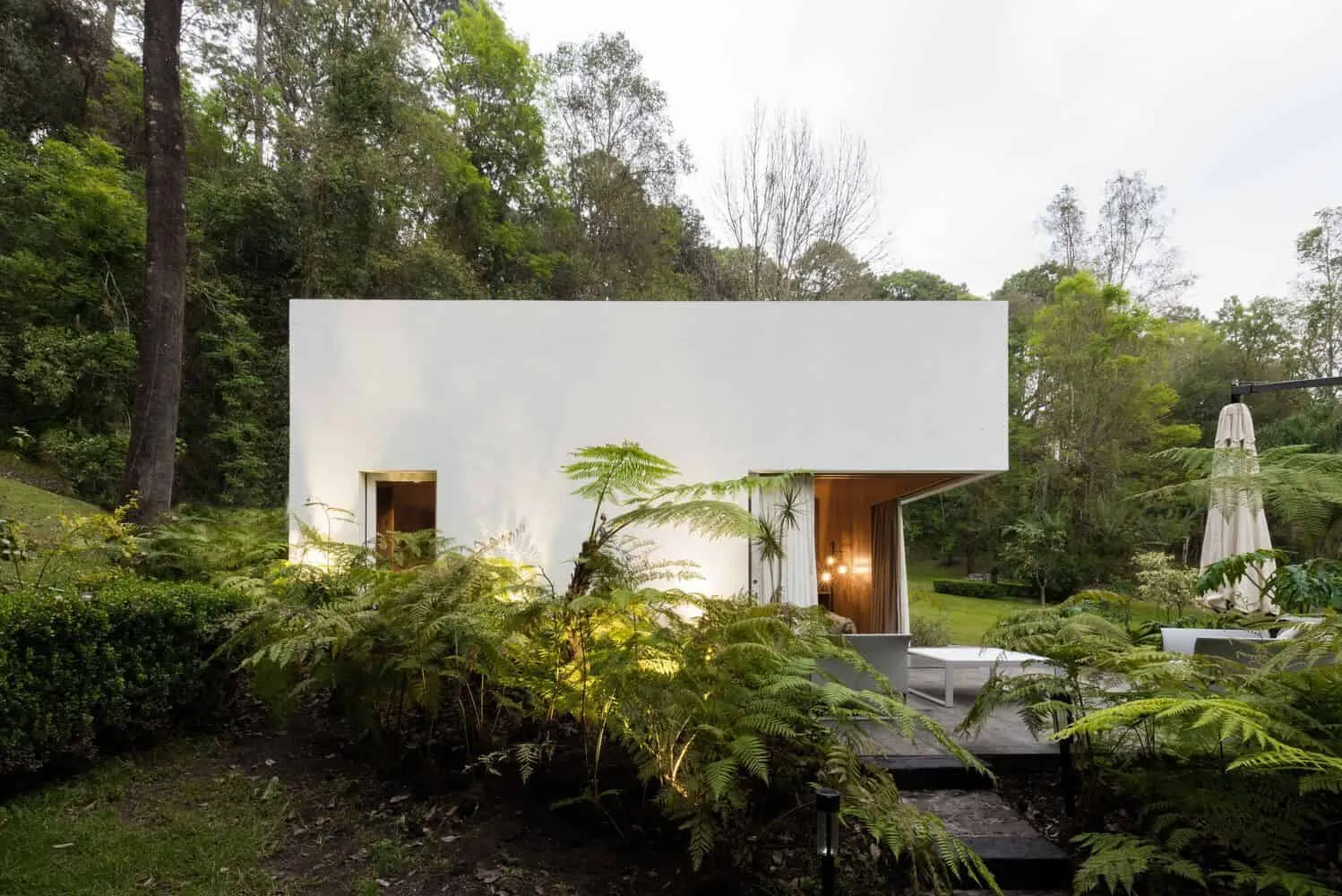
Therefore, the house was designed as a small village with clearly defined sections arranged along internal and external pathways from front to back. The central element of the plan is the courtyard, which receives northern sunlight, screens views of neighbors and serves as a connecting space between internal and external areas, the entrance and family studio. From the street, most of the house is not visible, while a generous setback to the north allows for a winding garden path and visual corridor to mature trees on the banks of Merri Creek. The house deliberately retreats into shadow from the garden, allowing the garden to be the main experience.
The site was once the location of the family's first home in Northcote, which faced north rather than toward the street. We took inspiration from archival photos of the house's northern facade and scaled down the house both toward the street and to the backyard. Located on the banks of Merri Creek on a long north-south site, we wanted to create internal and external pathways through the site to the garden and distant views of trees along the creek. We also considered it important to create a public visual corridor from the street to the creek.
The house should embody two nearly opposite qualities. It must be a sanctuary and a stage for the family living in it. This was the key question of the West Bend House: how to raise very independent lives within this home, while also providing a variety of ways and means for interaction among its inhabitants and friends. This was achieved through a broad range of social spaces, differing in scale and interconnected with each other or with more private areas of the house.
Through long-term engagement with the family, we designed another house for them, including a detailed and comprehensive pre-design phase and briefing process that allowed us to gain a thorough understanding of their needs. Challenges such as both parents working from home but wanting to share workspaces with children rather than being isolated, organized and improvised musical group rehearsals, the needs of a large teenager and two close-aged sisters, the need for an active village life with friends and neighbors who are encouraged to visit just for fun.
The house is not connected to gas and operates entirely on sustainably generated electricity. A 9kW photovoltaic panel is installed on the main bedroom roof, connected to a battery system for the family. The energy generated in the house is used for domestic needs and also to charge an electric vehicle. All hot water for heating and domestic use is provided by heat pumps. All appliances are high-performance, low-energy, and water-efficient. Very high-performance wooden windows and doors. Sliding doors with lifting and sealing systems. Passive ventilation windows — tilt-and-turn.
All rainwater from the roof is collected and used for various purposes: toilet rinsing, washing machine use, and landscape irrigation. All bricks are restored, in a less popular cream range rather than red. All external timber is sustainably grown and finished silver birch forest. Internal wood and veneer are FSC certified. Orientation, overhangs, and thermal mass are optimized for passive solar heating in winter. Thermal mass is additionally used to regulate temperature in summer.
– MRTN Architects