Log Cabin Chinking – Methods and Materials for Curing Wooden Logs
Chinking Materials
Various materials are used by craftsmen for chinking. Commonly used ones include:
- natural moss;
- ordinary hemp;
- pre-made rope;
- varieties of jute.
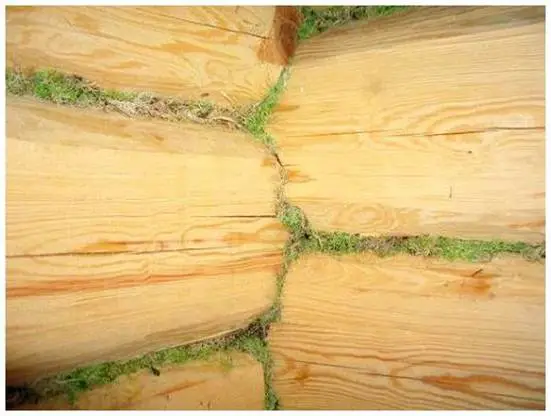
Photo 2 – Chinking with moss
The sealant is often fixed with a sealant.
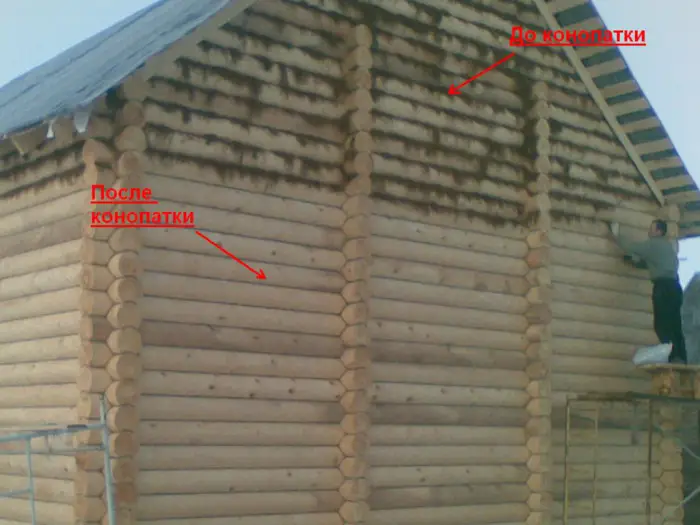
Photo 3 – Before and after chinking
Chinking is not complicated but labor-intensive. The result is a significant reduction in heat loss from the log wall (up to 6%). If climate conditions allow and the log is sufficiently thick, additional insulation after chinking is not required.
IMPORTANT! Chinking increases the wall height by 5–7 cm.
Chinking Procedure
Chinking is always performed in two stages: immediately after log wall construction and again after the settling process is complete.
The process is always carried out as follows:
Chinking Methods
There are two main chinking techniques: 'in bundle' and 'in stretch'.
In bundleBest for sealing wide gaps and large grooves. Hemp is packed in strands. The tool 'road trowel' is used.
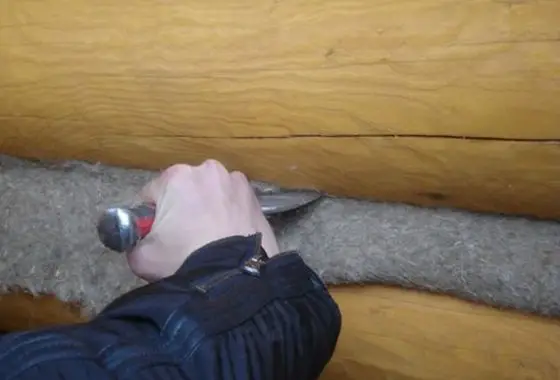
Photo 4 – Chinking 'in bundle'
In stretchAfter treating large grooves, proceed to insulate the main gaps formed between logs during laying.
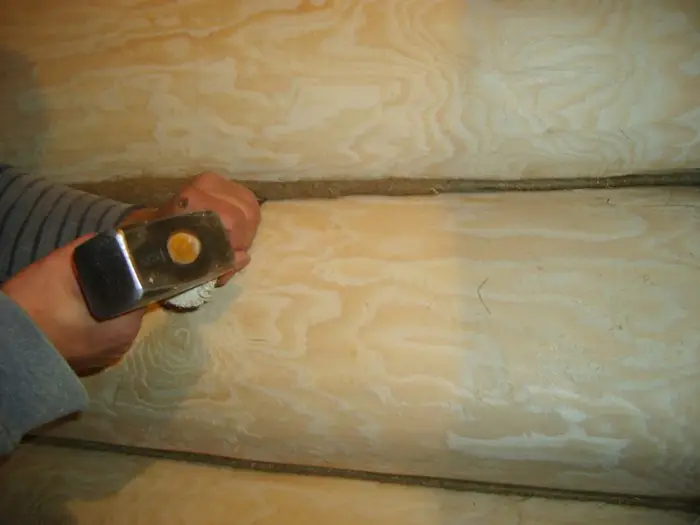
Photo 5 – Chinking 'in stretch'
The insulator is rolled into a cylinder and driven into the gap using a wide chinking trowel.
Which Insulation to Use
You can use natural or composite insulation. For example, if using moss, follow expert recommendations:
Pre-wet the moss with a solution made of 500g oil, 200g soap, and 10 liters of water.
If using hemp, treat the material with a wood preservative before installation. The same advice applies when insulating with jute.
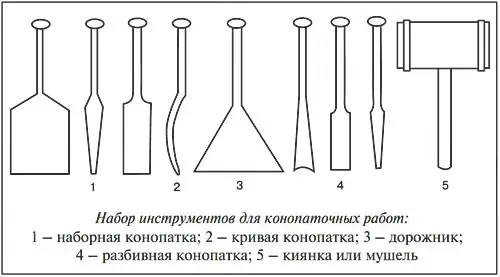
Photo 6 – Insulation for chinking
IMPORTANT! Initial chinking is done right after log wall assembly. After 12–24 months, during the settling phase, the process must be repeated to close newly formed gaps.
For easier fixing of insulation in large gaps, a hammer drill may be used.
Chinking a Log Wall Made from Cylindrical Timber
Chinking is done using a specialized tool. Trowels are made from metal or strong wood. The tool can be purchased in specialized stores or made by hand.
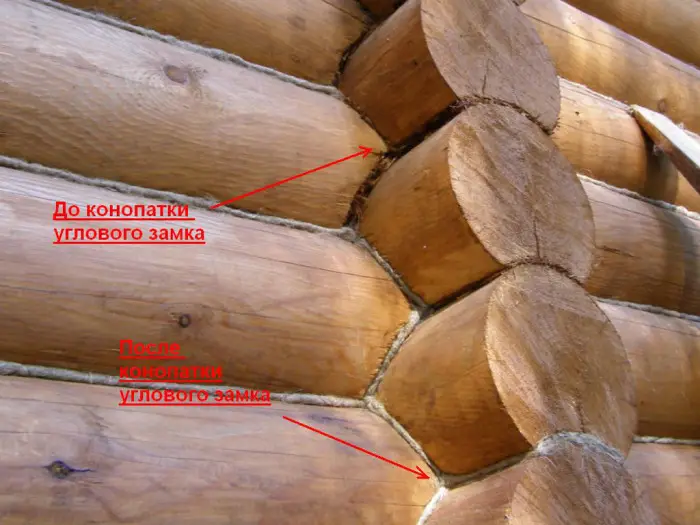
Photo 7 – Types of chinking tools
Bundle trowelThe 'bundle' chinking trowel is designed for groove treatment. It has a flat blade measuring 5x100 mm.
Curved trowelThe curved trowel is used to pack insulation into hard-to-reach areas: curved and corner sections. The flat blade of the curved trowel measures 5x60 mm.
Tool 'Road Trowel'The 'Road Trowel' is a groove chinking tool that compacts hemp fibers and forms them into rolls. There are three types, suitable for medium, narrow, and wide grooves. The flat blade of the 'Road Trowel' measures 15x170 mm. A deep groove runs along the blade. Depth of groove – up to 10 mm.
Splitting trowelThe 'Splitting' trowel is used to widen narrow grooves. It helps insert insulation into joint gaps. The blade is wedge-shaped and 30 mm wide.
Mushel (rammer)A wooden rammer used for tamping insulation. 2–4 metal rings are placed on the mushel to prevent splitting and to add weight.
Handle length: 30 cm. Trowel length: 20 cm, diameter: 10–15 cm.
IMPORTANT! The blades of tools used in chinking must not be too smooth. Otherwise, the insulation will not stay in the grooves. Too sharp blades will cut the material.
Chinking a Cylindrical Timber Log Wall – Video
High-quality chinking of log walls built from timber is demonstrated in a video.
Chinking a Log Wall – Video
$ Chinking a Log Wall – Price
The cost of chinking depends on wall complexity, gap size, whether it’s internal or external chinking, and the type of material used.
Price starts from $10 per 1 m².