There can be your advertisement
300x150
Single-slope Roof from Profiled Sheet
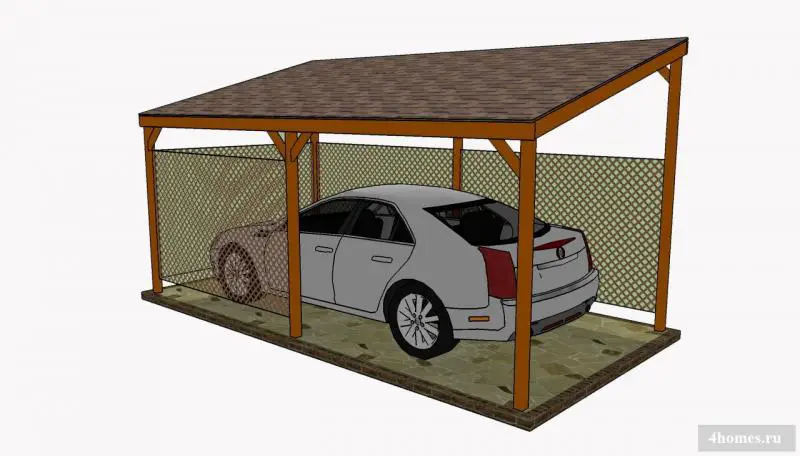
There are several types of buildings where the most valuable factors for roofing are reliability, simplicity, and cost-effectiveness in construction. For example, small storage facilities, compact standalone shops, and private garages. Typically, owners of such structures do not aim to create a masterpiece of roofing art and instead focus on minimizing costs while preserving the roof's primary function:
protection from precipitation and heat loss during cold weather.
Single-slope roofing using profiled sheeting rightfully holds a leading position in the budget segment. Several reasons contribute to its success: simple design, low specific weight of the finished roof, and ease of installation even by just two workers.

Profiled Sheet: Brief Overview of the Material
Profiled sheeting, also known as profiled metal sheet or simply profiled sheet (profiled metal plate), is a rolled product made from galvanized steel sheet. Modern manufacturing technologies allow for the production of profiled sheets with various cross-sections: steel thickness, wave height, and wave pitch can vary. For roofing applications, the most suitable grade for a single-slope structure is C35.
Profiled sheets are fastened to the decking using special fasteners – roofing (or farmer’s) screws, which are screws with a drill tip and hexagonal heads. Each screw is equipped with a washer with a rubber sealing gasket.
Important to remember: fastening must be done only into the lower wave of the sheet. Fastening through the upper wave is not allowed, as it may not provide sufficient screw length and risks deforming the profiled sheet.
The roof slope is achieved by a difference in wall heights. When using profiled sheeting as roofing, it's essential to note that the minimum allowable slope must exceed 8 degrees. A smaller angle poses a risk of sheet deformation under snow load.
Roof Skeleton Preparation
To ensure that the profiled sheet lies flat and secure, a proper base must be prepared. The base includes rafters and decking. Rafters are made from well-dried, pre-treated wood (with anti-fungal and fire-retardant agents) with a cross-section of 100 x 150 mm or 50 x 150 mm.
Decking is installed perpendicular to the rafters, separating the vapor barrier membrane, which will be installed on top to prevent moisture penetration from the future insulation layer. It's crucial to offset the membrane by the thickness of the decking board to prevent clogging of membrane pores by insulation fibers, thus avoiding moisture accumulation and frost formation on the inner side of the membrane.
A properly installed membrane with correct overlap sequence will protect the roof from leaks for a long time and prevent wood components from rotting or developing mold due to possible moisture exposure. The overlap width between membrane sheets must be at least 15 cm, and 20 cm when the roof slope increases.
The profiled sheet itself is fastened with an overlap of one or even two waves between adjacent sheets. An advantage of this roofing material is that work is not weather-dependent and can be carried out in both summer and autumn-winter periods. The material cuts easily, produces minimal waste, and has a low defect rate.