Technology of Carpet Laying
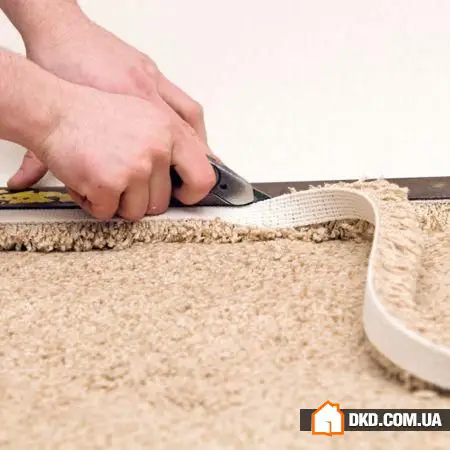
But how pleasant and convenient the material is to use, equally demanding is its installation. Carpet should always be purchased in a quantity exceeding the nominal area of the room. This situation is due to the high waste factor of the material during cutting.
When choosing a piece of carpet, always rely on the two maximum linear dimensions of the room. The resulting maximum dimensions should ideally be increased by 15-20 cm to account for any unforeseen issues, so that you don’t have to join two pieces at a visible location later.
Conditions and Methods of Carpet Installation
The most important condition to meet during carpet installation is... surprisingly... the room's temperature. It should be between 15...25 °C. This means that you should not install carpet in a newly built, unheated room, or in conditions of excessive heat. The room's temperature directly affects the carpet’s ability to slightly stretch, and this property is the basis of one of the installation methods.
Main Carpet Installation Methods
- Installation without fixation (free, adhesive-free laying).
- Installation using double-sided tape.
- Direct gluing.
- Installation on a subfloor with double gluing.
- Stretching (installation with tension on a special subfloor).
Below, we will examine the two most popular methods of carpet laying. Direct gluing is used for large floor areas, while stretching is popular in apartments where high requirements exist for a flat surface free of wrinkles and folds.
Gluing Carpet
The floor for gluing carpet must be properly leveled beforehand. If the goal is to additionally insulate the floor and block noise sources, a special subfloor made of extruded polystyrene or foamed polyethylene can be installed under the carpet. The thickness of such a subfloor is usually 5–10 mm, and the durability and service life of the entire floor covering increase with higher subfloor density.
During traditional gluing, only the joints and edges (perimeter) of the carpet pieces are glued. However, if the carpet is being installed on a staircase or in a commercial space with high foot traffic, it may be worth gluing the entire surface area.
For adhesive, ordinary, inexpensive construction PVA glue is ideal. When applying the glue, be extremely careful and attentive, especially if the carpet base is made from natural materials such as jute. An excess of glue may easily penetrate through the carpet and appear as a hardened spot of glued fibers on the face side.
Stretching
Stretching is one of the most commonly used methods for carpet installation. Its principle is based on the elastic and resilient properties inherent in all carpet coverings. The carpet is installed on a special wooden strip run along the room’s perimeter. Two rows of nails (at a slight angle) are driven into the strip, to which the carpet is secured and then tensioned using specialized tools on the opposite side of the room.
A subfloor is also installed under the carpet in this method, which adds softness to the floor and reduces impact noise from footsteps. Carpet installed using stretching lasts longer than any other installation method.