Moving here was considered a great fortune.
Cheremushki quickly became a symbol of new housing. The neighborhood was such a notable phenomenon that an operetta titled “Moscow, Cheremushki” appeared in 1958. The name of the neighborhood itself gradually came to be associated with mass moving-in and new urban life.
It’s hard to imagine today the excitement surrounding an ordinary five-story building. But back then, moving here meant that a family had their own apartment. And that was what mattered most.
The small kitchen was their own kitchen
It’s easy to judge such an apartment by its square footage these days: the kitchen is small, the bathroom is small, the hallway is narrow, and the ceilings are low. But for someone who had previously lived in a shared apartment or house without the usual conveniences, something else was more important:the kitchen now belonged to one family, the bathroom was their own, and they could close the door behind them.
The video features the memories of journalist Tatyana Maksimova. She moved into a Khrushchevka as a baby, and the act of joining the family was remembered as joyful—she could forget about using the toilet in the yard and use the bathroom at home.
Another example cited in the episode is a family of six who, before moving, lived in 17 square meters in a shared apartment. Getting their own two-bedroom apartment was seen as true happiness.
Having a private bathroom changed daily life
Memories of the most ordinary conveniences particularly highlight this difference. In Valery Zolotukhin’s diary entries, the ability to bathe at home becomes a significant event. He describes having a separate bathroom and toilet, hot and cold water, and the pleasure of no longer having to go to a public bathhouse. From a modern perspective, this is basic infrastructure, but for people at that time, it represented a noticeable change in daily life.
Such memories make it clearer why a small bathroom or kitchen size was not seen as the main drawback of an apartment back then.
Why Apartments Became So Compact
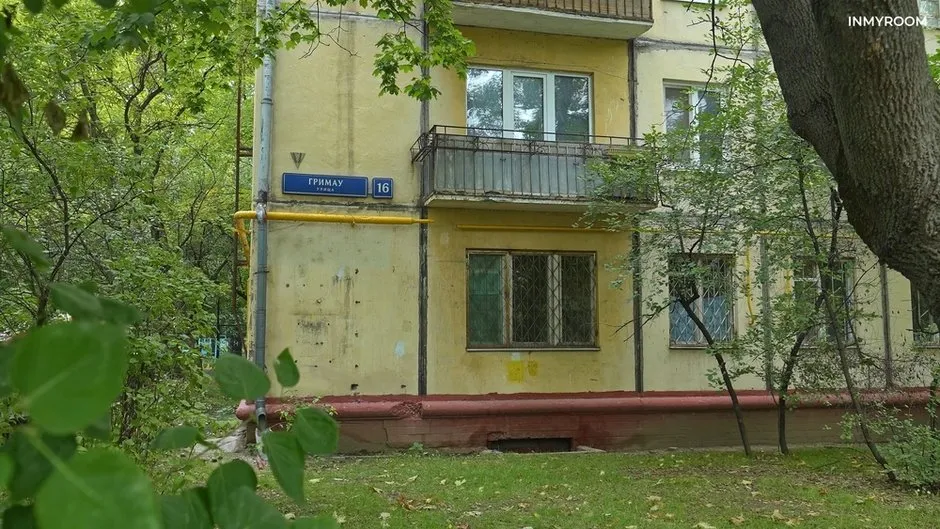
Mass construction addressed a very specific goal: providing separate housing for a huge number of families. In 1955, a decree was issued to eliminate excesses in design and construction. Architecture was meant to become simpler, while construction faster and cheaper. Homes no longer needed to be built on site but rather assembled from pre-made components. Every square meter was to be utilized. This led to small kitchens, compact passages, tiny bathrooms, built-in cabinets, and various niches.
Even the refrigerator, familiar to many, was part of this logic: there was little free space, so literally everything had to function.
The five-story design also wasn’t accidental
The height of buildings was related to the same cost-saving considerations. Four- and five-story structures allowed buildings to function without elevators. Elevators entailed additional expenses, which were avoided in mass construction.
Thus, the familiar appearance of Khrushchev-era neighborhoods—five-story buildings without elevators—was not an arbitrary architectural choice but part of the overall goal of making housing more affordable and faster to build.
Requirements Have Completely Changed in 70 Years
It is here that history completes a full circle. What was once considered modern housing has gradually come to be seen as outdated infrastructure.
Washing machines, air conditioners, and dishwashers have appeared, and our expectations regarding the size of kitchens, bathrooms, and storage space have changed. Climbing to the fifth floor every day without an elevator no longer seems normal either.
The Khrushchev apartment has not become smaller than it was in 1958. What has changed is what we expect from an apartment.
Therefore, it’s easier to understand the history of such a house if one stops comparing it to modern housing, even for a short time.
Seventy years ago, people came to Cheryomushki to see what the future would look like. For the first residents, this future began with very simple things: their own kitchen, their own bathroom, and their own door.