Five battery-related issues people regret when turning on the heating
Problems start in the fall when heating is turned on. The room suddenly becomes cooler than expected, windows start fogging up more often, and a chill can be felt near the window. In such situations, it’s easy to assume that the radiator isn’t working properly or that the heating system is at fault. But sometimes the radiator is fine — it’s just that too many obstacles have accumulated around it over the summer.
The radiator has an important characteristic: it transfers heat through both radiation and air movement. The heated air rises, creating circulation near the window, while some of the heat is transferred directly to surrounding surfaces. If this path is blocked by curtains, furniture, or a too-closed box, the efficiency of heating may decrease.
Floor-length curtains right in front of the radiator
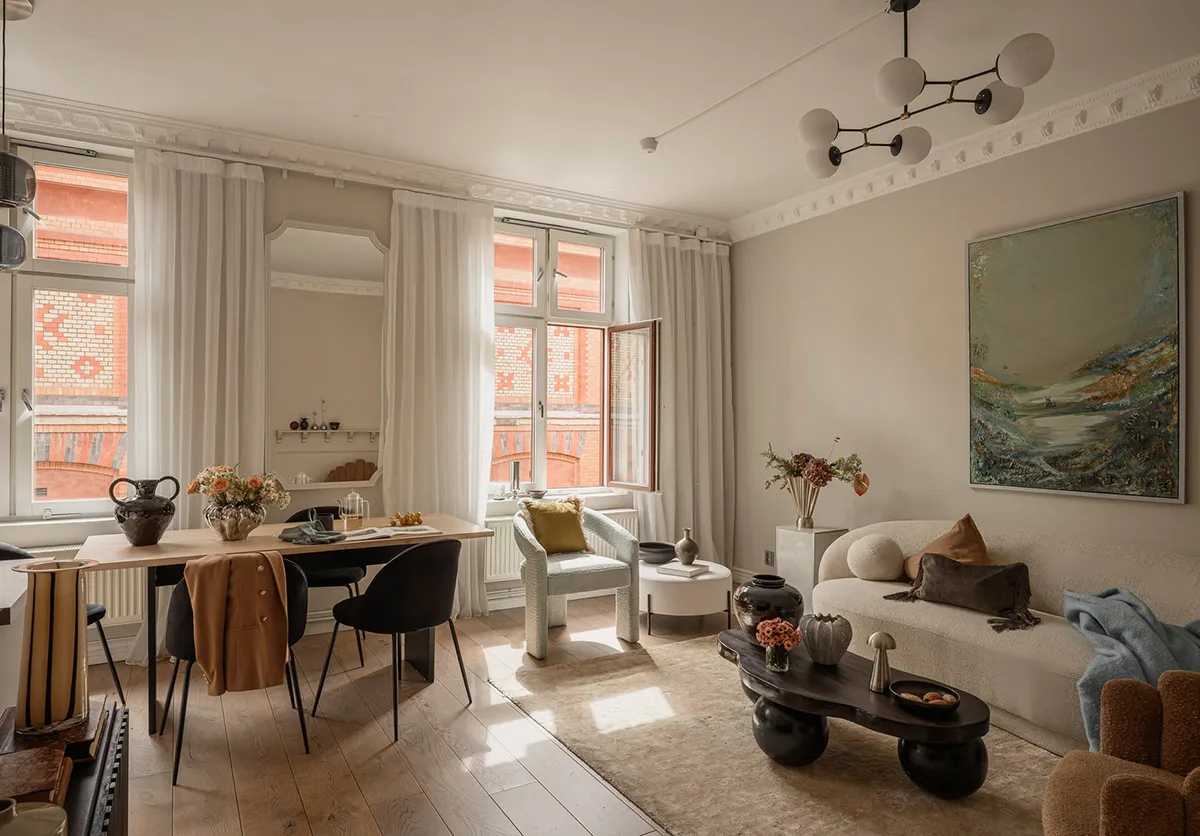
Thick floor-length curtains can indeed make a window appear more expensive visually and hide radiators that don’t fit well with the interior design. In summer, this looks perfect: the fabric lies neatly down to the floor, and the radiator seems to disappear.
In winter, the same setup starts to work against heating. The warm air from the radiator hits the thick fabric, disrupting proper circulation between the radiator, the window, and the room. Part of the heat remains in the space behind the curtains, resulting in less even temperature distribution throughout the room.
The problem is especially evident in the fabric itself: the area near the radiator may heat up significantly, while the deeper parts of the room lack warmth. Under certain conditions, condensation may also appear on the cooler glass surface.
If you want to keep long curtains, it’s better not to cover the radiator with them: you can pull the fabric to the sides and leave space above the radiator, or use a lightweight sheer curtain that interferes less with air circulation.
Solid Decorative Box
Hiding the radiator behind a decorative panel seems like a simple way to unify the interior design. But it all depends on the screen’s construction. An open grille with large holes will interfere with air flow much less than a dense panel with fine perforations or a practically airtight enclosure.
A particularly poor design is one where warm air has to escape through a small gap at the top. The radiator continues to heat up, but a significant amount of heat remains trapped inside the enclosed space.
There’s also a practical issue: dust and lint gradually accumulate inside such an enclosure. When the radiator heats up, they can cause unpleasant odors, and thorough cleaning through narrow openings proves inconvenient.
If the sink severely affects the appearance, it’s sometimes simpler to paint it to match the wall color. If a screen is still needed, consider adequate air circulation from below, a sufficiently large open area above, and a removable front panel that can be taken off and cleaned regularly.
Very Wide Counter Above the Sink
Expanding the windowsill into a full-sized work surface is an attractive solution for small apartments. This creates extra space for a laptop, books, or plants, and makes better use of the area near the window.
A wide countertop can significantly hinder warm air from rising from the radiator. If its depth covers most of the radiator, the airflow hits the lower surface of the countertop and changes direction. As a result, the window may remain colder, and condensation can form on the glass under unfavorable conditions.
This doesn’t mean you have to give up on the idea of a workspace by the window. It’s just important to include a ventilation gap or grille above the radiator during design. However, don’t expect a single grille to automatically solve all fogging problems—much depends on the window surface temperature, room humidity, and overall ventilation.
Furniture Close to the Radiator
Another common scenario is when a sofa is placed with its back against the radiator, a bed is moved so that its headboard faces the window, or a cabinet is placed in a niche next to the heating element. During warmer seasons, this seems completely normal.
Once heating is turned on, it becomes clear that a significant amount of heat goes to the furniture. The back of the sofa heats up, the space between the radiator and the cabinet becomes hot, and air circulation in the room worsens. Additionally, constant heating can gradually dry out certain materials and affect their appearance.
One should not rely on a single universal figure, but rather on the actual design of the radiator and the manufacturer’s recommendations. However, it is definitely not advisable to press furniture tightly against the radiator: there must be enough space between them for air to flow freely. It is especially undesirable to completely block the radiator with solid furniture.
Knobs Hidden Behind Finishes
People usually think of this when the heating has already been turned on. During repairs, the valve on the pipe or the Mayevsky faucet might be hidden behind a decorative box, panel, or other finishing. As long as the radiator is cold, it seems like a trivial detail.
Then the first cold spells arrive. The radiator may heat unevenly, prompting the need to check or release air from it. Or, conversely, the room becomes too hot and one wants to lower the temperature. That’s when it’s discovered that it’s impossible to reach the necessary faucet properly.
Therefore, any decorative fixtures near the radiator should be made removable or with easy access to the shut-off valves and air vent. A small, neat door is far better than having to disassemble a nice-looking enclosure during the heating season.
What to Check Before Turning On the Heating
This inspection doesn’t require repairs or even the purchase of new materials. All that’s needed is to walk through the apartment and examine each radiator from the perspective of air flow and access to controls.
Check:
- whether a tight curtain is blocking the radiator;
- Does the screen interfere with proper air circulation?
- Does the countertop cover the upper part of the radiator?
- Is there enough space between the radiator and furniture?
- Is it possible to easily access the vents and the Maevsky valve?
The most interesting thing is that during summer, most of these drawbacks are completely unnoticed. But once heating is turned on, those 20 centimeters of free space, an open grille, or the ability to quickly reach the valve prove to be much more important than they seemed during renovation.
The radiator doesn’t have to be the main decoration of the room. It can be visually hidden, but it shouldn’t be blocked from air flow. If the radiator is allowed to release heat properly and all necessary valves have easy access, interior design and comfort can coexist just fine.