Tian Ceremony Hall Designed by SYN Architects
Project: Native Moon – Tian Ceremony Hall
Architects: SYN Architects
Location: Tian City, Shandong Province, China
Area: 20,085 sq ft (site), 15,812 sq ft (building), 9,213 sq ft (interior space)
Photography: Zheng Yan
Tian Ceremony Hall by SYN Architects
The colorful banners welcoming passengers at the high-speed railway station in Tian, China mark the arrival of the Native Moon. The inscriptions above the Nine Goddess Peaks (Jiunü Ridge) showcase the Native Moon or Native Cloud, inviting people to walk under the moon or stroll among clouds. The mysterious writing is part of a creative campaign encouraging travelers to visit attractions beyond the main tourist area of Mount Tai. The strategy aims to revitalize the Nine Goddess Peaks, a branch of the famous mountain that gave its name to Tian City.
In early 2019, Shandong Lushang Group commissioned SYN Architects to develop the overall planning and design of the mountainous terrain, villages, and the Native Moon – a representative structure within the project. Soon after, the state of Native Cloud began to spread. The theme of Fei Xian (Native Cloud) was repeated in the building. The romantic song from the 1980s touched hearts, creating a nostalgic atmosphere. The Nine Goddess Peaks attracted attention on social media, bringing new people, a new face, a new industry and new opportunities to the Dunzimen village area. The region of humble villages became an internet phenomenon, attracting thousands of tourists. During the project, Lushang Group effectively used the "cloud" image to demonstrate the immense value of architecture as a means of communication.
However, a few scattered buildings are insufficient to stimulate regional development. Thus, the online popularity of Native Cloud declined in less than a year. Today, Lushang Group requires a long-term comprehensive approach that can connect the chain of mountain villages in an area covering 55 square kilometers. Furthermore, there is a need for certainty in industrial and spatial structures, as well as the introduction of new innovations satisfying visitors seeking fresh experiences. In this context, SYN Architects integrates daily life, industrial development and ecological sciences into each project. Using years of practical experience in rural areas, the firm develops client markets in Jinan, the provincial capital of Shandong. In addition, attractions such as Baloou Theater and Native Moon, along with their supporting facilities, were introduced in turn. Thus, SYN Architects returns to the homeland of Confucianism, restoring connections between duality such as city and village, modern society and native land, seeking forgotten values and neglected opportunities.
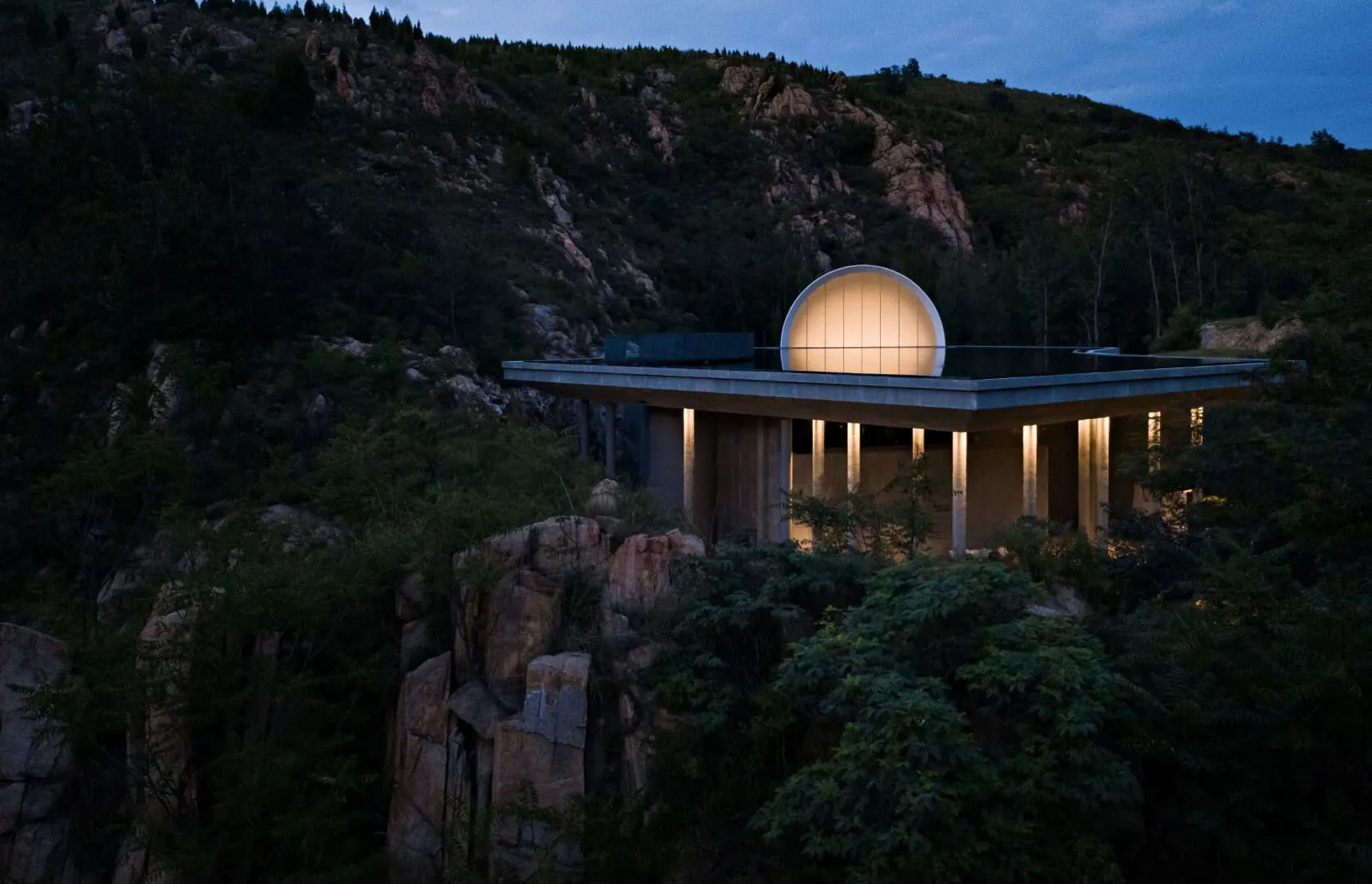
The original concept of Native Moon emerged from the developer. During the Mid-Autumn Festival 2019, a ten-meter diameter moon-shaped balloon was illuminated over Nanyehu Bay, distributing magical colors and light around. Inspired by this scene, Lushang Group hopes to illuminate a full moon on the Nine Goddess Peaks and write a new chapter in intellectual property for designed native places.
Mr. Zhu Yinsi, the lead architect and planner of the project, aims to infuse deep meaning into the artificial moon. He dreams of a moon that never sets. With this rhetoric, the building functions as a ceremony hall designed to go beyond conventions. Among its key features, the construction attracts local residents and tourists from other provinces, can host ceremonies and events, as well as provide spiritual and operational value that enhances village resources.
The ancient poem of the Song Dynasty contemplates nature's perspective and emotions: "Clouds and moon remain the same, but mountains and rivers change with time." Modern catalysts can also evoke nostalgia regardless of location. Thus, the lunar architectural poem is not necessarily bound to classic symbolism. Following this philosophy, SYN Architects combines abstract geometric forms and simple materials to create a clean space with complex visual effects that stimulate the soul, leaving behind traditional figurative expressions.
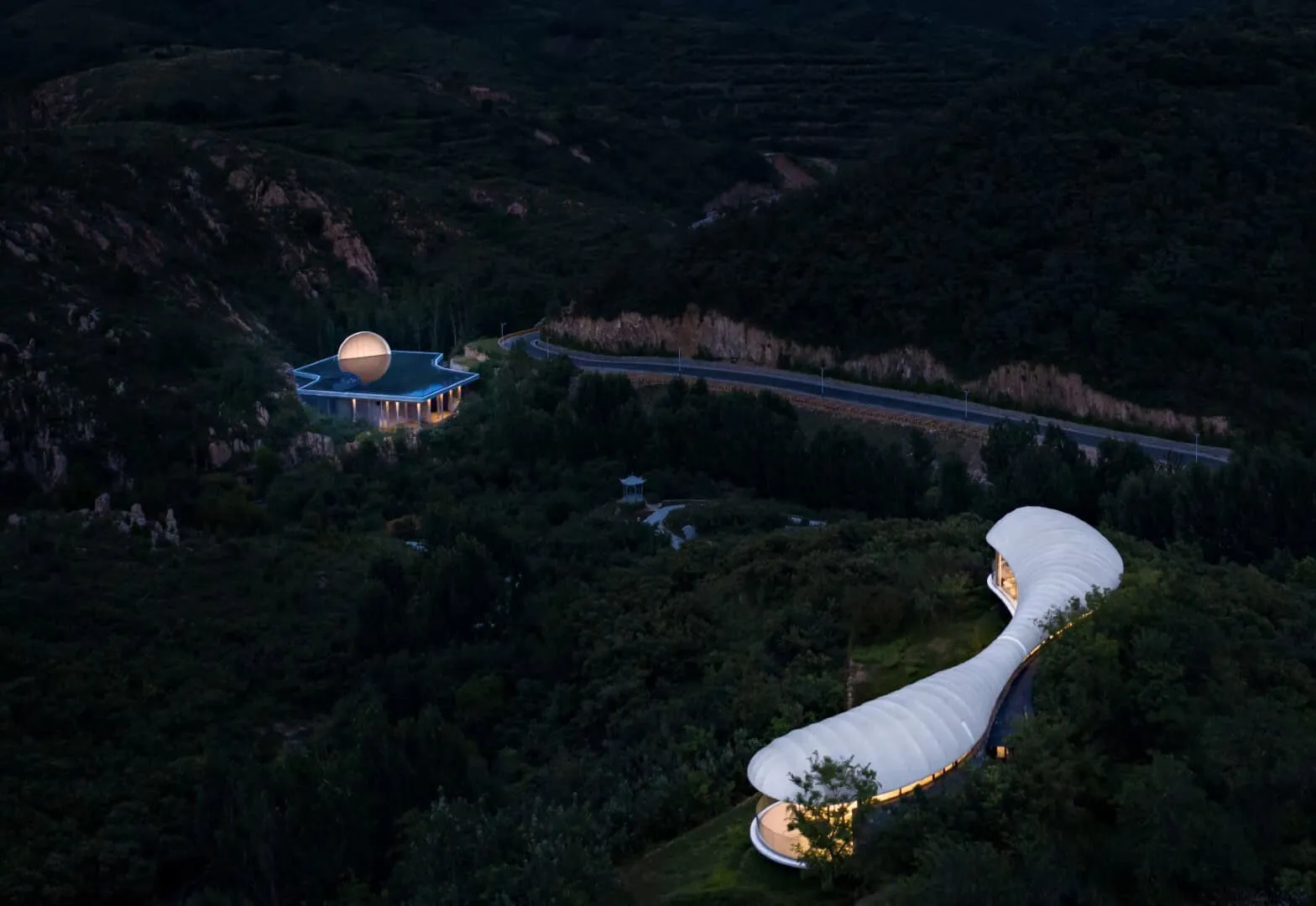
The location of the moon matters. It should complement Native Cloud in terms of tourist flow and engage in meaningful dialogue with the natural landscape of the Nine Goddess Peaks. Following these two principles, lead architect Zhu Yinsi explored the mountainous terrain, considering its geographical features and architectural possibilities. After careful consideration, the final location was chosen as a scenic terrace with views of Native Cloud from the mountain stream near the entrance.
Thus, Native Cloud becomes a viewpoint for Native Moon and a starting point to catch it. Looking from the mountain peak, Native Moon and the moon in the sky establish a dialogue between artificial and natural symbols, fitting into the environment while maintaining aesthetic integrity of the valley. Descending to Native Moon, the structure playfully disappears from time to time among trees and branches. It gradually grows larger until the artificial wonder fills the full view. Local residents and visitors thus receive a romantic image of their homeland. After reaching Native Moon, visitors can look back at Native Cloud. Then a desire arises to pursue Native Cloud again. For this reason, the buildings complement each other as symbolic counterpoints.
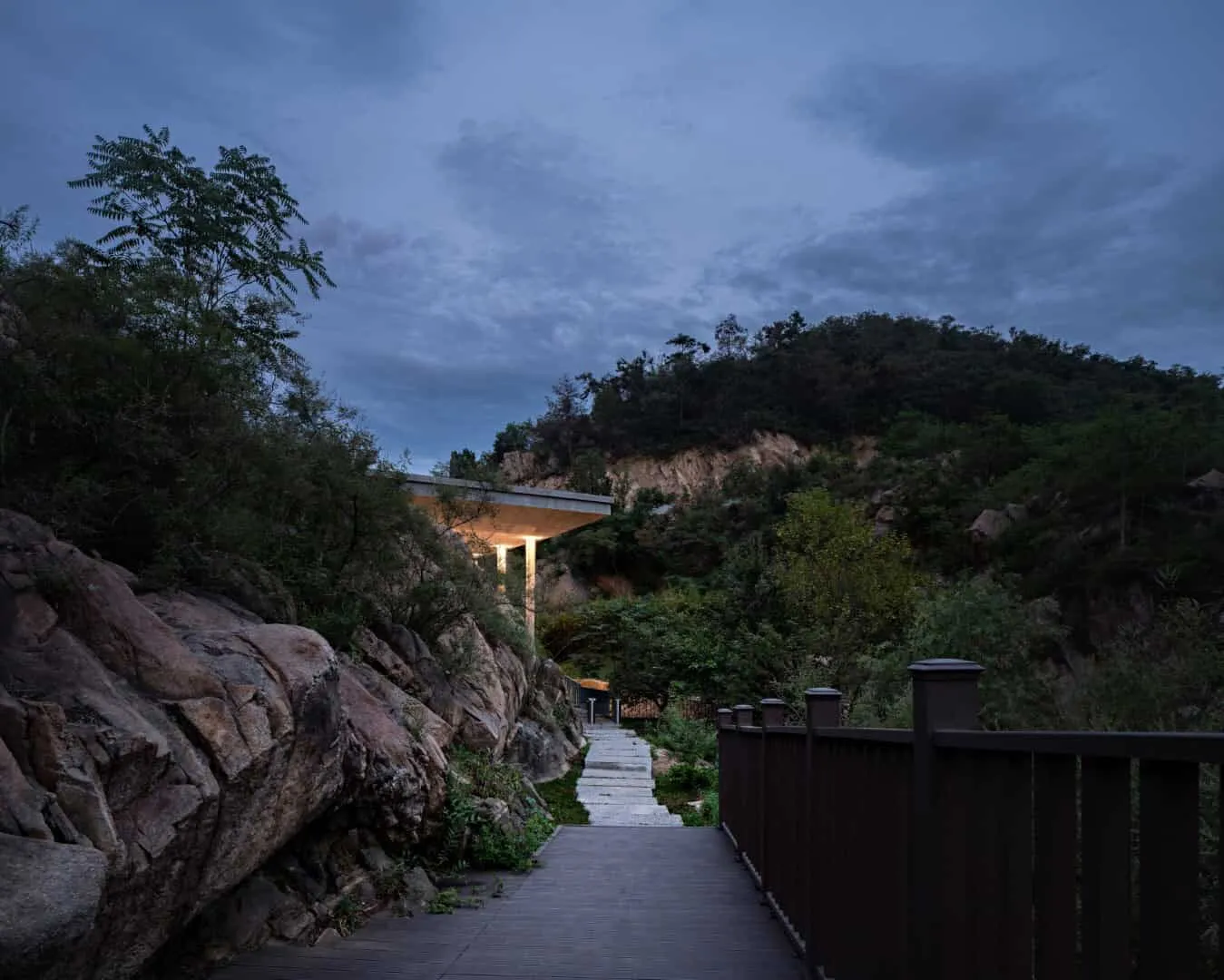
Parking is the last reminder of modern civilization. To reach Native Moon, visitors must walk through a purifying path. This takes about five to ten minutes of walking between mountains and streams. The entrance is behind a boulder. From here, visitors begin to enjoy nature's company. Bird songs, insect buzzes, rustling leaves, babbling brooks and beating hearts from joy and anticipation; natural sounds make visitors calm. After passing the mountain, river and exploring several winding trails, visitors finally arrive at the building. Here they contemplate the mysterious nature of architecture. Emotionally speaking, their touch and smell are stimulated by natural surroundings.
Long and winding trails enhance visitors' curiosity. Attracting the structure in nature's heart, they suddenly find themselves inside the construction, contemplating the charm of an inverted moon. Like Buddhist meditation, the experience develops understanding through feeling the background of mountains and forests to complete psychological reconstruction, calming urban souls. Wooden paths have children's play areas, camping zones, fire pit areas and anti-fog devices. These and other such spaces enrich the experience and scale of the project.
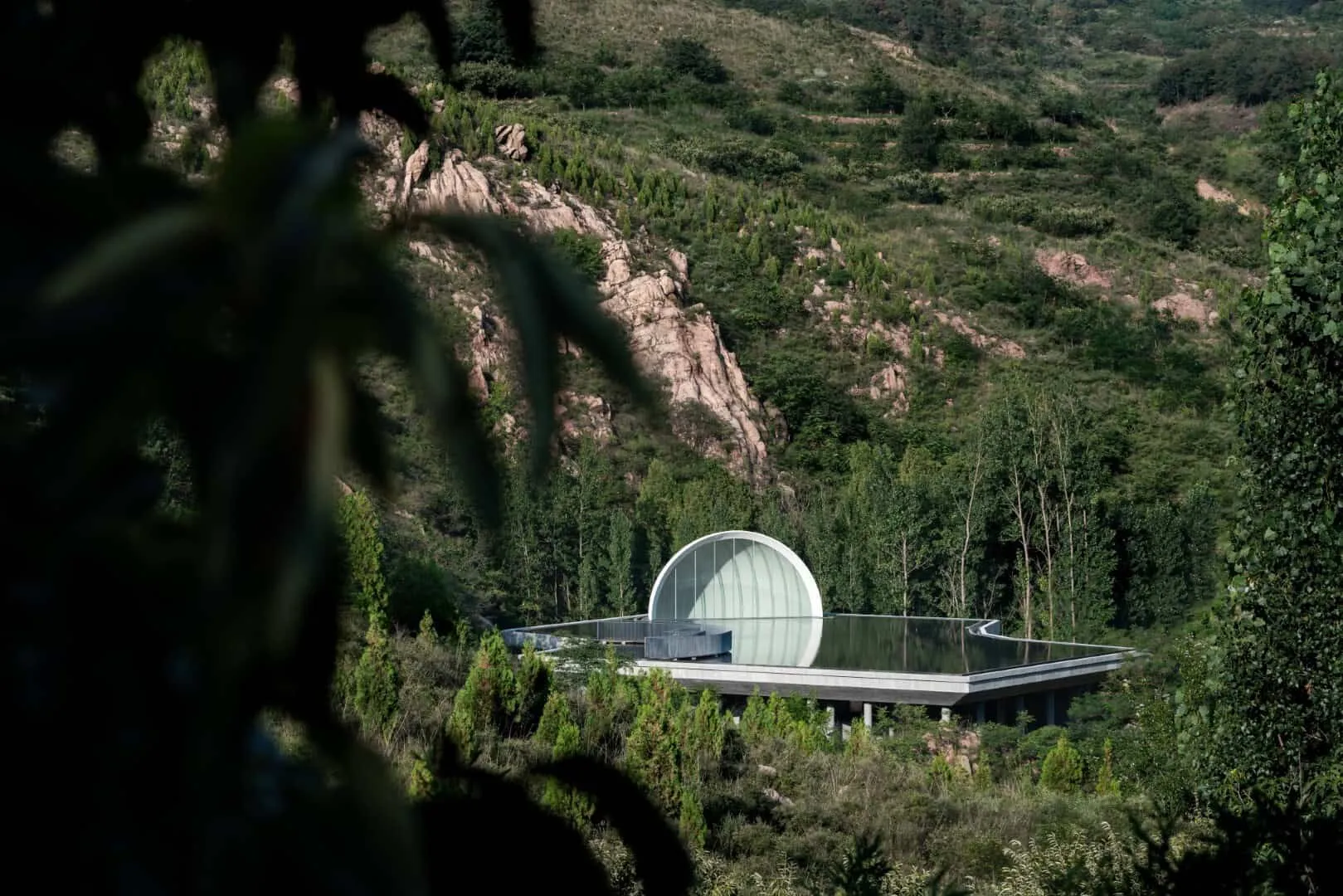
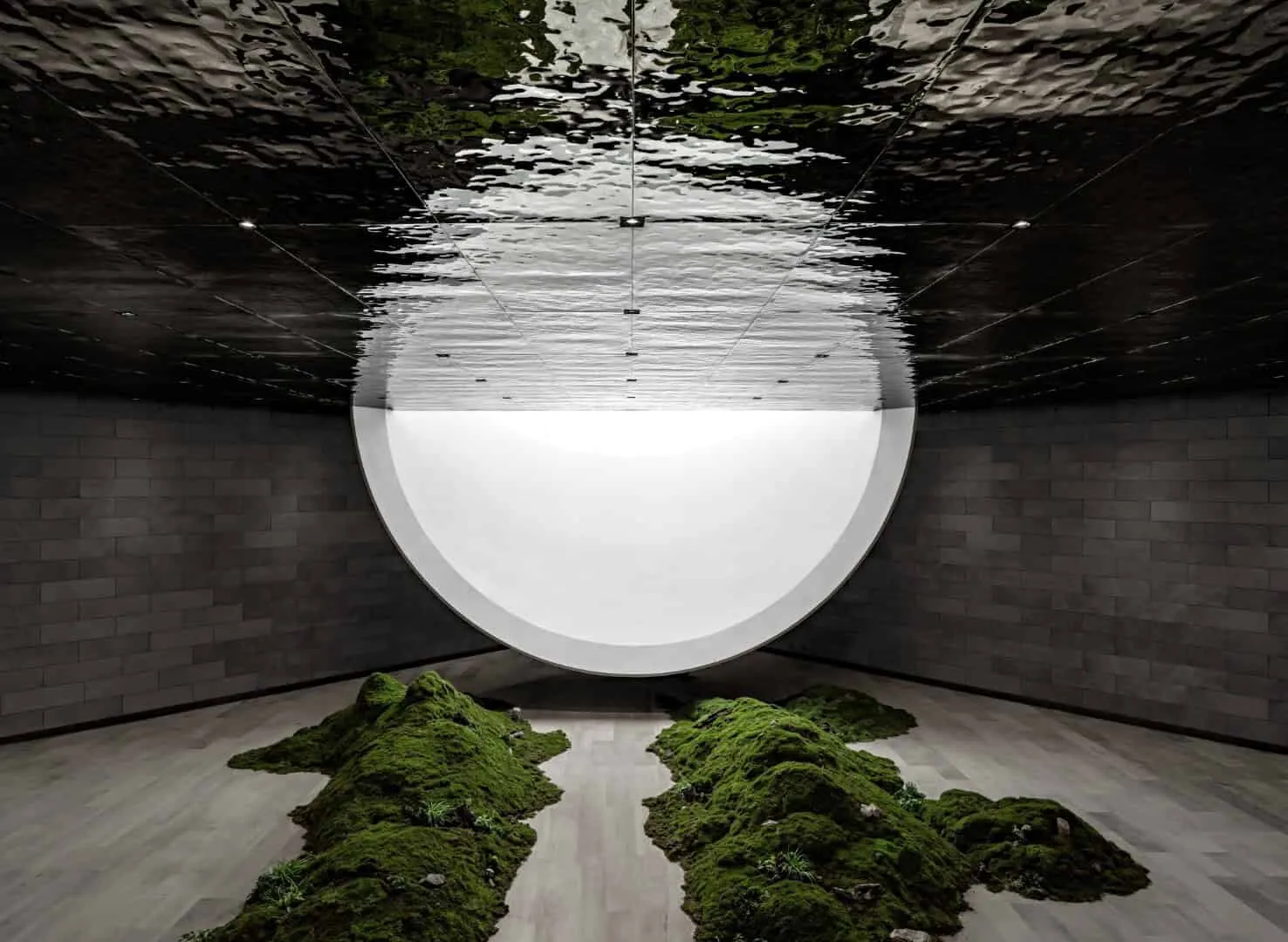
Groups of bridges above the structure allow visitors to contemplate the moon by reflecting pond without entering the building. A wooden path between groups of bridges and the mountain provides access to this goal. If a ceremony is held in the room, the roof door can be closed to avoid disturbance. If no activities are taking place in the room, visitors touched by the moon on the ceiling can enter the building and contemplate the lower half of the moon.
 Interventions
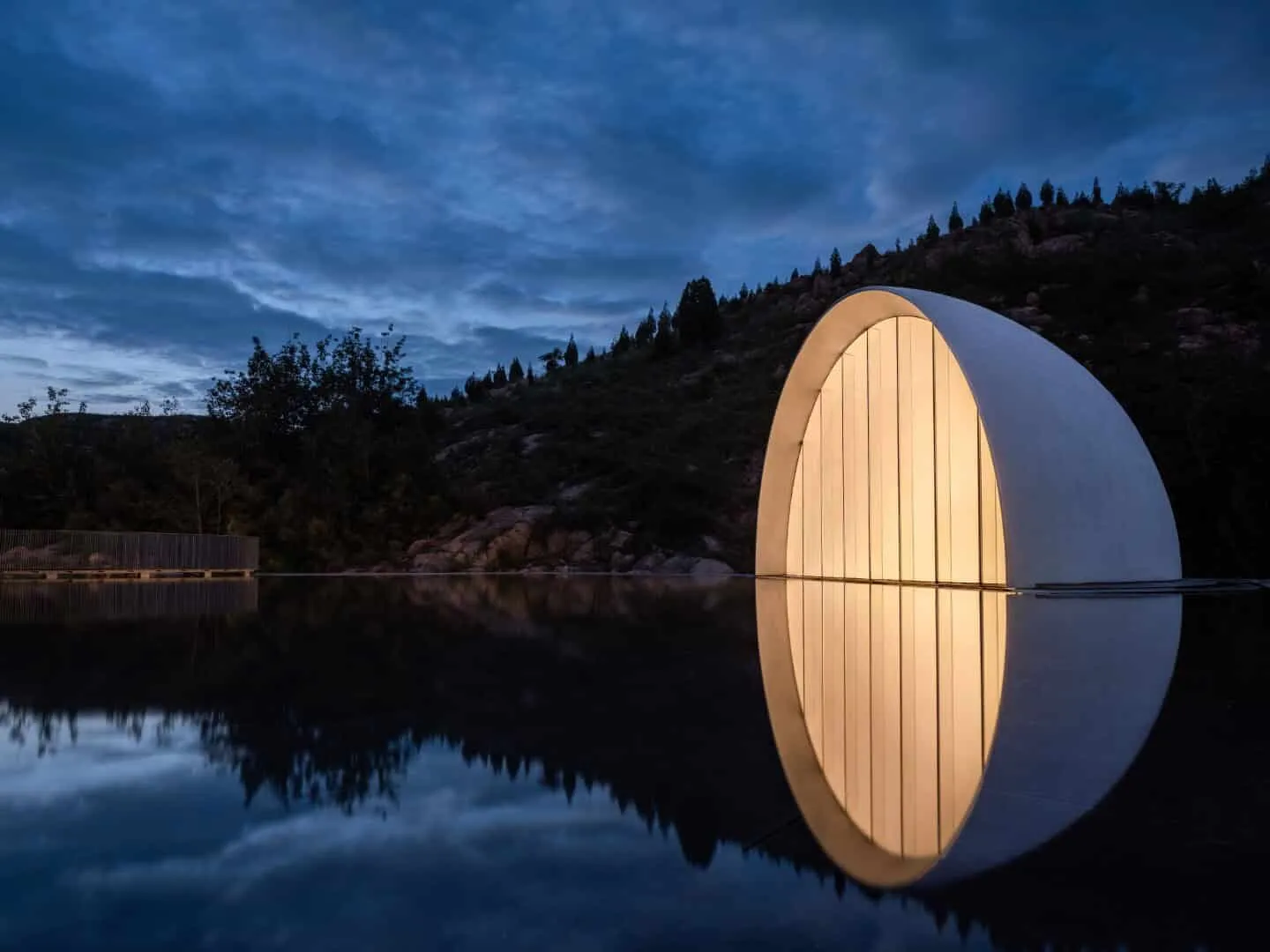
When the environment becomes gray, visitors officially enter the moon’s territory. The building occupies more than 1000 square meters, including the moon, cavity and gray space. Inspired by the mountain stream at the base of the building, the designer uses architecture as a means to recreate a romantic idea about the moon born at sea.
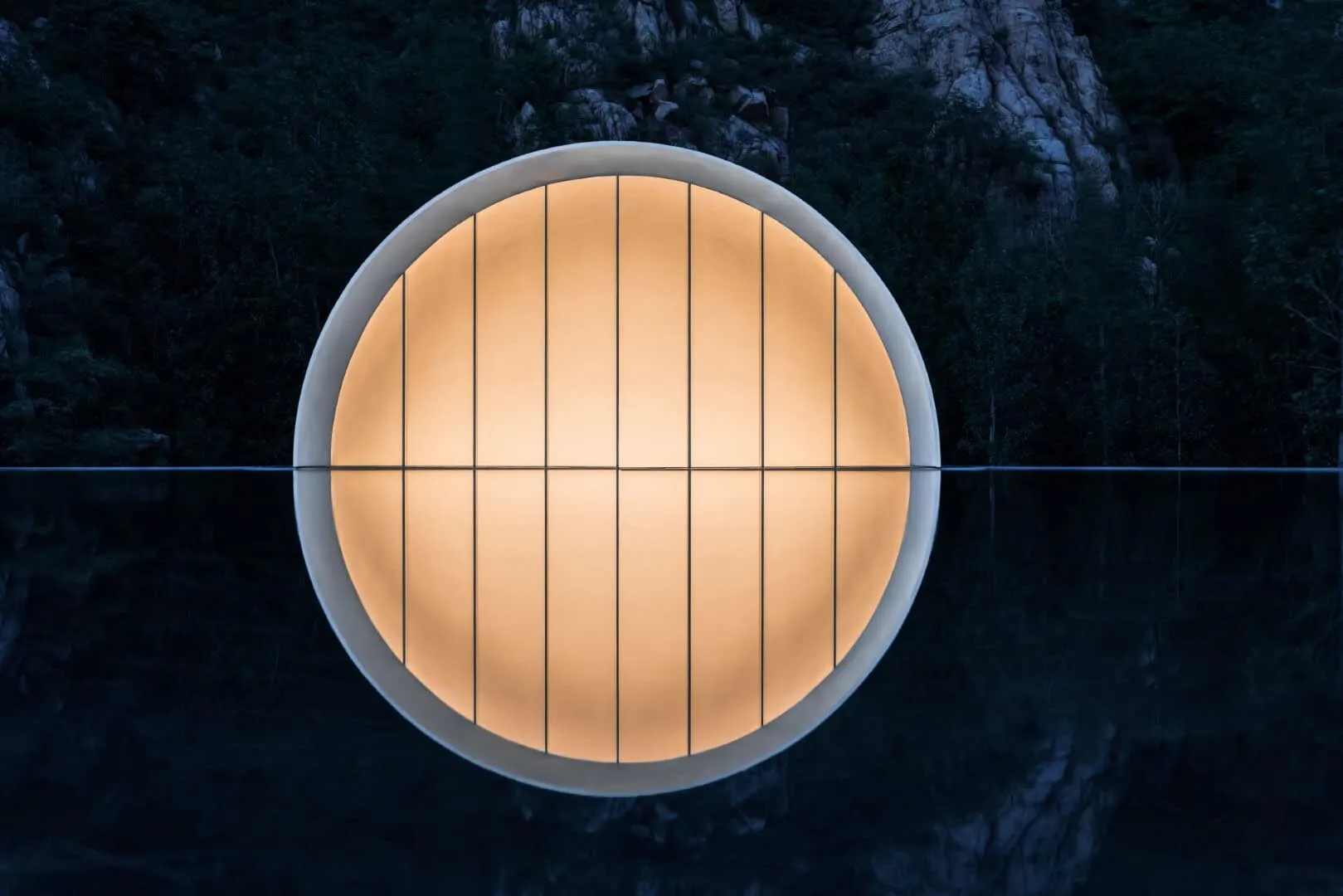
The placement of Native Moon was determined by several factors: height must remain moderate, and the building should not block mountains behind it. It also should not be obstructed by a hill in front. In terms of proportions, the diameter of the moon and water surface area should correspond to each other so that the architectural element and its reflection on water form a complete moon together. Additionally, the cavity in the building must contain half of a 12-meter diameter moon. The space should also allow necessary height for hosting ceremonies.
The depth of the pond requires consideration of water evaporation rate. In this context, a 0.5-meter deep water reservoir and central interlainer work together to reduce the frequency of watering. The ceremonial space must remain column-free, and form and shape of the full moon should limit beam thickness. Ribbed and flat slab concrete floor meets structural requirements at a reasonable cost.
SYN Architects uses locally available materials, applying a limited intervention approach. The strategy involves expanding the valley base before construction. This method also preserves the original drainage system to prevent natural disasters. Foundations are excavated according to calculated moon diameter and desired space. Moreover, rocky and mossy mountain walls remain untouched as natural boundaries of the project. Thus, the walls demonstrate the struggle between man and nature, additionally participating in the aesthetic concept.
The natural landscape is the starting point of Native Moon. Indeed, nature is a catalyst that nourishes architects' imagination. They provide reasonable solutions, achieving goals and satisfying spatial and functional requirements while maximizing integration with nature.
Reflecting on ancient Chinese wedding ceremonies, Zhu Yinsi innovatively develops the concept of wedding banquets in Jinan and Tian. The architect hopes to place Native Moon as a beautiful venue with strong ceremonial sense, meeting local and national needs for high-class weddings. Emotion is one of the main functions required in a ceremony hall. Participants must feel comfortable and well-placed during the ceremony. A formal atmosphere is needed to provide space for rest during reception. Activities such as makeup preparation and other amenities, along with practical needs like kitchen utensils, toilets, etc., must also be addressed. Nevertheless, Native Moon should remain an emotional place where happiness occurs.
The moon and love are closely interwoven in symbols. Ancient Chinese poems sing of love in terms of blooming flowers under a snowy moon. Japanese writer Natsume Sōseki even translated "I love you" as "such a beautiful moon tonight." Love is the unique moon living in the depths of our eyes, making everything else pale by comparison.
SYN Architects interprets the unique nature of love, following materials closely tied to mountainous environments. Graceful stone slabs, stone objects, smooth gray concrete cover walls and floors of the structure almost like part of the mountain. The use of transparent glass on the roof provides free access to sunlight to illuminate the room.
The curved moon wall forms a natural echo cavity, as a functional symbol strengthening the promise between lovers, conveying their vows to the world. From dawn till dusk, changing light makes the moon take various shapes, reminding different mental states. Besides the moon, there are almost no decorations inside the chamber, even artificial lighting. The large moon is powerful enough to light up the space, surpassing temple limits and even philosophical thoughts. Without external intervention, the project spiritually unites people. All for purity of love between bride and groom.
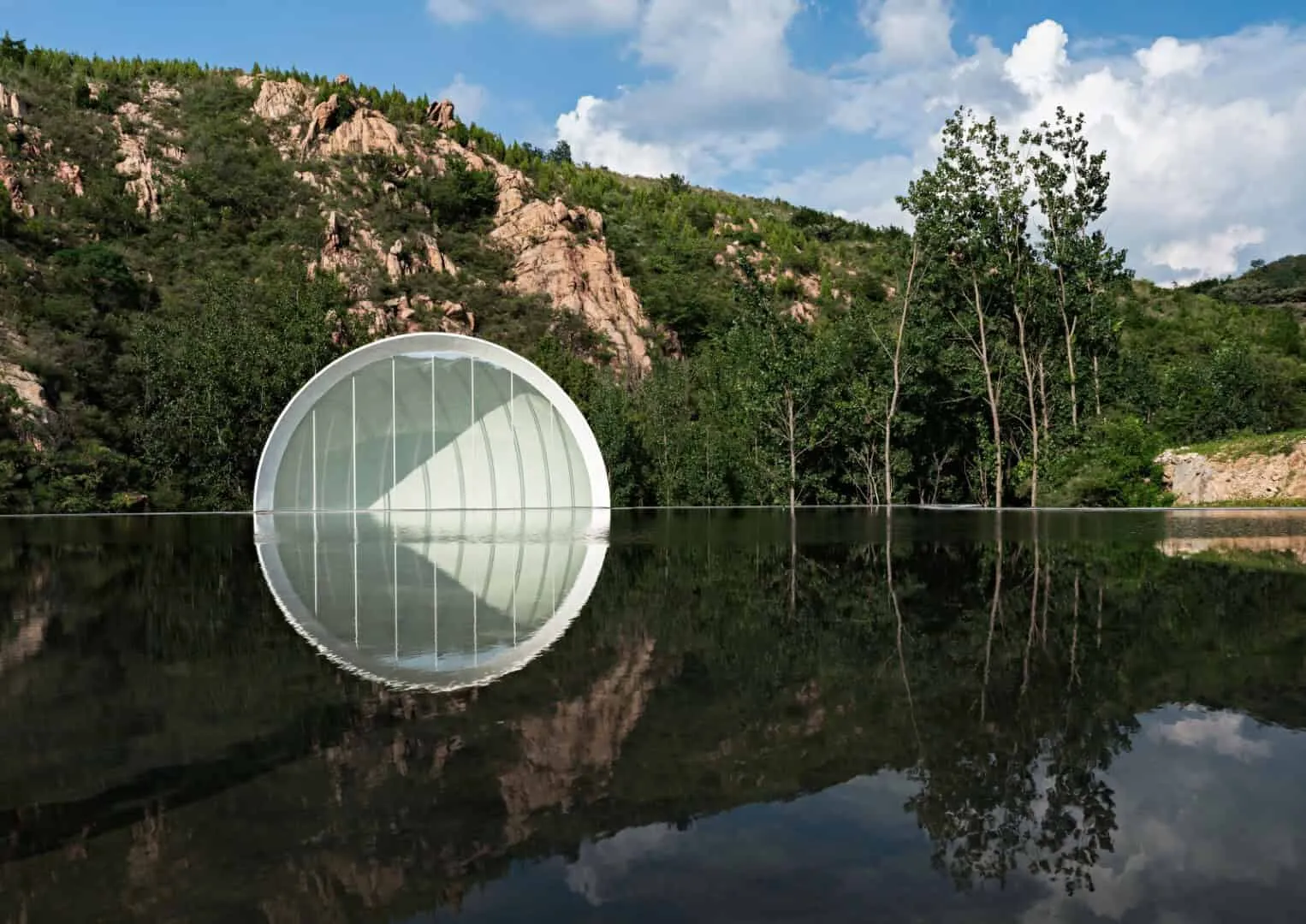
The Native Moon ceremony hall divides the full moon in half. The reflection above the water-like surface of corrugated steel makes it whole again. Perhaps life's essence is imperfect. Thus, people continuously seek their other half, like seeking completion. This second half perfectly complements the essence of the other, just as the other half of the moon. Furthermore, the principle of Yang is present on the upper side of the hall, while Yin resides below, forming a balanced combination. The philosophical concept of duality (existence and non-existence) is uniquely shown through architectural language.
SYN Architects built a poetic and philosophical building that words cannot describe. The project combines central ideas of Buddhism (harmony, continuity, comprehensiveness and infinity), Taoist concept of emptiness and Confucian cultural heritage to provide physical shelter from wind and rain in the form of Native Moon. Its glorification of ritual in our society and new rural aesthetics demonstrate the importance of rural development. Native Moon also encourages cooperation between government agencies, private sector, media and residents, creating a complete circle through careful planning. Native Moon is what Le Corbusier called an indescribable space, a place where being there matters most.
"Since completion, it has begun a dialogue with users and nature. I hope to see it changing over time, increasingly fitting into the environment as trees grow.
Every architecture has two purposes: to be destroyed or protected. I hope to create architecture that doesn't want to be destroyed. This will be the pinnacle of my career. For this reason, I will add deeper meaning to my architecture and create more emotional connections for its users. I hope that the moon can become such an architecture. Even if it disappears over time, it will still exist in our spiritual world."
-Project description and images provided by SYN Architects