Ceiling for Kitchen: Which One to Choose?
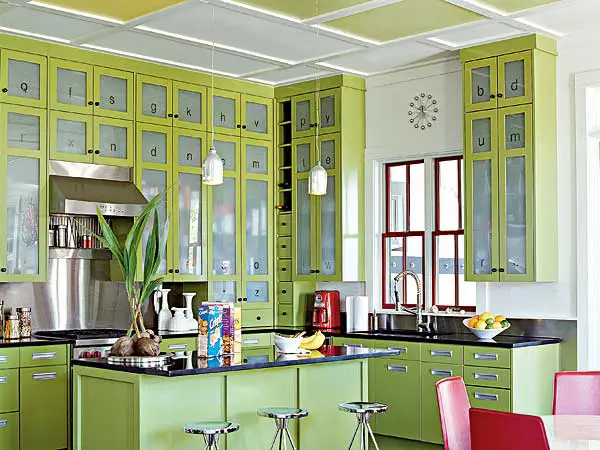
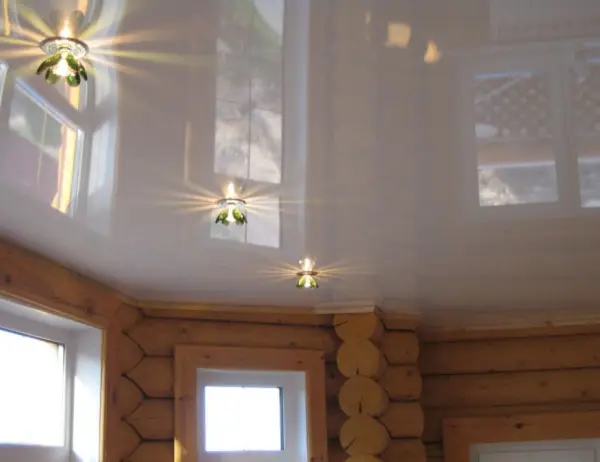
Such ceiling design for a 9 sq. m. kitchen will make it eye-catching
Besides the traditional plastered ceiling, sensitive to frequent fluctuations in humidity and temperature in the room, there is now a choice among much more reliable ceiling coverings whose appearance is no less than a smooth whitewashed surface.
A kitchen ceiling is a surface that needs not only cleaning from dust or soot but also from contaminants caused during meals or cooking. For example, if a blender is not tightly closed, you will have to wipe banana cocktails off the walls and ceiling. We bet that even with splashes of champagne, you won't manage to clean it off a plastered ceiling.
Polystyrene Ceiling Tiles
The cheapest option for kitchen ceilings is polystyrene ceiling tiles.
Advantages:- tile installation can be done by yourself;
- due to thickness and elasticity, the material covers ceiling defects;
- easy to clean;
- polystyrene is moisture-resistant.
- trivial appearance (these ceilings are unlikely to be called modern);
- limited selection of polystyrene tiles (this applies only to the color of the material, while the range of finishes is much broader).
One square meter of polystyrene ceiling tiles rarely costs more than $3.5–$5. However, you can find cheaper options in the market starting from $1.7/m².
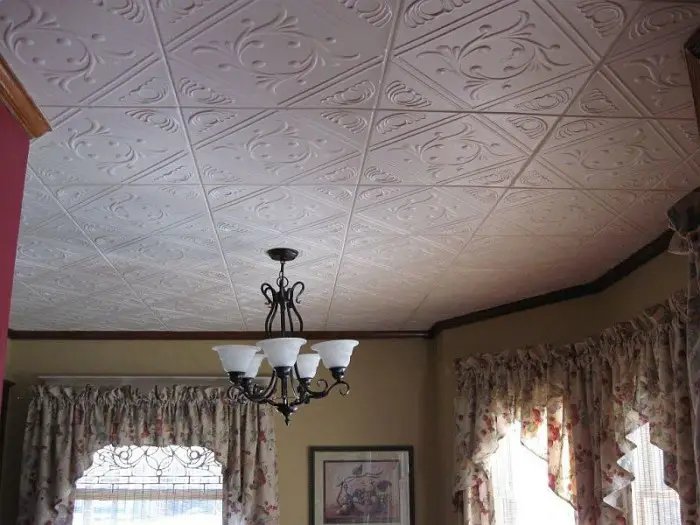
Photo 2 — Ceiling for a vintage-style kitchen made of polystyrene tiles
Plastic Panels (Furring Ceilings, Siding Ceilings)
This option for kitchen ceiling design is somewhat more expensive than the previous one not only due to material costs but also because of installation fees. Both types belong to the suspended ceiling category.
Advantages:- high installation speed of plastic ceiling panels and furring ceilings;
- no need for pre-preparation of the ceiling surface;
- possibility to embed lines of engineering communications between the base ceiling and panels;
- convenient for installing ventilation systems and mounting recessed lights;
- if necessary, damaged parts of the ceiling can be replaced without dismantling the entire ceiling system (this also applies to tile ceilings).
- suspended ceilings require more space during installation and reduce ceiling height (if normal kitchen ceilings of 2.85 m allow installing such systems without major sacrifices in spatial perception, then in a Khrushchyovka-style apartment with 7 cm height occupied by suspended ceilings from panels, it is always an extra burden);
- not everyone will like the look of this type of ceiling — to be honest, it looks rather simple and cheap.
Depending on the color and texture of the material, the cost per square meter varies from $4.5 to $8. If you want white PVC panels (commonly known as tongue-and-groove), you can pay slightly less — from $3.2/m² of such material.
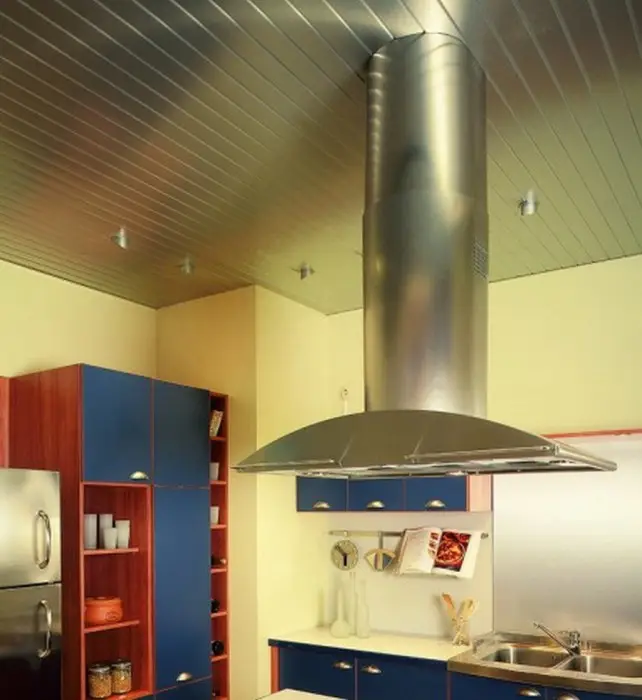
Photo 3 — Aluminum furring ceilings — a reasonable alternative to plastic. Such ceiling not only looks better but also lasts longer
Gypsum Board Ceiling
Gypsum board ceiling belongs to the suspended ceiling category and is just as effective as plastic in dealing with high humidity. However, there is one very important condition: the type of gypsum board and its thickness must match the intended application.
It is no secret that for every room or surface in a house or office, there is a specific type of gypsum board. For kitchen ceilings, it is better to use moisture-resistant boards (marked as GKLV, green color of the board, optimal thickness of core and facing — 9.5 mm).
Gypsum ceilings do not require preparatory work, but installing such a ceiling in a small kitchen with low ceilings is not recommended.
The reason is the same as with furring ceilings: gypsum board facing can only be installed if a metal frame or wooden frame is used. This in average requires 7–15 cm (a significant portion of the height is taken up by lighting and engineering communication routes hidden in the space between GKLV and the base ceiling surface).
Advantages:- possibility to install embedded lighting;
- no need for preparatory work;
- installation does not leave much waste;
- variety of construction options (you can install either a single-layer ceiling or a multi-level gypsum board ceiling);
- the surface of such a ceiling does not burn (in case of fire, the cardboard facing of the gypsum core chars);
- all possible finishing works can be carried out after installing the gypsum board sheets.
- the surface of gypsum boards is not resistant to strong mechanical impacts (those who like to open champagne dramatically in the ceiling should not test the surface strength);
- after installation, the system cannot be modified without dismantling (e.g., it is not possible to install embedded lights or run additional cables behind the gypsum board ceiling);
- moisture-resistant gypsum board is indeed more durable under frequent steam exposure, but it won’t protect your kitchen from unexpected “neighboring” floods;
- additional finishing work is required after installation, which means extra time and cost.
Depending on the thickness of the board, its specifications, and the type of gypsum board you choose, the cost will range from $5.2 per sheet (Rigips (1 200/2 000/9.5 mm), special ceiling gypsum board) to $11.05 per sheet (KNAUF (1 200/3 000/12.5 mm), GKLV).
Stretch Ceilings
It should also be said that stretch ceilings are quite practical for kitchens:
- the decor of such a ceiling can be any (from the chosen print on PVC film or fabric ceiling material to lighting installation);
- the color palette of the stretch film is unlimited (any color and shade can be used for the ceiling: dark green, bright pink, soft milk white, etc.);
- ceiling decoration can be done not only with a stretch system — there is also the option of installing combined ceilings, just like wallpaper combination helps zone the space (e.g., in a kitchen-living room or any other combined room, where differences in ceiling decoration can be used to zone the space);
- PVC film is not afraid of moisture and floods, and it is easy to remove;
- installation of such ceilings takes only 4 hours (if it's a simple single-layer system);
- these ceilings can be cleaned with any non-abrasive cleaning agent;
- they are durable (the warranty in most cases is 10–15 years).
Regarding the price, purchasing materials and installing a stretch ceiling for a 10 sq. m. kitchen will cost approximately $180.
On each of the mentioned ceiling types, we have provided more detailed information in relevant articles.
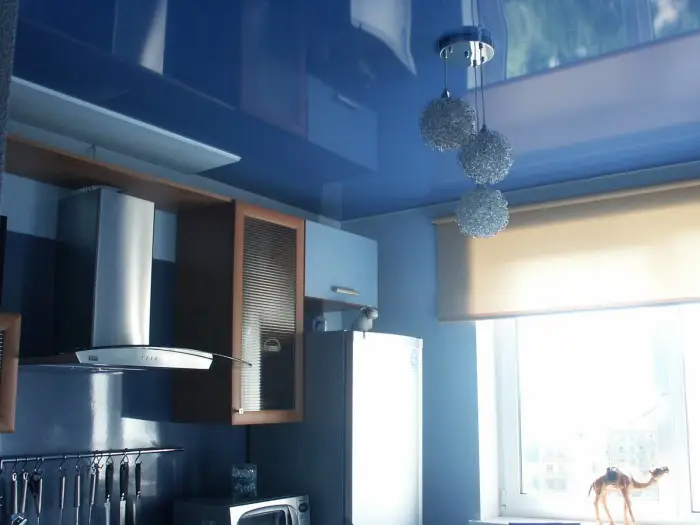
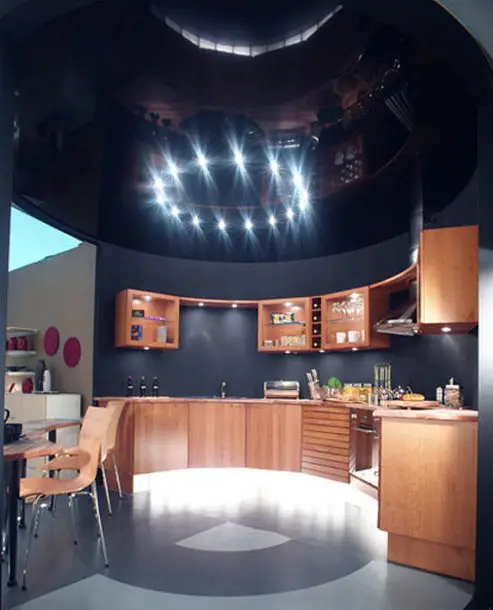
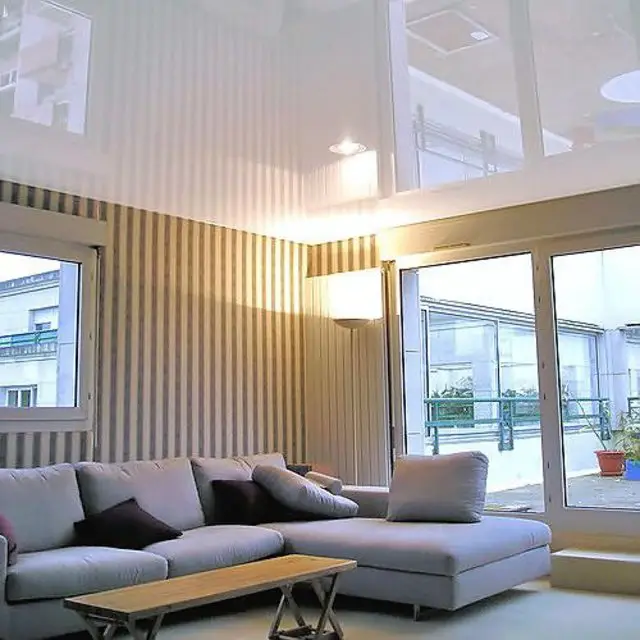
Photo 4 — Glossy stretch ceiling for a kitchen. Such ceiling can be installed not only in rooms with high ceilings. The minimum height required for installation is 5 cm
As an alternative, in a kitchen with good ventilation, you can install ceilings made of MDF.
And, of course, the costly classic — ceiling plastering remains a viable option. The classic "plaster and then whitewash" scheme will cost at least $23/m², and it will take at least one week to complete.
Any of the adhesive, stretch, or suspended ceiling will fully justify itself — these surfaces are suitable and practical for kitchens.
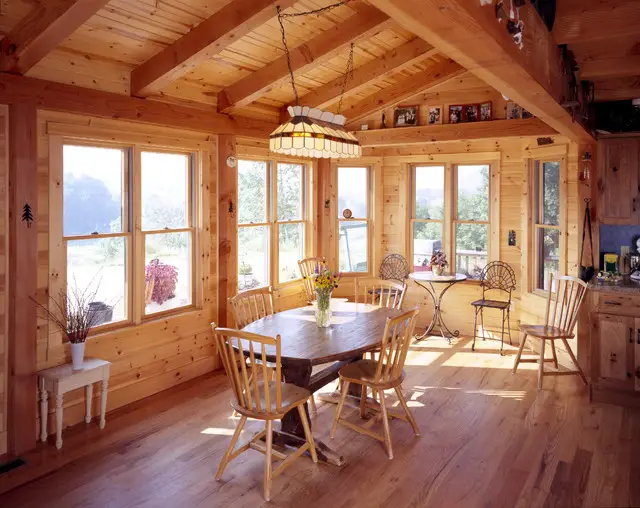
Photo 5 — In a wooden house, it is better not to make major finishing work that could alter the natural appearance of the ceiling structure with beams. None of the previously mentioned options can create such a cozy atmosphere as this one