Installing Fixtures on Different Surfaces
Share on Twitter
Post to Blog
Lighting fixtures are the most essential and indispensable element of every room. Properly selected and placed lighting fixtures add a special atmosphere to the interior design of a room. In this article, we will discuss which lighting fixtures to choose, where and how to install them.
Lighting fixtures come in 220V and 12V versions. When installing 12V fixtures, it is necessary to install a transformer of the appropriate power.
Mounting a Fixture on a Hook
Mounting a Fixture on a Hook
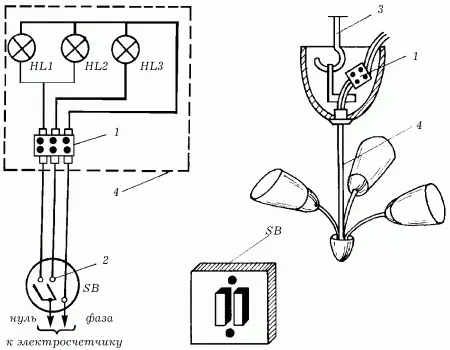
An old but still used method of mounting lighting fixtures in panel ceilings is on a hook. In this case, the hook itself and the cable where it exits from the ceiling are insulated – a polyvinyl chloride tube is slipped over them. The hole through which the hook exits is covered with a ceiling outlet. However, it can also be left uninstalled and filled with mounting foam or mortar instead. The fixture is hung, and the fixture wires are connected to the distribution wiring: two wires for live and one for neutral. Copper and aluminum conductors must not be twisted together. For their connection, a sleeve is required.
Mounting Fixtures in a Suspended Ceiling
Mounting Fixtures in a Suspended Ceiling
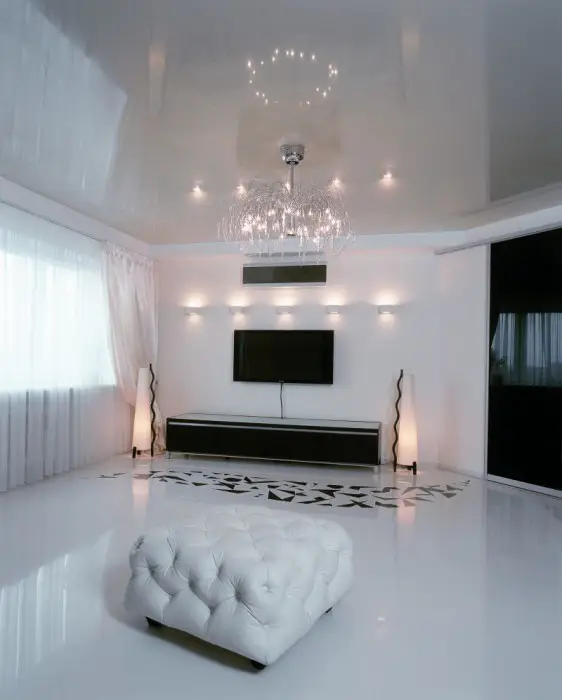
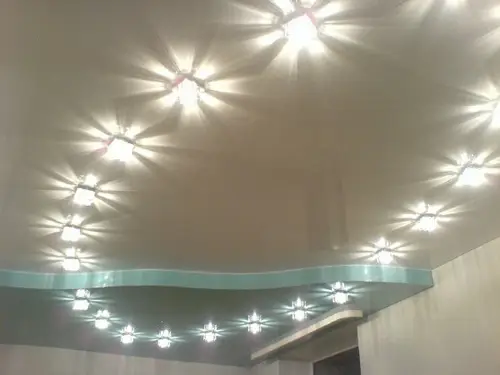
It is advisable to plan the installation of lighting fixtures in a suspended ceiling before installing the ceiling itself and install special light fixture brackets. After the ceiling has cooled down, a special circular profile is glued to it strictly under the bracket. Then part of the ceiling fabric is cut out along the inner surface of the profile. The wiring for the fixture is pulled through the hole thus created. The hole itself is bordered with a decorative profile.
When installing halogen lamps of high power or very bright luminaires, it is recommended to place them in a special thermal insulating ring to prevent the ceiling from overheating and sagging. However, pendant fixtures and those made of steel can be mounted in a suspended ceiling without thermal insulation.
Lighting Fixtures in Gypsum Board
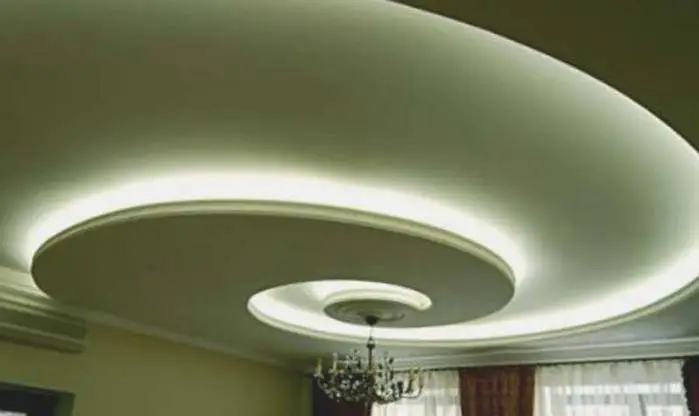
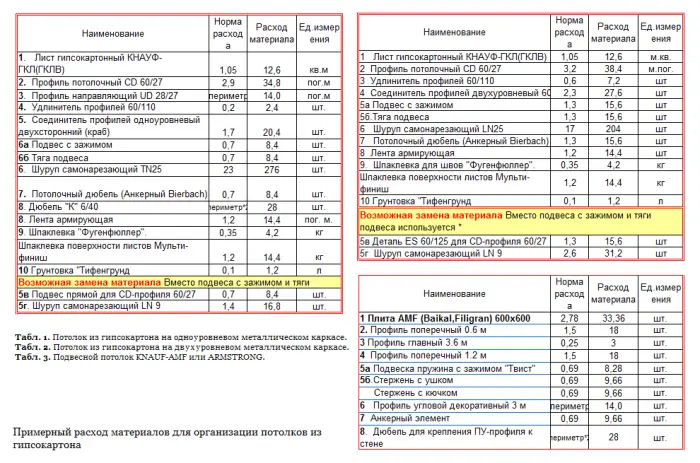
When installing lighting fixtures in gypsum board, it is important to remember that the distance between fixtures should not be less than 30 cm, and the distance from the wall corner to a fixture should not be less than 20 cm. All markings for fixtures must be made on the walls, then transferred to the gypsum board sheets. Holes for each fixture should be drilled using a special drill bit designed for installing fixtures, with the diameter chosen according to the fixture size. Holes can be made either before or after finishing work. After connecting to the cable, a recessed fixture is inserted into the drilled holes. The fixture is securely fastened to the gypsum board using metal brackets. The wiring behind the gypsum board must always be laid in a corrugated protective tube made of special flame-retardant plastic.
When installing large square fluorescent fixtures, the ceiling frame must be prepared in advance. For this, after marking the locations for fixtures, an additional square frame made from CD profile should be constructed for each fixture. The frame should be 0.5-1 cm larger than the dimensions of the fixture for easier installation.
Mounting Pendant Fixtures
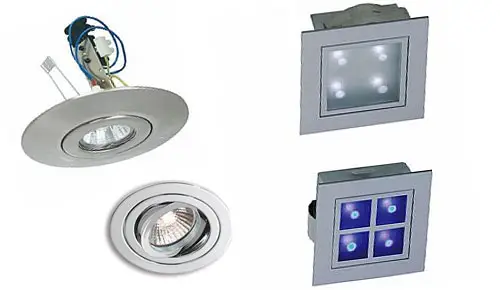
Mounting Pendant Fixtures
Pendant fixtures are mounted on gypsum board using self-tapping screws or butterfly anchors. These allow mounting not only on the surface of gypsum board but also on wooden or particle board surfaces. The “feet” of the anchor, when tightening the screw into the gypsum board, firmly press against the back side of the surface and securely fasten the mounting.
When installing ceiling fixtures, it is necessary to ensure that the distance from any fixture’s lowest point to the floor surface should not be less than 2 meters.