Suspended Ceilings - Advantages and Disadvantages
What Is a Suspended Ceiling?
A suspended ceiling is a perfectly flat surface obtained by stretching PVC film of special composition or so-called "fabric" panels. It is impossible to achieve such a high level of surface quality in such a short time using traditional finishing methods: achieving a perfectly flat ceiling requires considerable financial and labor costs.
The film is stretched by securing the panel in a groove (a mounting system located around the perimeter of the room).
IMPORTANT! After installation, slight sagging of the ceiling may occur on large surfaces: for example, when the ceiling area exceeds 20 m², the allowable sagging level is 4 cm. Avoiding sagging without cutting the ceiling into sectors is practically impossible.
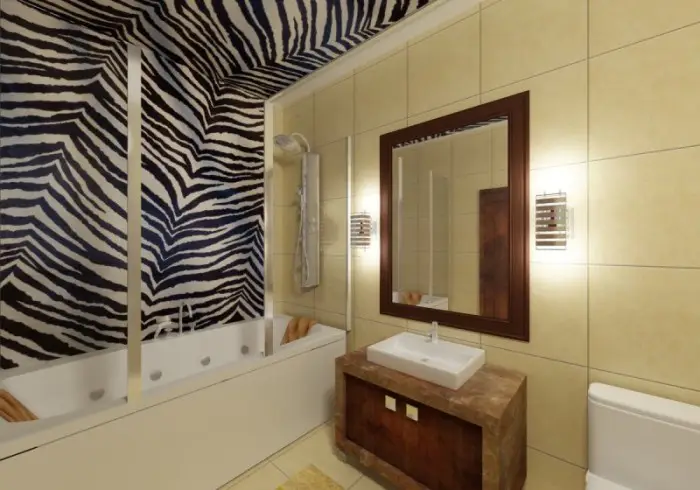
Photo 1 — Design Solution for a Bathroom
A suspended ceiling, except for seamless ceilings, is made of PVC film strips sewn together. After measuring the room, the film is cut precisely to size. The pattern for cutting must be drawn up by a professional technician.
What are the advantages and disadvantages of suspended ceilings?
Advantages of Suspended Ceilings
Traditional methods (such as spackling) do not have the following properties:
- moisture resistance;
- fire safety (fire rating class M1);
- they are also not distinguished by quick installation (one suspended ceiling can be installed in 3-4 hours);
- durability (the suspended ceiling fabric can withstand a load of up to 100 kg/m²);
- convenience in operation (no need for special maintenance);
- durability (the warranty period for suspended ceilings installed by a certified company is up to 10-15 years).
In addition, suspended ceilings are characterized by a wide color range of coatings, the possibility of ordering textured fabric (only for "fabric" ceilings), and the ability to print any image on a suspended ceiling at the customer's choice.
Although the advantages of suspended ceilings do not exclude their disadvantages.
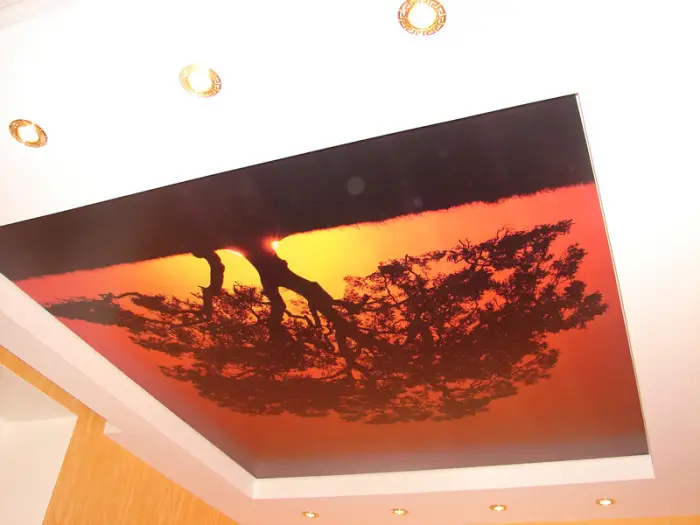
Photo 2 — Print on a Suspended Ceiling. Any fabric can be made according to an individual order
Disadvantages of Suspended Ceilings
- suspended ceilings are afraid of sharp objects;
- they are relatively expensive (the cheapest variant of suspended ceilings today costs about $18/m², though one cannot expect high-quality fabric at such a price);
- it is impossible to install a suspended ceiling by oneself without the necessary experience and tools, unfortunately (just as it is impossible to fix a cut or seam separation on the ceiling).
What Are Suspended Ceilings Made Of?
Fabric for suspended ceilings is made from ordinary PVC film of various textures (more about this later). This film does not contain cadmium. The thickness of the film is 0.17-0.22 mm.
IMPORTANT! Fabric ceilings, which you might have also heard about, are not made from fabric. Such a fabric is made from polyester impregnated with polyurethane. "Fabric" ceilings are called so only to give the fabric a textile appearance. In addition to appearance, fabric ceilings have several differences from film ones. You can learn more about this in a separate article dedicated to fabric ceilings.
What Types of Suspended Ceilings Are There?
First, let's divide suspended ceilings by installation method into seamed and seamless.
The first type is fabric without welded seams. In practice, whether a seamless or seamed installation should be performed depends on two factors: the width of the room and the width of the material preferred by the customer.
Sheet suspended ceilings are mainly produced in widths of 1.3 m and 2 m. Fabric ceilings are made up to 4-5 m wide. Fabric panels are often called the only way to install a seamless ceiling. However, this is not entirely true. If the working object ceiling width does not exceed 2 m (for example, a corridor or bathroom), it is possible to install film ceilings in a seamless way.
We also wrote about the advantages and disadvantages of seamed and seamless ceilings in a separate article.
By surface type, the fabric can be divided into:
- matte;
- semi-matte (satin);
- glossy (lacquered);
- metallic;
- suede;
- marble;
- leather-like;
- and other suspended ceilings.
How much height does a suspended ceiling construction occupy? Can it be installed in a Khrushchyovka?
A single-level suspended ceiling without installing recessed lights can take up 3 cm of ceiling height. With this calculation, it is possible to install suspended ceilings in apartments with low ceilings. However, only simple light coatings should be chosen that can visually expand the room space.
Can suspended ceilings be installed in a bathroom?
Yes, they can. There are special waterproof types of suspended ceilings for these purposes. These ceilings are available in the product range of the following manufacturers:
- PVC (France);
- Pongs (Germany);
- RENOLIT (Germany);
- Malpensa (Italy).
There are special ceiling coverings that can be used even in public spaces with high humidity levels. For example, in swimming pools.
Which Manufacturers of Suspended Ceilings Are Considered the Best?
Industry leaders, whose product quality is confirmed by years of experience in the suspended ceiling market and customer reviews, are imported ceilings from Clipso ("Clipso", Switzerland), Descor ("Descor", Germany), and Cerutti ("Cerutti", Italy).
What Can the Design of Suspended Ceilings Be Like?
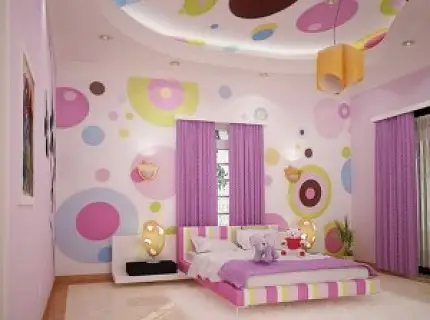
The ceiling decoration can be very diverse. From choosing the texture and color to various prints.
It is appropriate to show examples — what room decoration with a suspended ceiling can look like and, in particular, how to decorate the ceiling itself (photo gallery — below).
Suspended Ceilings - PHOTOS
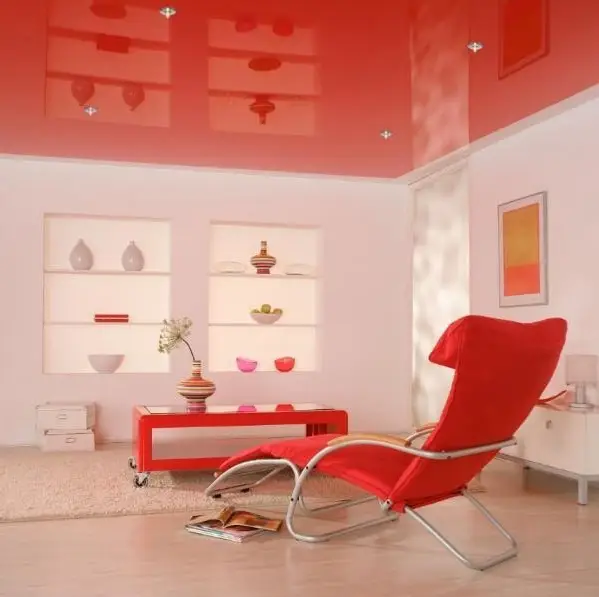
Photo 3 — Color and Light Harmony
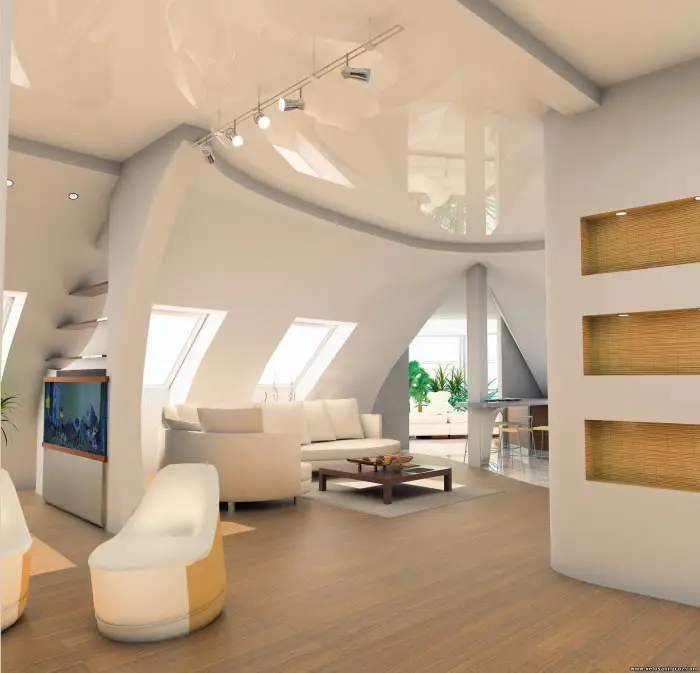
Photo 4 — Glossy White Ceiling in a Studio Apartment — Unites the Room, Adding Volume
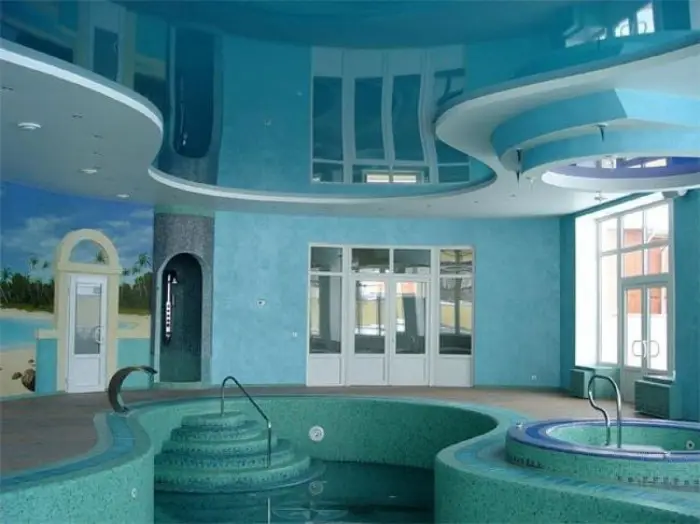
Photo 5 — Glossy Suspended Ceiling — A Reliable Solution for Swimming Pools
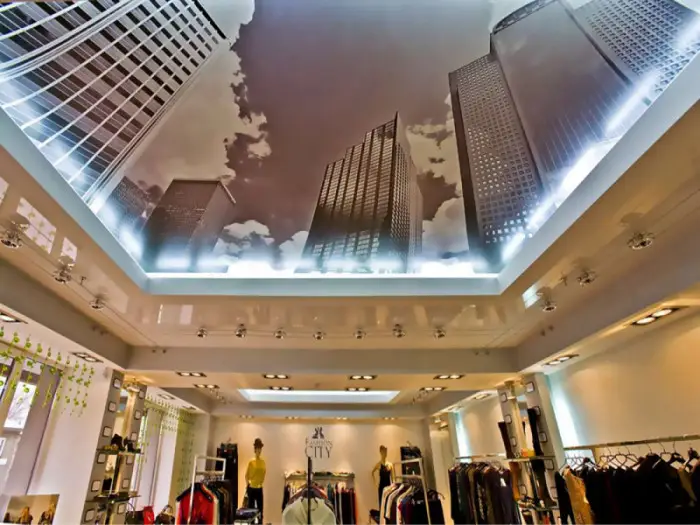
Photo 6 — Any Prints Can Be Applied to Suspended Ceiling Panels — From Nature Scenes to Urban Landscapes, and Art Reproductions from the Renaissance Period
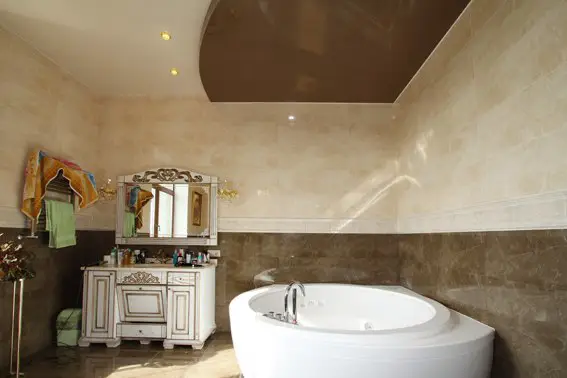
Photo 7 — Suspended Ceiling in a Bathroom
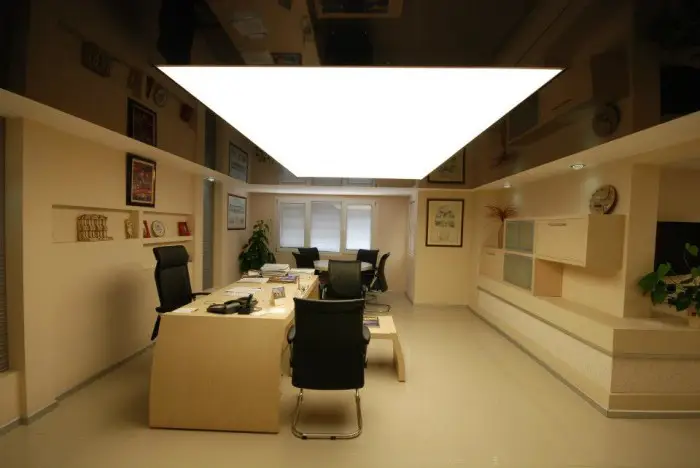
Photo 8 — Suspended Ceiling in an Office Interior
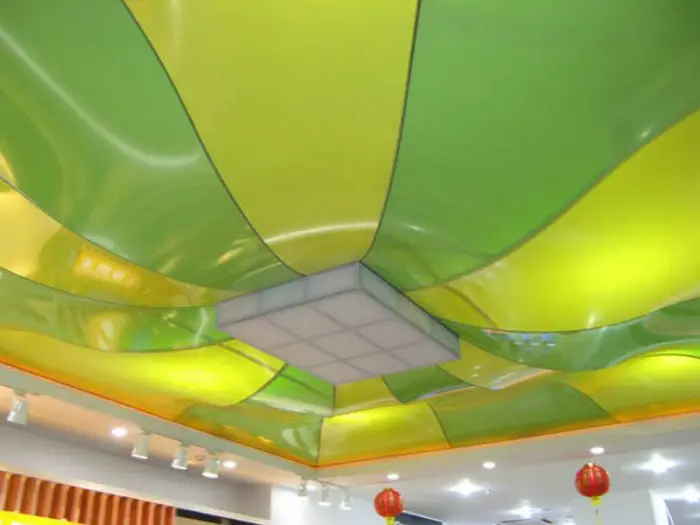
Photo 9 — Suspended Ceiling of Complex Shape in Fast-Food Interior
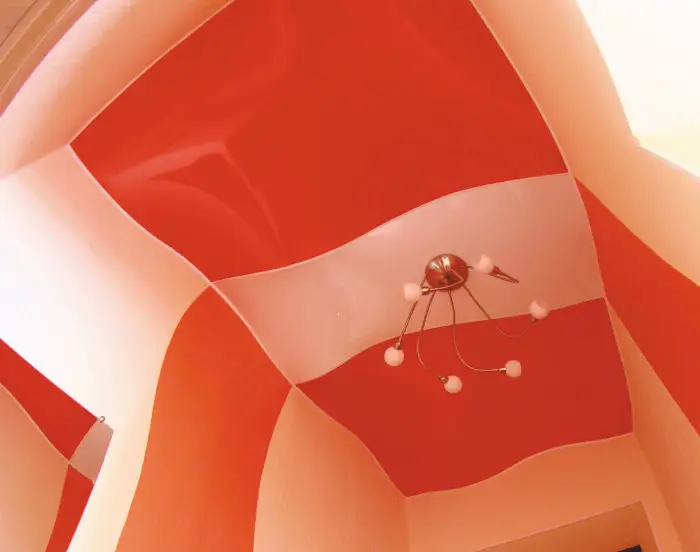
Photo 10 — Suspended Ceilings Can Be Not Only Any Color, But Also Any Shape
Suspended Ceilings, Care and Ways to Fix Minor Damage
Suspended ceilings (especially glossy ones) require minimal maintenance: the fabric does not attract dust, and surface cleaning is sufficient with a soft sponge without nap for glossy ceilings or with a soft-nap sponge for matte ones, moistened in a weak soapy solution or plain water.
What you cannot use to clean a suspended ceiling is abrasive cleaning agents or products containing aggressive components (e.g., acids).
As mentioned earlier, a suspended ceiling is a coating that can be easily damaged by sharp objects. The "wound" can be accidentally inflicted by the room owner or an unskilled repairman who incorrectly installs a recessed light fixture.
Unfortunately, it is impossible to restore the ceiling by oneself after damage (cut, tear in a weld seam, etc.). The same applies to the case of possible flooding: the ceiling will not burst under the weight of water, but to drain the water, dry it, and re-stretch it, you will need to call a specialist.
However, minor ceiling problems can be solved by resourceful people without any help: stickers, children's stickers, and a needle with thread are used. Examples of such "folk creativity" and professional work are shown below.
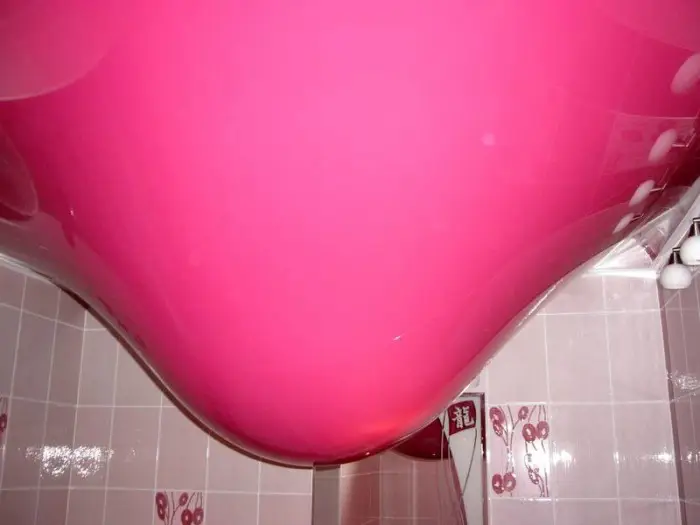
Photo 11 — Suspended Ceiling During Flooding
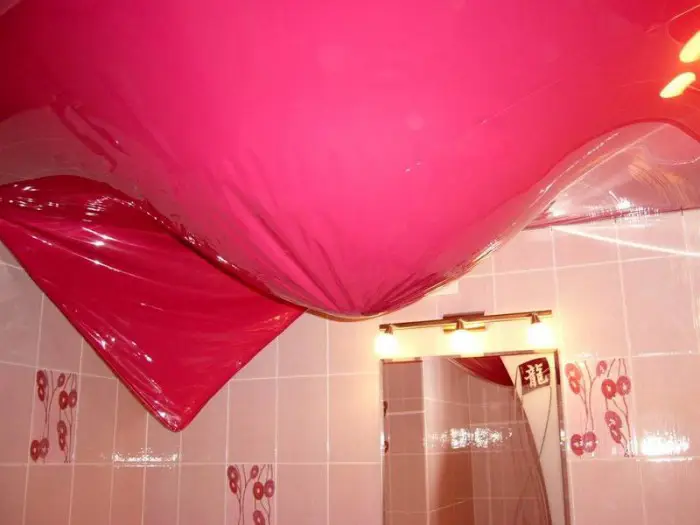
Photo 12 — Draining Water
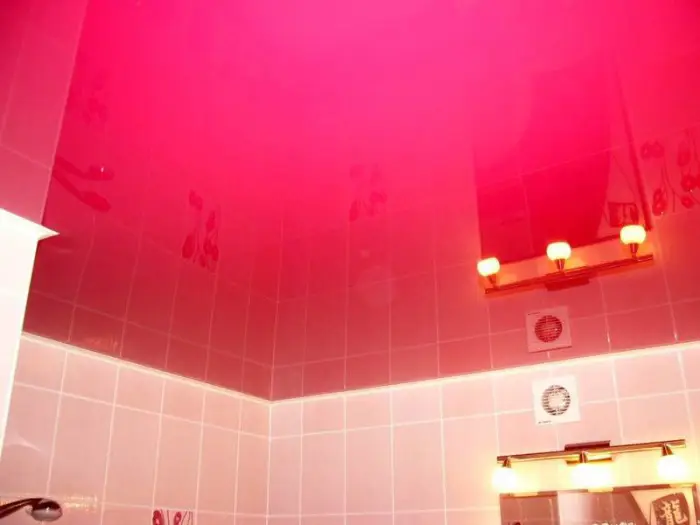
Photo 13 — Re-stretching
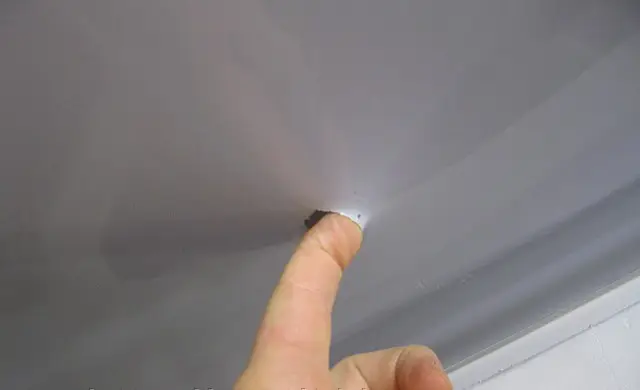
Photo 14 — Minor Damage to a Suspended Ceiling
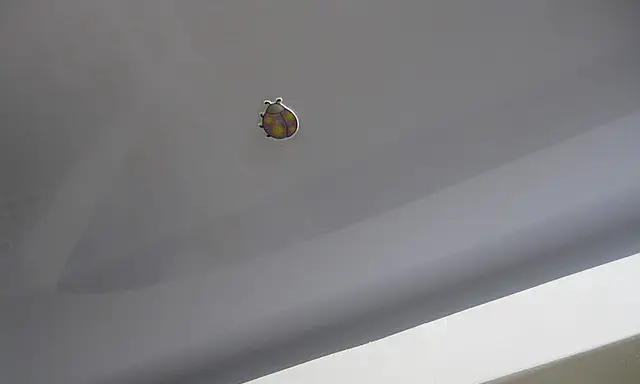
Photo 15 — A Child's Sticker Covers the Damaged Area. No Threat of Further Tear
At What Stage of Renovation Should a Suspended Ceiling Be Installed?
Whether you are doing the renovation yourself or hired professionals, it is important to know: suspended ceilings are installed after completing all rough, dusty works but before wallpapering. IF film ceilings are used.
Why?
For installing a film suspended ceiling, a gas blower is used to heat the secured panel in a groove to a temperature of 45-60°C.
Matte fabric (including cotton) ceilings do not require heating — such types of ceilings are simply stretched and secured to the walls.
Newly applied wallpaper risks peeling off from the walls during panel heating, and thus the entire room.
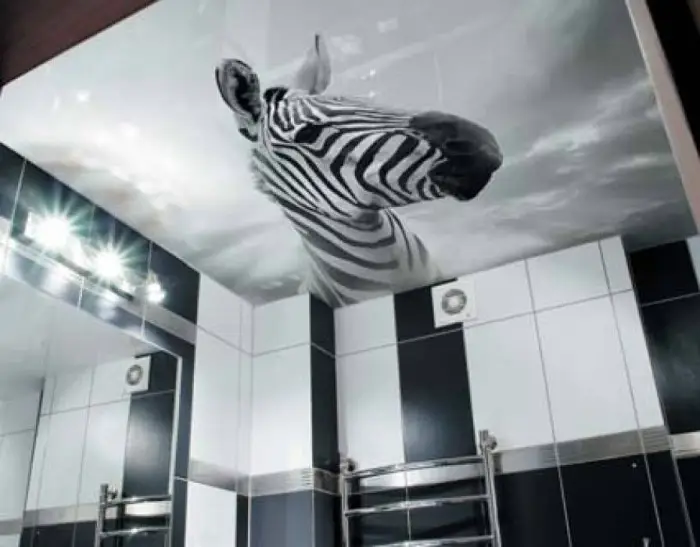
Photo 16 — Suspended Ceilings with a Pattern
If wall painting was used for finishing, the paint must also "settle" on the wall coating. It is dangerous to install the ceiling just a day or two after painting.
Since we mentioned the heating blower, another reason not to do the work by yourself is safety. Safety during installation of suspended ceilings is a matter of life and death: there is a risk of gas cylinder explosion, burns of various degrees, and other unpleasant incidents.
A detailed description of the suspended ceiling installation process, as well as installation specifics of various types of ceilings is provided in a separate article.