What Profile to Choose for Gypsum Board?
Learn about the types of profiles for gypsum board and which tools you might need when working with them by yourself. Figure 1 — Types of Profiles
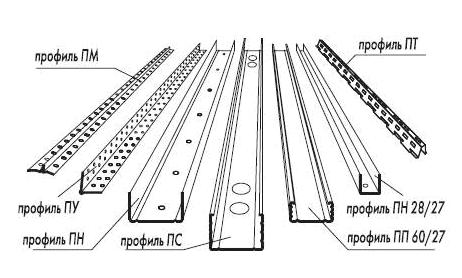
Figure 1 — Types of Profiles
Types of Profiles for Gypsum Board
What profiles are needed for gypsum board is a question every craftsman should consider after reviewing the initial project. A person who knows their trade won't be overwhelmed by the variety of profiles used for different types of gypsum board work. However, it's important for amateur DIYers to know at least the basic types of profiles and their differences.
Gypsum board profiles can have several different cross-sections, and it's easy to get confused about when to use each one.
All profiles used in gypsum board work can be grouped into six main types, four of which are profiles for building the structure frame:
- Guide profile (marking ПН/UW);
- Guide ceiling profile (marking ПНП/UD);
- Ceiling metal profile (marking ПП-профиль/CD);
- Stud profile (marking ПС/CW).
Besides, there are also corner profiles (marking ПУ) designed for reinforcing corners and marker profiles (marking ПМ), used in construction to level walls.
Guide Profile
This type of profile serves as the base or guide onto which stud profiles are mounted. The guide profile should be used when organizing a wall frame or a frame for interior partitions.
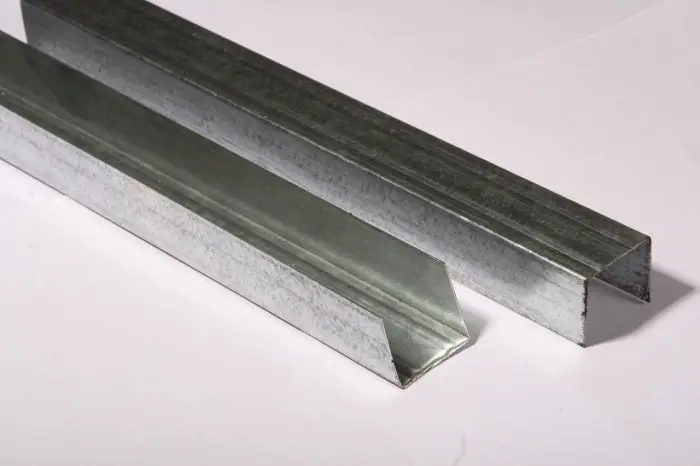
Photo 1 — Guide Profile
Stud Profile
This is the main element in building wall and interior partition frames. The stud profile is mounted into the guide profile, which in turn must be secured around the working area (in this case, along the walls).
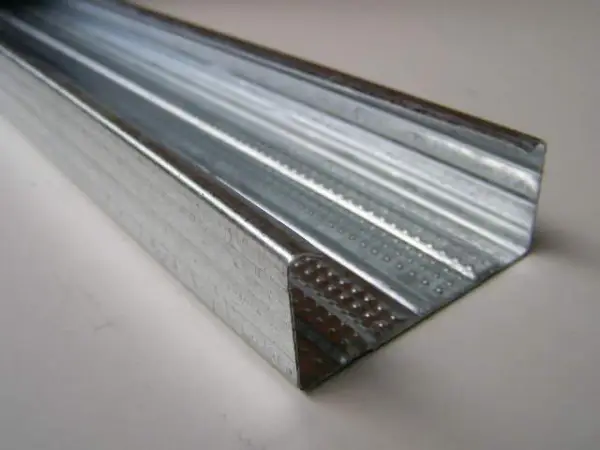
Photo 2 — Stud Profile
Ceiling Guide Profile
This profile type has the same functions as a regular guide profile, but it's specially designed for constructing ceiling frames and is mounted only on the ceiling.
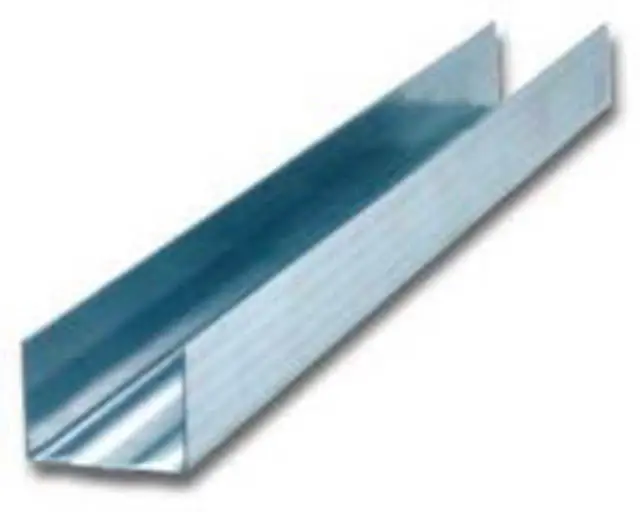
Photo 3 — Ceiling Guide Profile
Ceiling Profile
This is another type of profiles used in ceiling work with gypsum board. The main difference between ceiling and stud profiles is that the ceiling profile must be mounted to the ceiling using special fasteners (which fasteners are best and more — read below).
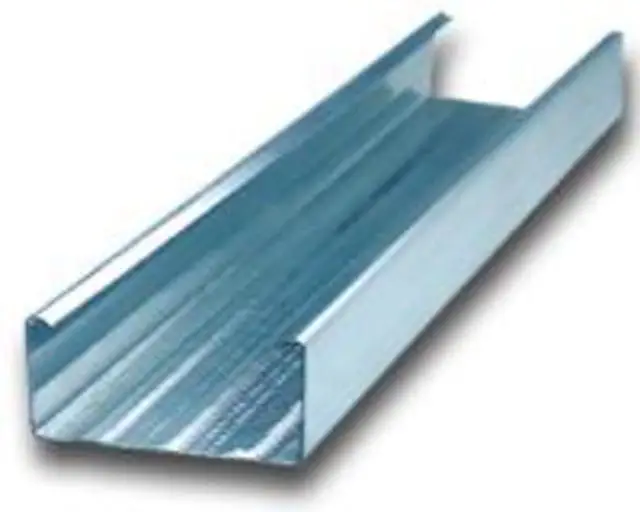
Photo 4 — Ceiling Profile
Corner Profile (Reinforced)
The name of this profile speaks for itself: it is designed to reinforce the corners of the structure after finishing the main work of covering the frame with gypsum board sheets.
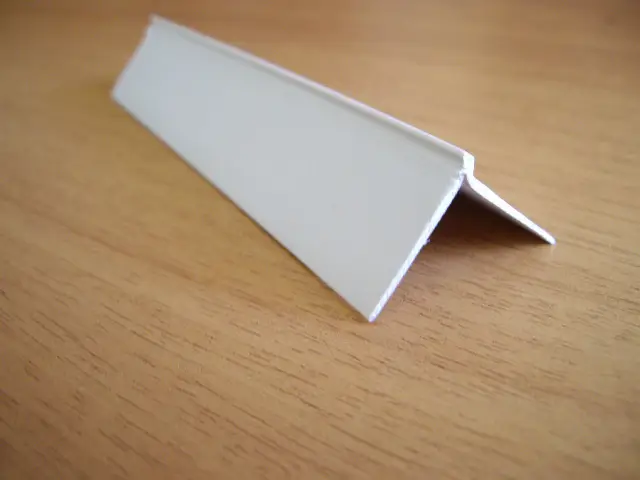
Photo 5 — Corner Profile
Marker Profile
Used in plastering work for leveling walls. Master workers use marker profiles to align the wall levels for leveling.
IMPORTANT! Some types of gypsum board structures do not require a frame — in such cases, the sheets are mounted directly on adhesive.
Gypsum board without a frame (without a structure) can be mounted in several cases: for example, when the overall weight of the structure is important and adding weight from an aluminum frame is undesirable, or when wall curvature does not exceed several millimeters and leveling is possible without installing framed partitions — also on adhesive (like «Perlfiks» and similar products).
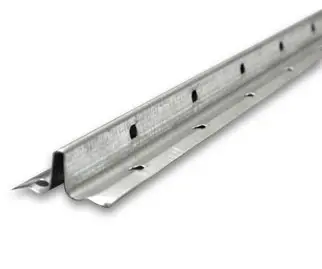
Photo 6 — Marker Profile
Additional Fastening Elements
Besides profiles, there is a wide range of standard parts used in building frames and mounting the profile base to walls and ceilings.
Most commonly, these are used:
- straight hangers and hangers with anchor clamps (used to mount ceiling profiles to the ceiling);
- crab connector (used in almost all structures for creating 90° angle connections in the frame);
- connector and extender (these additional fastening elements are used for connecting profile sections in various combinations).
By connecting these parts with different types of screws and anchor dowels, a craftsman can build any complex or shaped gypsum board structure.
Gypsum Board Profile: Dimensions and Other Useful Technical Specifications
Let's look at some types of profiles in more detail, as well as the installation of profiles for gypsum board — methods of connecting elements.
CW 50 (stud, wall profile) is used to organize vertical metal frame posts designed for gypsum board sheet cladding and partitions. The profile should only be mounted in combination with the appropriate size guide profile. For selecting CW 50 profile, the primary criteria are the width and height of the partition.
CW 50 is used in gypsum board structures by mounting it into the UW50 profile. The mounted elements form a stud element.
How to mount this type of profile for gypsum board to the frame: To mount a stud profile to the frame, use screws measuring 3.5 x 25 mm. The profile's fastening grooves ensure easy connection of elements. This type of profile is suitable for cladding structures with gypsum board sheets on both sides.
Technical specifications of CW 50
- Profile Size: 50x50 mm.
- Thickness: 0.42 mm.
- Length: 3 m, 4 m.
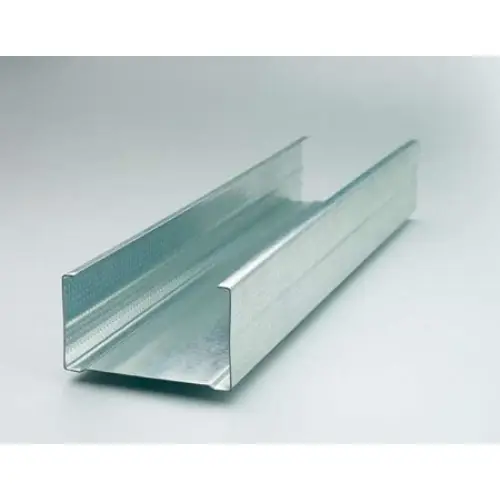
Photo 7 — CW 50 Profile
CW-75. Production of profiles for gypsum board: This is a galvanized metal profile made by cold rolling — lightweight and yet strong. The profile thickness varies from 0.35 mm to 0.55 mm.
The profile shape is a straight base and two flanges (a detail with sides of equal thickness). Thanks to longitudinal grooves in the profile, it's easy to screw in screws, simplifying the measurement process.
CW-75 is used when creating frames for gypsum board cladding. The profile is often used as a vertical post.
How to connect elements: Correctly mount the profile with screws. It is mounted with the UW-75 profile of matching dimensions. The profile element is selected based on the thickness and height of the partition being created.
Technical specifications of CW-75
- Size: 50x75 mm.
- Thickness: 0.42 mm.
- Length: 3 m, 4 m.
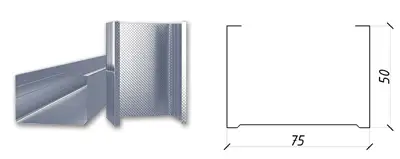
Photo 8 — CW-75 Profile
CW-100. Application: This is one of the main elements in mounting metal stud structures. It is used in combination with a UW guide profile of similar dimensions.
The CW-100 profile is often used for mounting gypsum board partitions.
Manufacturing: galvanized metal cold-rolled. The strength of the entire structure largely depends on the thickness of this profile (average thickness 0.35–0.55 mm). CW-100 is a C-shaped component. The width of each side of the profile is 100 mm.
Technical specifications of CW-100
- Profile Size: 50x100 mm
- Thickness: 0.42 mm
- Length: 3 m, 4 m
UD-27. This profile is used for guiding CD profiles (CD-60) when mounting suspended or multi-level ceilings, and frames for wall cladding with gypsum board.
The base width of the CD-60 profile is 60 mm.
UD-27 is mounted along the perimeter of the workspace. When cladding walls, the profile is mounted to the ceiling or floor to add additional stiffness to the structure. Special dowels are used to mount the UD-27 guide profiles: the profile has corresponding 8 mm holes spaced 250 mm apart.
Technical specifications of UD-27
- Size: 27x28 mm
- Thickness: 0.37 mm
- Length: 3 m, 4 m
UW-50. An element used as a guide profile for CW-50 stud profiles. It is used when mounting false walls, door frame structures, and various partitions.
Made from steel.
UW-50 is mounted to CW-50 using dowels.
Technical parameters of UW-50
- Size: 40x50 mm
- Thickness: 0.42 mm
- Length: 3 m, 4 m
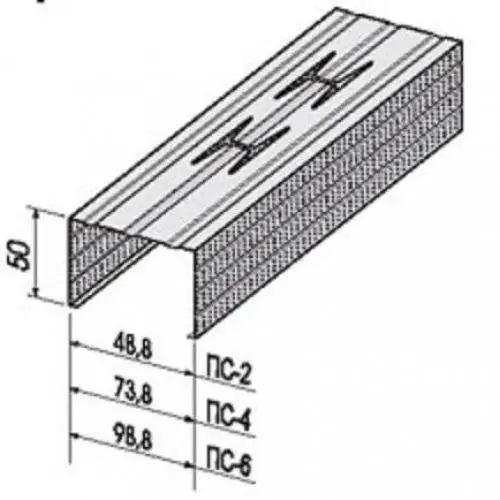
Figure 2 — UW-50 Profile
Additionally, there are many other profiles, such as the bent arch profile ПА, which is the base for any curved gypsum board structures. The ПА profile is made from ПП 60/27 profile with a bend radius of at least 500 mm. Despite the profile having a bend, it is not flexible.
To enhance the suspended system capabilities, the T-15 Albes profile is used. This profile is used for mounting cassette formats 300x600 mm, 300x1200 mm, 600x800 mm, and others. Installing gypsum board ceilings using this profile can be done without templates.
So far, we've only discussed metal profiles for gypsum board. However, plastic profiles can also be used in construction — end profiles and corner finishing profiles.
Tools for Working with Profiles
Is special equipment necessary for working with profiles for gypsum board?
Here is a list of tools without which work with the profile will be slow and of poor quality:
- metal cutters for cutting profiles;
- profile clamps — tools that connect profiles;
- profile perforator — a tool necessary for punching holes in frame parts, as it's impossible to assemble the frame without connecting the profiles;
- profile splitter is used for joining profiles at angles.
Some Additional Tips on Mounting Profiles
How to mount gypsum board to the profile?
Mainly, gypsum board is mounted to the profile using screws (screws with round heads).
How to bend a metal profile?
No special instructions are needed. For bending the profile during building a shaped frame, it is cut along the end surface at 5 cm intervals.
What to use to cut profiles?
Mainly, these works are performed with metal cutters.
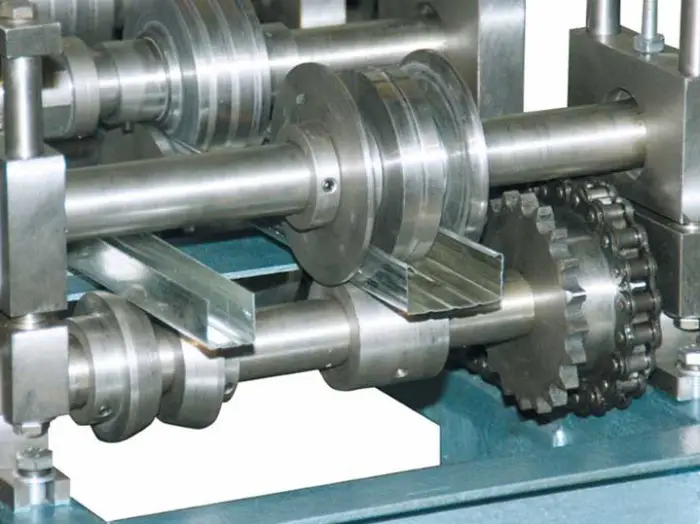
Photo 9 — Profile Production Machine
Installing Profiles for Gypsum Board: VIDEO
Profile Calculation for Gypsum Board
For craftsmen just starting to learn about gypsum board work, one of the first tasks is to memorize the technology for making different types of gypsum board structures and, accordingly, calculate the required materials.
For those who are unsure of their knowledge and generally to speed up calculations, there are several online resources that perform all calculations automatically (as calculating the amount of all materials can be quite complex).
Thanks to these online programs, you can calculate not only the amount of profile needed per 1 m² of gypsum board but also all required structural elements. After selecting the room area and the type of structure to be installed, you will receive a detailed list of all necessary components and the quantity of each element used.
Some applications (in common parlance, «material cost calculator») also indicate the spacing of a particular type of profile (e.g., the distance between ceiling guide profiles), screw fastening spacing, and other technical details.
$ Profile for Gypsum Board: Price
You can buy profiles for gypsum board directly from the manufacturer in any construction superstore.
The cost of the profile depends on length and type of product.
For example, one linear meter of CW 50 profile (length 4 m) costs $0.85, CW-75 profile costs $0.96, UD-27 costs $0.35, and UW-50 costs $0.65 per linear meter.
How much does a profile for gypsum board cost:
- In Moscow — from 11 to 37 rubles per linear meter depending on type and length of the product;
- In Kiev — from 2.76 to 8.91 UAH per linear meter depending on type and length of the product.