Installation of Fire Alarm System
Fire Alarm System: Installation According to Regulations
According to the List of Buildings Requiring Fire Suppression and Fire Alarm Systems (NPP 11003, approved by Order No. 315 of the Ministry of Emergency Situations of Russia dated 18.06.2003), automatic fire alarm systems must be installed in administrative and residential buildings by law.
Some rooms (with an area of 24 m² or more) must be equipped with automatic fire suppression systems. The necessity of installing a fire alarm system and fire alert in an apartment is not stipulated in legislation.
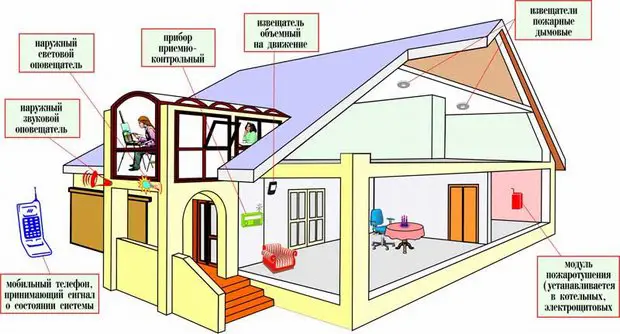
Figure 1 — Fire Alarm System Installation Scheme in a Private House
Fire Safety Systems: Main Requirements
The main document defining requirements for automatic fire suppression systems and fire alarm systems is the Federal Law "Technical Regulation on Fire Safety Requirements" (Article 83).
Among others, the following requirements apply to fire alarm systems:
- SPS installation must be carried out in full compliance with the project documentation developed and approved accordingly;
- SPS must automatically detect a fire or ignition, send control signals to the fire alert and evacuation management system, as well as to devices controlling fire suppression systems, smoke prevention systems, etc.;
- Fire detection equipment should be placed inside the protected room, from which it is easy to identify the occurrence of a fire in any part of the room.
In addition to the Federal Law, requirements for SPS are also set out in the following documents:
- SP 5.13130.2009. Rules of Thumb. Fire Protection Systems. Automatic Fire Alarm and Suppression Systems. Design Standards, approved by Order No. 175 of the Ministry of Emergency Situations of Russia dated 25.03.2009;
- SP 3.13130.2009. Rules of Thumb. Fire Protection Systems. Fire Alert and Evacuation Management System. Fire Safety Requirements, approved by Order No. 173 of the Ministry of Emergency Situations of Russia dated 25.03.2009;
- NPP 58 97. Fire Safety Standards. Addressable Fire Alarm Systems. General Technical Requirements. Testing Methods, approved by Order No. 64 of the Main Directorate for State Protection of the Ministry of Internal Affairs of Russia dated 31.12.1996.
IMPORTANT! You can also use the relevant OKDP as a reference material.
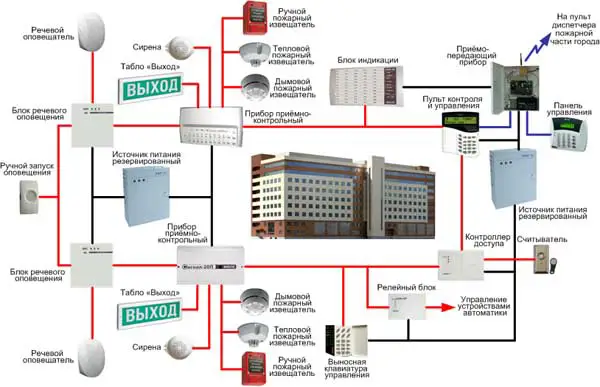
Figure 2 — Fire Alarm System Project
Types of Fire Alarm Systems
Three types of fire alarm systems are distinguished:
- Threshold type;
- Addressable polling type;
- Addressable analog type.
Threshold
The principle of operation of the threshold fire alarm system is that each fire detector (sensor) has an embedded trigger threshold. For example, a heat sensor will activate when the temperature reaches a specific threshold set individually for it.
The threshold system is designed so that the control panel located in the center of the so-called "star" has outgoing control loops (rays) from which a certain number of sensors (usually not more than 30) are mounted. If one of these sensors activates, the entire loop will activate. However, locating the fire source further requires manual search—automation is limited to this point.
Advantages of the system: low cost of equipment.
Disadvantages: low informativeness of the system and lack of ability to monitor sensor status at any time.
Manufacturers: POLON-ALFA IGNIS 1030, IP 101/435-1-А1/2 "Expert".
Addressable Polling
In a threshold fire suppression system, the control panel monitors changes in loop parameters, while an addressable polling system generates queries about the status of elements and sends them to sensors. In addressable polling systems, sensors are connected in a ring loop. The system can generate messages such as "Normal", "Fire" and "Fault".
Advantages of the system: high informativeness, continuous monitoring of sensor status. This type of alarm also matches the "price-quality" ratio.
Disadvantages: the system reacts to fire or fire later than addressable analog systems.
Manufacturer: Polon-Alfa Polon 4100 or Polon 4900.
Addressable Analog Fire Alarm System
This is the best type of fire alarm system. It not only includes all technical advantages of previous types but also has its own significant benefits. The main difference in the system is that the decision on the alarm signal is made not by the sensor itself but by the control panel that receives a signal different from normal.
There is continuous communication between the control panel and sensors, enabling the panel to constantly receive and analyze any changes in controlled parameters.
Advantages of the system: early fire detection, reduced material consumption during installation, less installation work, continuous monitoring of sensor functionality.
Disadvantages: high cost.
Manufacturers: Bosh FPA-1200.
Fire Alarm System Installation Standards
All necessary rules for installing fire alarm systems are outlined in the publicly available document SP 5.13130.2009. Rules of Thumb. Fire Protection Systems. Automatic Fire Alarm and Suppression Systems.
This document should not be understood as a guide for DIY installation of fire alarm systems. Work must be carried out exclusively by certified companies and with project approval from higher authorities.
We will provide an example of installation rules for water or foam fire suppression devices.
First group of rooms includes libraries, bookstores, circuses, shops, management buildings, hotels and hospitals.
The intensity of sprinkler coverage in these areas must be at least 0.08 liters/(second * square meter), and water consumption should not be less than 10 liters per second. Water supply during a fire must last no less than 30 minutes, and the maximum distance between sprinkler heads should not exceed 4 meters.
If the protected room height is up to 3.5 meters, one detector can monitor an area of up to 85 square meters. When installing detectors, the distance from the wall must be at least 4.5 meters.
Fire alarm system installation can be performed when:
- the room temperature is +20°C;
- supply-exhaust ventilation is organized;
- relative humidity of air does not exceed 60%;
- noise level is no higher than 65 dB.
The cost of installing a fire alarm system is approximately calculated based on the area of the protected room and the system options.
For example, for an area up to 150 m², the cost will be between $12 and $20 per square meter.
For addressable fire alarm systems, the coefficient will be 0.7–1.2.
To calculate labor costs, multiply the area requiring protection by the price and then by the coefficient.
For example, for a room of 45 m², the minimum labor cost will be $378.
This price includes warranty service for SPS provided by the installation company.
Cost of Work
- Kiev – from 100 UAH/m² (with a correction factor of 1);
- Moscow – from 550 RUB/m² (with a correction factor of 0.7).