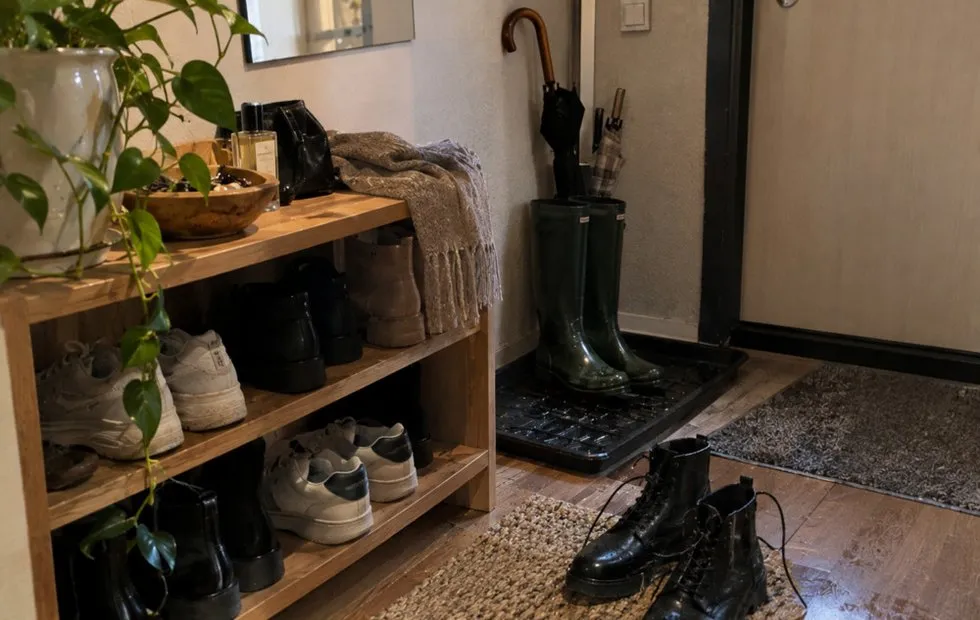
The hallway facing September: where wet shoes, umbrellas, and jackets will be kept
The easiest way to prepare the entryway for autumn is not through purchases but by imagining a scenario: picture yourself coming home in the rain. Where will you put your shoes? Where will you leave your umbrella? Where will you hang your wet jacket? If you have to move things around at every step, September will quickly turn the entryway into a storage area.
Space needs to be reserved by the door for wet shoes
The main autumn problem starts even before considering the closet. If the entire floor by the door is occupied by seasonal shoes, there’s simply no place to put wet boots.
Therefore, summer pairs that are hardly worn anymore should be stored higher up or deeper in the closet. Before storing, shoes should be cleaned and completely dried, and boxes should be labeled clearly on the visible side.
Only items that are actually in use now should be left by the entrance. This creates a clear area where one can comfortably take off their shoes without walking further around the apartment in wet shoes.
Wet boots need a temporary storage area
A closed shoe cabinet is good for keeping shoes dry. It’s inconvenient to put shoes there right after rain, as moisture remains inside and stains the shelves and nearby pairs of shoes.
It’s simpler to designate a separate spot for drying—a washable tray or mat that prevents water from seeping onto the floor. This can be easily removed, rinsed, and put back in place.
This way, wet shoes have a clear intermediate step: first dry, then move them into the shoe cabinet.
Umbrellas shouldn’t be put away in the closet right away either
Folding umbrellas are often closed while still wet and placed anywhere available. As a result, water ends up on the floor, clothing, or the cabinet wall.
After being used outside, umbrellas need a place where they can dry properly. For multiple umbrellas, it’s convenient to use a stable stand with a tray or another location where drops won’t fall on wooden furniture, shoes, or outlets.
The most important thing is not to leave an open umbrella in the middle of a passage. During autumn, temporary drying should not prevent others from entering the apartment.
Only keep on hooks what is being worn currently
By September, an entire season’s worth of clothes quickly accumulates on one hook: a windbreaker, a raincoat, a warm jacket, a bag, and more clothes “just in case.”
As a result, the wet raincoat has nowhere to hang separately, and the dry clothes end up pressed against it.
It’s better to reserve at least one convenient spot for each resident and store the clothes that aren’t being worn right now in a closet. A wet jacket should be left to dry first before being put back with the rest of the clothes.
If two seasons’ worth of clothes are constantly hanging on the hook at the same time, it’s usually not because the hallway is too small, but because the summer clothes weren’t stored away in time.
Bags Need a Separate Dry Place
On a rainy day, it’s especially unappealing to put a bag on the floor—there’s already water from shoes and street dirt. The shoe rack is also too cramped, with keys, gloves, and wet small items piled on top.
Therefore, it’s useful to designate a specific spot in advance for daily use bags: a sturdy hook, shelf, or empty area on a cabinet.
If the bag is heavy, especially one with a laptop, the mounting solution must be strong enough to handle its weight. A decorative hook meant for holding a scarf certainly won’t be able to support a work bag.
Keys and small items should be easily accessible
In autumn, it’s especially inconvenient to look for keys when holding a wet umbrella in one hand and a bag in the other.
Therefore, it’s better to gather daily essentials like transit passes, keys, headphones, and other items in one spot near the entrance. This could be a small tray, box, or shelf—anything where you can place everything with one motion.
The fewer actions required after entering home, the lower the chance that gloves will stay on the shoe rack, keys will end up in the pocket of a wet jacket, and the bag will end up on the floor.
A good autumn entryway doesn’t have to be large. It only needs to consistently accommodate everything a person brings in from the rain: first the shoes and water, then the outerwear and umbrella, and finally the bag and small items.
If there’s at least a temporary place for each of these items, the September rain stops at the front door instead of spreading throughout the apartment.