What to change in the apartment by October: textiles, lighting, carpets
But first, it’s worth rearranging and bringing out what already exists at home. In the fall, it’s often not new purchases that change a room’s atmosphere, but five simple items.
Curtains: Restoring a Dense Layer
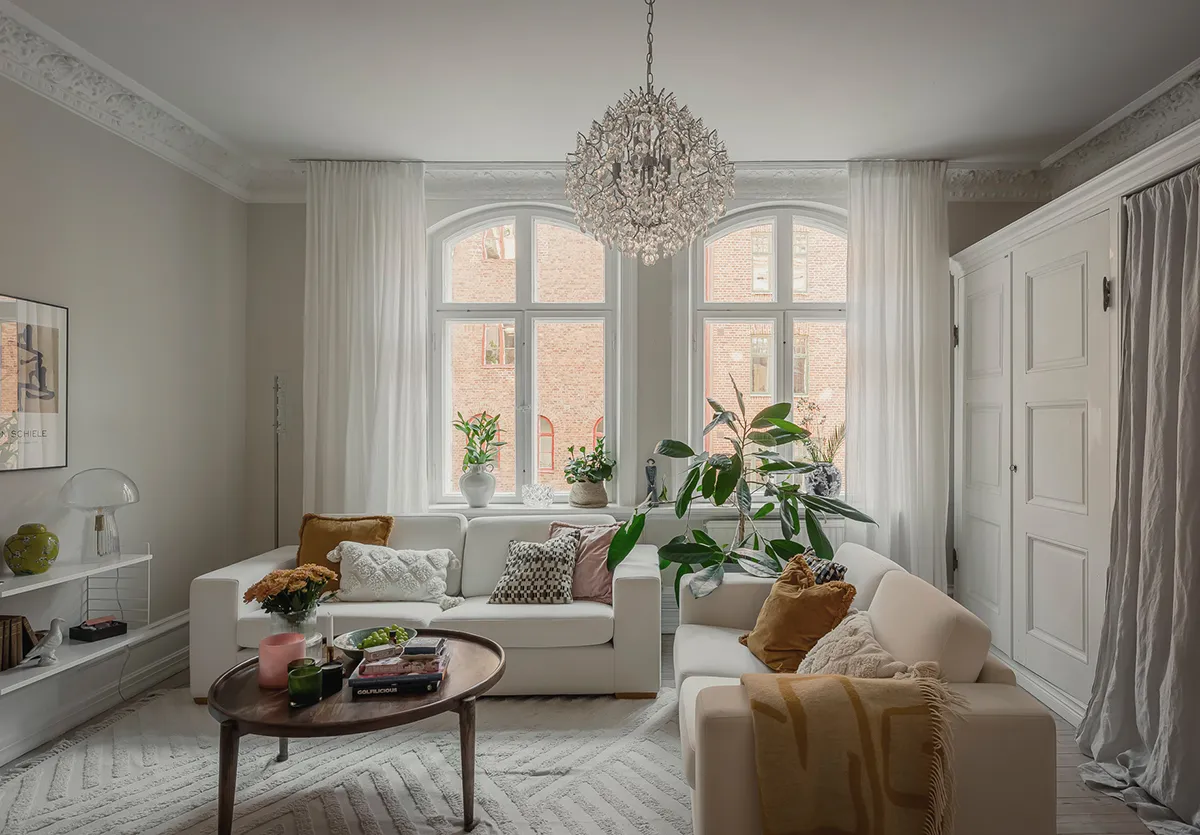
In the summer, heavy curtains are often left open for weeks or replaced with lighter fabrics altogether. In autumn, their role becomes more significant: at night, the window turns into a large dark surface, and heavy curtains visually make the room feel more compact.
If the curtains have been stored for several months, they should be refreshed according to the fabric’s care instructions before being used again. It’s also a good time to check whether they block the radiator and prevent warm air from flowing freely into the room.
It’s not necessary to buy a new set just for the season. Sometimes it’s enough to draw back those curtains that were hardly used in the summer at night and see how much the room’s atmosphere changes.
Rugs and Blankets: Getting Them Where They’re Really Used
A rug in the top shelf doesn’t make a room warmer. In autumn, it’s more useful on a sofa arm, in a chair, or by the bed — where you’ll really want to reach for it in the evening.
The same applies to seasonal textiles. If you already have a thicker blanket at home, warm pillowcases for decorative pillows, or bedding sets for cooler weather, now is the perfect time to bring them out.
But there’s no need to change everything at once. Sometimes just a blanket and an extra cover is enough to make the bedroom or living room stop looking as empty as in the summer.
Rug: Return it to where your feet are coldest
If you removed a carpet during the summer, you don’t necessarily have to put it back exactly where it was in the fall. It’s better to first consider where the cold is felt most intensely. This could be the area near the bed, the spot in front of the sofa, or the zone by the table on tiled flooring. Sometimes a small carpet in those areas provides more comfort than a large one in the center of the room.
Before the new season, clean the carpet and check it after storage. And for a lightweight rug on smooth flooring, it’s better to secure it with an appropriate non-slip mat: comfort fades quickly if it slips away from under your feet.
Lamps: Check not only brightness but also light color
In summer, artificial lighting is turned on late, so its characteristics are hardly noticed. In autumn, the lamps run for a few hours each evening, and suddenly it becomes apparent that one is too harsh, another is blinding, and it’s entirely uncomfortable to read by the sofa.
In the bedroom and living room, many people prefer a warmer light, but it’s not necessary to replace all the lamps at once. Start with the light fixture that you turn on most often in the evening and compare the sensations.
If you do replace the lamp, it’s important not only the color temperature of the light but also the appropriate base type, power, and limitations of the fixture itself. It’s better to rely on its labeling and instructions rather than choosing a bulb based solely on the color of its packaging.
Lighting: Use Several Small Sources Instead of One Chandelier
In autumn, it becomes especially noticeable how uncomfortable a room with just one bright chandelier hanging from the ceiling can look. There is light, but it’s dark near the sofa, the corner of the room stays dark, and the space feels flat in the evening.
Before buying new lights, check what you already have in the apartment. Maybe there’s a floor lamp in a room that’s hardly used, or a table lamp that can be moved closer to a chair or sofa.
The most convenient way to distribute lighting is by area: one light near the reading nook, another on the desk, and soft lighting in the area where you relax in the evening. When rearranging, it’s important not to run wires through walkways and to avoid using lamps with damaged cords or plugs.
Before making autumn purchases, spend one trial evening in your apartment. Draw the heavy curtains, bring out a blanket, lay down a rug, and instead of one chandelier, use several smaller lamps. This makes it much clearer what is truly missing. Sometimes it turns out that you don’t need new “autumn decor” at all, just one lamp — or maybe nothing at all.