Why do white walls look gray in autumn and what can be done about it
The wall, which appeared almost blindingly white in July, suddenly starts to look gray, cold, or even slightly blue by the end of September. This is especially noticeable in rooms that seem bright on their own in summer but begin to look as though it’s always overcast inside them in autumn.
The first thought is to assume that the paint has faded, the finish is damaged, or the wrong shade was chosen from the start. Sometimes the cause might indeed lie in the condition of the surface, but far more often nothing is wrong with the paint itself. What has changed is the light falling on it. The color of a wall cannot be considered in isolation from the lighting. A white surface does not have a single constant visual tone: it reflects the light hitting it, so under different light sources the same color can appear completely different. This is why paint that looks clean and fresh in summer may suddenly turn gray or gray-blue in autumn.
And this doesn’t necessarily mean that an error was made during repairs. Sometimes it’s enough to change the lighting and a few interior details to make the same wall look lighter again.
A White Wall Changes with the Light
We don’t perceive the color of a wall as a separate property that exists independently of its surroundings. The eye perceives the light that falls on the surface and is reflected from it.
Simply put, it can be understood this way: the same white wall reflects a large amount of light under bright sunlight and appears clean and light. The same wall in deep shadow looks darker. Under warm artificial lighting, it may appear creamy or yellowish, while under cool diffused light, it appears gray or bluish.
It’s especially easy to overlook this in summer. The sun is higher above the horizon, the daylight hours are longer, and much more natural light enters the room during the day. On sunny days, a white surface receives bright lighting and visually remains very light in color.
In autumn, the situation gradually changes. The sun becomes lower, the daylight shortens, and cloudy weather becomes more frequent. Instead of bright direct sunlight, the room receives diffused light from the cloudy sky. This light is usually perceived as cooler, so white and very light shades with a cool tone begin to show their gray or bluish side more pronouncedly.
One important detail here is:autumn itself does not turn white paint gray. There is no separate autumn effect that literally changes the color of the coating. What changes is the combination of the amount of light, its direction, spectral composition, and the surrounding surfaces.
That’s why in one room, white walls can appear normal even in November, while in another room they might already seem cold and dull by September.
Why a wall can look even worse in the evening
As darkness falls, natural light gradually disappears, and lamps become the main source of illumination. And artificial light has its own characteristics.
For example, common lamps with a temperature of around 2700 K produce a warm yellowish light. In such a room, a white wall may appear creamy, beige, or slightly yellow. A more neutral light around 4000 K is perceived as cooler and usually changes white surfaces less toward yellow. If the paint itself has a cool gray or bluish tint, combining cool natural light during the day with warm artificial light in the evening can yield a particularly strange result. During the day, the wall appears gray-blue, while the warm light adds a yellowish hue at night. Visually, the shade may not be perceived as a pleasant creamy tone but rather as dull and dirty.
That is why paint cannot be evaluated based on lighting alone.
There is another reason why the color in a store often differs from the color at home. In color perception, there is a phenomenon known as metamerism. It occurs because two colors can appear identical or very similar under one light source but differ significantly under another.
This has practical implications for home renovations. The paint sample in a store may be under bright artificial lighting, surrounded by many other colors, and set against a completely different interior background. At home, it is applied to a large wall, next to wooden flooring, curtains, furniture, and under the natural light from a specific window.
Therefore, a small sample that appeared as a neutral white in the store might turn out to be noticeably warmer or cooler at home.
The window is just as important as the paint itself.
When choosing a white shade, it’s important to consider not only the paint’s name but also how much natural light the room receives.
A room with large windows on the south side receives plenty of natural light throughout most of the day, especially in summer. In such a room, a cool white shade with a slight gray or bluish tint can appear very fresh. The excess of warm sunlight balances out the coolness of the shade, and the abundant light prevents the walls from visually turning gray.
But the same shade in a room with a north-facing window can behave completely differently.
There is usually less direct sunlight there, and natural light appears cooler. If the walls are additionally painted in a cool white, gray, or bluish-white, these properties start to reinforce each other. On a cloudy autumn day, a wall can appear much darker and colder than in summer. Therefore, for rooms lacking warm natural light, white shades with a warm undertone are often chosen. These can be soft milk, cream, slightly sandy tones, or ivory shades.
It’s important to note that this doesn’t mean the northern room must be painted yellow. A too-warm white can also look unpleasant, especially when warm lights are turned on in the evening. The goal is to choose a shade that won’t further emphasize the room’s coolness.
How to Quickly Determine if a White Has a Warm or Cool Undertone
On a small sample, it can sometimes be truly difficult to spot the undertone. Next to other colors, almost any white may appear simply as white.
For a preliminary check, you can apply the sample to a regular piece of white paper. The contrast often makes the undertone more noticeable: the paint may start to appear more yellowish, creamy, gray, or bluish. However, this method should not be considered a laboratory-based color determination. Papers from different manufacturers can also have their own shade and optical additives. Therefore, for an accurate choice, it is much more reliable to take several large samples of paint and examine them directly in the room where the renovation is planned.
It’s also advisable to do this not just during the day. Examine the sample in the morning, during the day, in the evening with the lights on, and on cloudy days. If the shade remains pleasant under various conditions, the likelihood of an unpleasant surprise after painting will be much lower. It’s especially important not to test the small sample only on a white wall and not to draw conclusions after just five minutes. The larger the surface area, the more significantly the color affects the overall perception of the room.
What to Do If the Wall Already Looks Gray
It’s not necessary to repaint the entire room at once. First, check whether the problem really lies with the paint itself. The simplest experiment is to change the artificial lighting.
If the room currently has cool light bulbs with a color temperature of around 4000 K or higher, try replacing them with warmer bulbs at around 2700 K. In some interiors, this change significantly alters the perception of white walls without applying any paint. However, here too, specific color temperatures shouldn’t be treated as a universal rule. 2700 K produces a fairly warm light, and when combined with warm white walls, it can create an overly yellowish atmosphere. Therefore, it’s better to consider the overall interior design and choose lighting in conjunction with the wall color, rather than separately.
If the walls look particularly unpleasant in the evening, you should first check the lights. The problem might not lie in the paint but rather in the fact that cool lighting makes the room visually uncomfortable.
Warm textiles also affect the perception of walls
Lights are not the only factor that affects wall color. There are other surfaces in the interior that constantly reflect light.
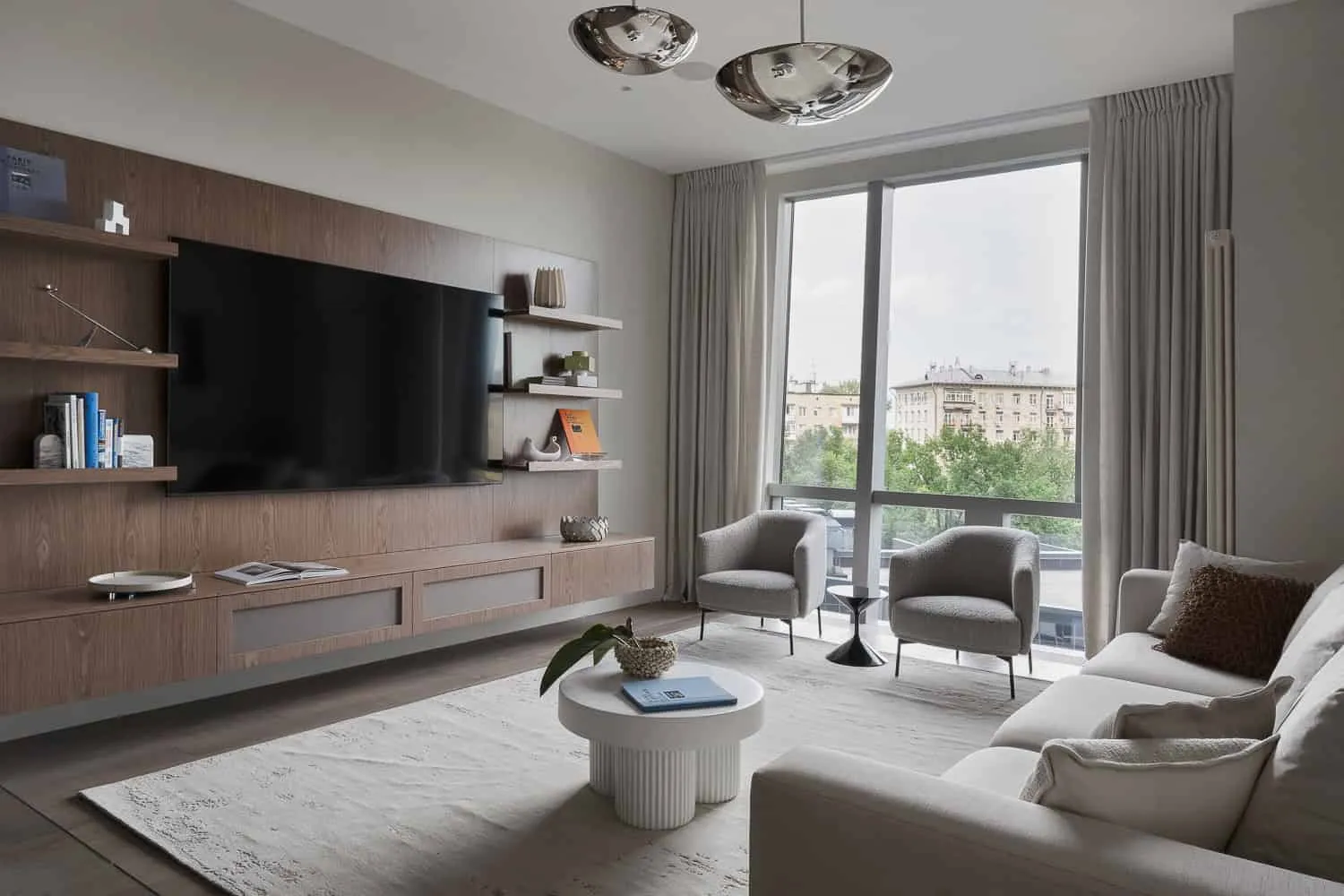
Curtains, carpets, blankets, wooden furniture, and other items with warm colors can slightly alter the overall perception of the space. Light from windows or lamps reflects not only off white walls but also off objects nearby. Therefore, a completely white room with a cold gray floor, gray curtains, and cool artificial lighting can appear much colder than the same room with wood, warm textiles, and softer colors.
This doesn’t mean you need to rush and buy beige curtains and a yellow carpet. Sometimes just one or two items with a warm tone are enough to make a space stop looking visually sterile. This trick works especially well in places where you don’t want to repaint the walls or don’t have the opportunity yet.
Light directed straight at the wall can sometimes help
Another underappreciated trick is using an additional light source near the wall.
Upper lighting isn’t always sufficient to evenly illuminate vertical surfaces. As a result, the ceiling and the central part of the room may remain quite bright, while the walls on the sides appear darker and cooler.
Table lamps, bathroom sconces, or another light source directed at the wall can visually bring this surface to life. The light is distributed differently, making the surface appear more three-dimensional and brighter. This is especially noticeable in long corridors, corner rooms, and spaces where natural light doesn’t reach the far wall well. Moreover, the directed light doesn’t necessarily have to be very bright. Sometimes, soft lighting is sufficient to eliminate the feeling of a dark spot.
And when is it really time to think about repainting?
If after changing the lighting and interior, white still appears dirty gray, cold, or unpleasant, then it makes sense to reconsider the shade.
But even in this case, there’s no need to immediately buy several gallons of new paint.
First, apply the chosen new shade to a small area or a large test surface. Observe it over several days under different lighting conditions. Morning sunlight, overcast daylight, and evening lights can reveal completely different aspects of the same color.
It is especially important to check the section of the wall that will actually be visible after the furniture is placed. A large wardrobe, curtains, carpet, and other items can significantly affect the perceived shade. Only if the new color looks good throughout the day after all these checks should you consider deciding on a full repaint.
You don’t have to start with the entire room. You can try one wall or a small area first. Sometimes it is only after doing this that it becomes clear whether the interior truly needed a different shade of white or if the problem was just the lighting.
What to Check Before Buying New Paint
If a white wall suddenly appears gray in autumn, don’t blame the paint right away. First, follow a simple algorithm.
- Observe the wall during the day and at night. If the color changes significantly after turning on the lights, it might be due to the combination of the wall’s color and artificial lighting.
- Check the temperature of the light bulbs.Cool lighting around 4000 K and above and warm lighting around 2700 K affect the perception of white surfaces differently. Replacing the bulbs sometimes yields noticeable results without any repairs.
- Determine how much natural light a room receives. Large south-facing windows and a north-facing room create completely different conditions for the same white color.
- Examine the shade of the paint. Compare the sample with white paper, or better yet, paint a large area directly in the room.
- Don’t judge the color only in the store. The lighting in the store, the size of the sample, and surrounding colors can differ greatly from home conditions.
- Try adding warm elements.Curtains, wood, a rug, or a blanket can change the overall impression of a cold room and make the white walls appear softer visually.
- Add a local light source. A bra or a table lamp directed at the wall can help where there isn’t enough overhead lighting.
- And only then decide on repainting. If the shade still seems unpleasant after all these changes, it makes sense to choose a different white color and test it in place.
White paint is considered tricky for this reason: it seems like the easiest choice. In reality, white comes in a vast array of shades, and the outcome depends not only on the paint can itself. Windows, direction of sunlight, weather, time of day, lights, floor, furniture, and even the color of curtains all influence how the same wall will appear.
And if a white room seemed perfect in summer but suddenly turned gray in autumn, it’s not yet a reason to start renovating again. First, you should change how the wall is lit. Sometimes, a few properly chosen lights, warm textiles, and additional lighting near the wall can restore the interior to that bright appearance it seemed to have lost with the arrival of summer.