Garden House Sitish Parikh by Dipen Gada and Associates: Climate-Adapted Building with Courtyard Inspired by Gujarati Architecture
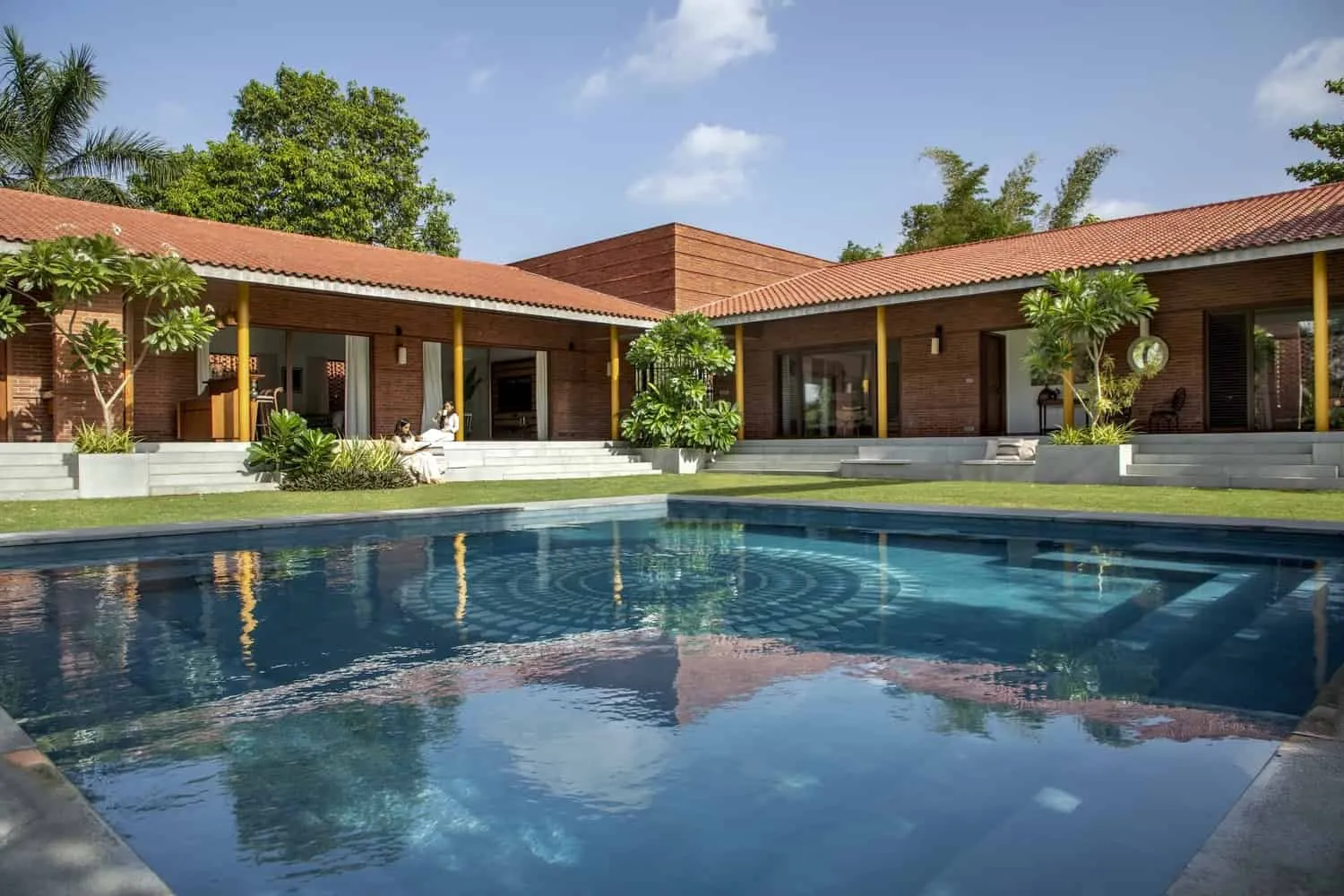
Located on the outskirts of Vadodara, near the village Aampad, the garden house Sitish Parikh by Dipen Gada and Associates (DGA) is a model of restraint, craftsmanship, and climate intelligence. Designed as a second home for a prominent local developer, this single-story residence transforms a square plot plantation into a tranquil retreat where brick, shade, wind, and filtered sunlight compose the rhythm of daily life.
Site, Brief and Strategy
With a large plot and a limited brief — two bedrooms, living-dining room, and kitchen — the project adopts a horizontal layout rather than vertical distribution. DGA employs the rural house archetype, utilizing exposed brick masonry, sloped roofs, and mangalore tiles to mitigate heat, channel rainwater, and harmonize with the rural landscape.
The L-shaped plan separates public and private zones, while also framing the courtyard, where a blue-tiled pool sits in one corner. This internal orientation creates intimacy, while carefully selected openings frame views of the plantation and draw prevailing winds through shaded verandas.
Approach as Narrative
The arrival process is orchestrated as a sequence of veils and revelations:
A tall curved brick lattice forms the first screen, creating a cinematic backdrop on a concrete platform.
Upon turning, visitors encounter a fragile entrance hall — an ornate grille with classical motifs marking the transition from nature to refined living.
Behind it, narrow corridors under sloped roofs surround the courtyard, where a vivid blue pool becomes the focal point of an composition of greenery, brick, and shade.
This high-low rhythm, from porous mass to light screens, sets a calm, almost monastic atmosphere in the interiors.
Courtyards, Lattices and Sun
A key feature of the project is its dialogue with sunlight. DGA uses dynamic perforated screens and semi-open courtyards to filter light, provide natural ventilation, and animate spaces with moving shadows throughout the day. Removable or operable edges extend rooms to shaded thresholds, increasing usable space without mechanical effort.
Materials and Details: Local, Tactile, Durable
The interiors are rendered in a soft white tone, allowing the materials to stand out:
Lime-washed walls and exposed brick provide thermal mass and breathable surfaces.
Bamboo, terrazzo, and wood add tactility and local identity.
Muted monochrome palettes are interrupted by occasional bursts of color — artworks, upholstered chairs, or the blue pool, maintaining calm while avoiding sterility.
Each bedroom and living-dining room opens onto a semi-open courtyard on one side and an external corridor, ensuring cross-ventilation and a continuous connection with the greenery.
Layout Serving Daily Life
The L-shaped layout efficiently distributes the house:
Public zone: entrance, living-dining room and common areas oriented toward the pool and courtyard.
Private zone: bedrooms with intimate courtyards and quieter views of the garden.
Edges as rooms: verandas and corridors are treated as programmed thresholds — for reading, tea time or barefoot evening strolls.
Through the garden, small episodes — a round nook for rest in the plantation, a terminal courtyard, and a perimeter jogging path — extend daily rituals into the outdoors.
Climate Adaptation, Not Style for Style's Sake
While the house photographs beautifully, its effectiveness is based on climate:
Deep eaves + sloped mangalore roofs reduce solar heat and provide shade.
Perforated brick screens (lattices) soften glare and admit airflow.
The courtyard microclimate cools adjacent zones; semi-open rooms expand the comfortable zone.
Local materials reduce energy use and fit the context.
The result is a home that stays cooler, quieter, and breathtaking, combining pleasure with care.
Quiet Architecture of Trust
Supported by a client rooted in simplicity and faith, DGA demonstrates restraint: no formal grandeur, just a well-balanced proportion, honest materials, and a delicate treatment of light. The Sitish Parikh House reads as timeless, a place for relaxation, for observing shadows, and for a slow life.