DRA House by D-Associates in Bali, Indonesia
Project: DRA House
Architects: D-Associates
Location: Bali, Indonesia
Area: 10,903 sq ft
Photos: Mario Wibowo
DRA House by D-Associates in Bali
D-Associates designed the DRA House on a beautiful location on the island of Bali in Indonesia. This large house offers just under 11,000 square feet of refined living spaces that connect with each other through both interior and exterior spaces.
Projects of luxury resorts and villas on the island of Bali are known for their lavish attempts to create a tropical retreat adorned with reproductions of crafts associated with the exotic 'Bali' atmosphere. In this context, D-Associates' endeavor to create a modest sense of home beyond the home in Bali is rare. The task was simple: to design a villa for an extended Indonesian family in Sanur, one of the most renowned southern Bali settlements and the island's most developed tourist destinations. Unlike the Western perception of some 'Bali' exoticism, here we encounter a more subtle understanding of Sanur's tranquil tropical landscape. The villa represents a family resort set in a tropical setting, contrasting with life in Jakarta while drawing from certain aspects of the spatial configuration of traditional Balinese residential architecture: emphasis on dividing the volume of the house and softening the boundaries between interior and exterior spaces.
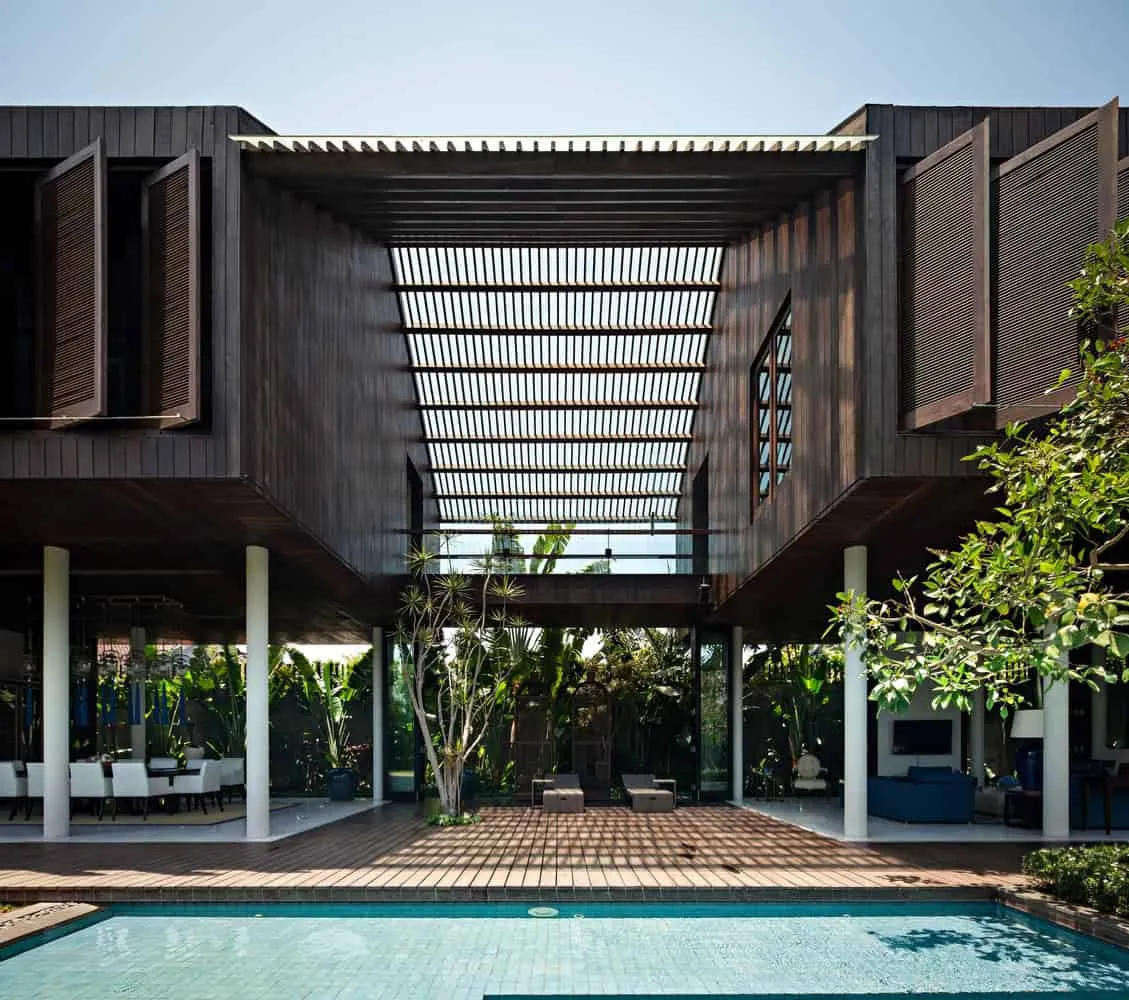
On a rectangular plot of 1277 m², the main structure of this two-level villa is located on the long southern side, creating a spacious open area with a pool and lawn on the northern side. This configuration allows all rooms of the villa — four bedrooms, each with its own bathroom, living room, dining room and kitchen — to face both south and north (avoiding direct exposure to the sun in the tropics), with grass and a pool as primary focal points of the villa. From the street, the significant height of the main mass of the villa is in the background and reduced through strategic placement of the front part of the plot, where a closed parking area, landscaped front courtyard (with a pond) and a pavilion foyer with a flat wooden roof serve as a modest entrance to the house. Further reduction of the volumetric composition is achieved through covering each structural element with a unique natural building material — heavy gray river stone walls as parking barriers, wooden columns and a foyer screen, unfinished concrete walkways, softened by a landscaped garden and pond.
The foyer pavilion refers to the aling-aling element in Balinese residential complexes, a transitional screen element where the act of entering the house is emphasized as a kind of procession denoting the beginning of the private zone of the home. In this project, D-Associates spatially realizes this traditionally superficial architectural element in the form of a small foyer, bounded and supported by several recycled ulin wood beams (previously used as railway ties).
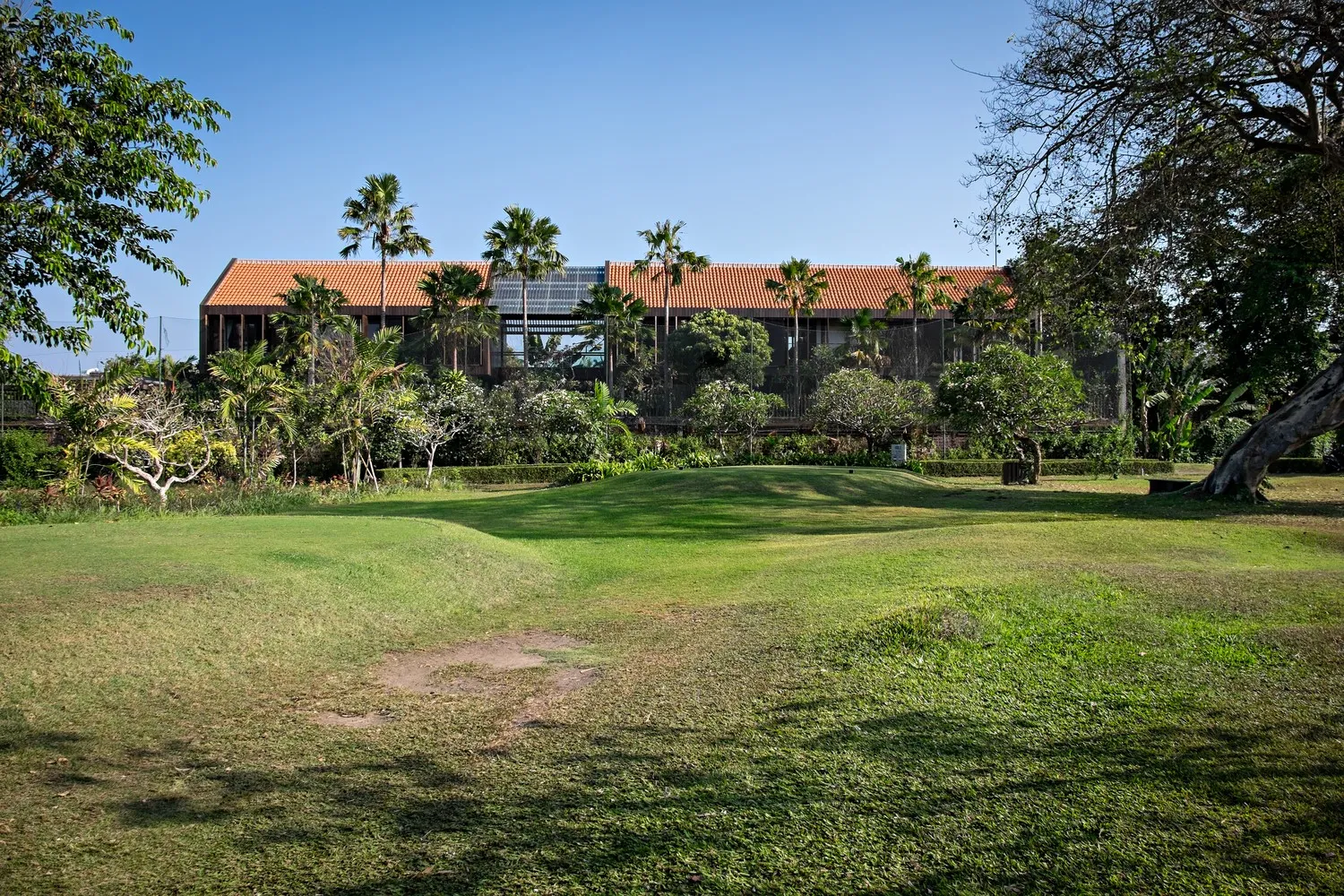
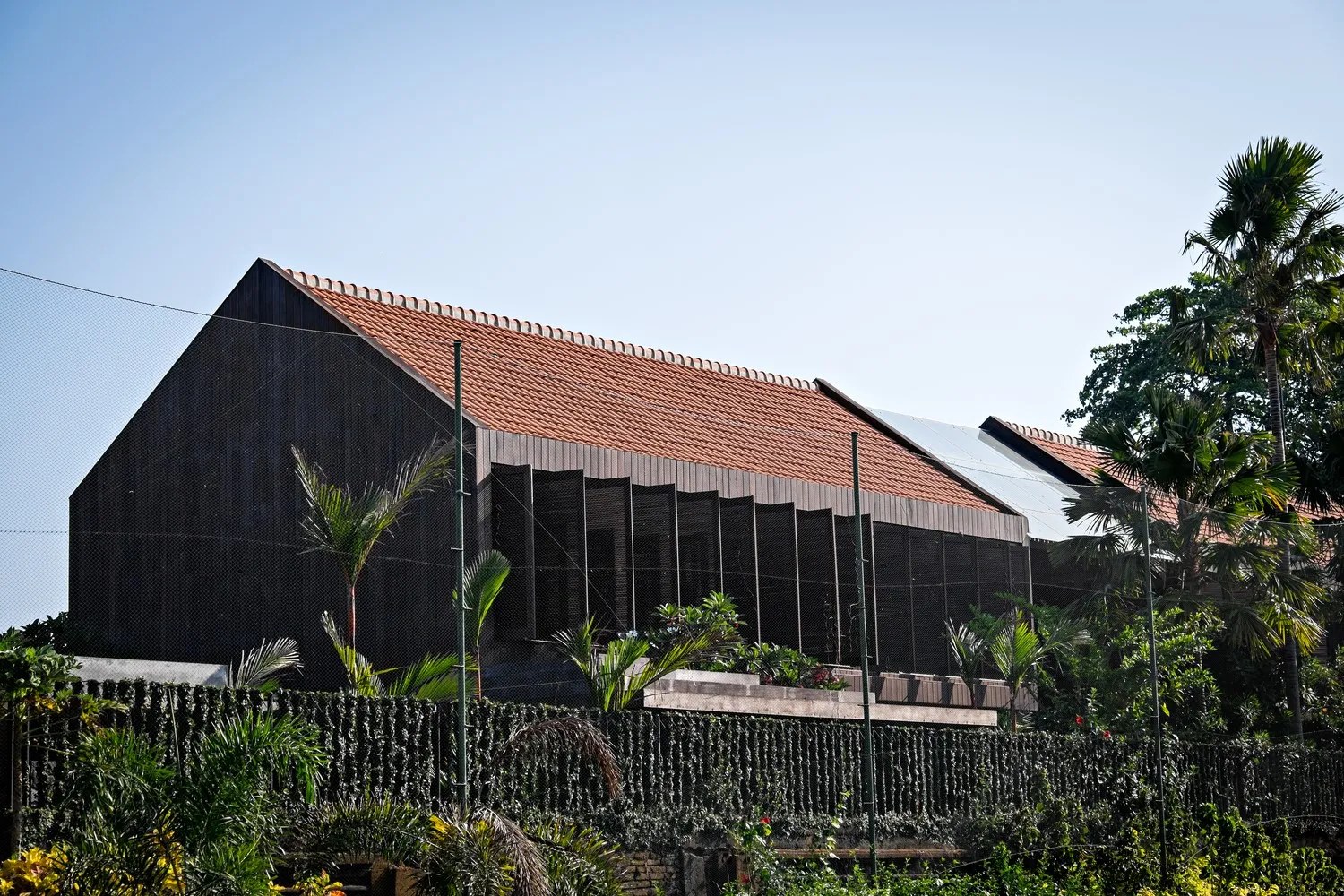
The internal structure of the villa is divided into two volumes: the upper level represents a floating dark wooden box covering the lower level — a contrasting open and transparent volume acting as a platform for family living activities. This strategy again reduces the mass of the villa to preserve a sense of home and human scale. The heavy dark brown ulin wood and plywood finish on the upper volume brings warmth to the house from strong tropical sun. The lower volume looks more like a space platform that merges with the pool and garden due to the lightness of its enclosing elements: pillars in the form of a row of thin round concrete columns painted white, and floor-to-ceiling glass panels that can be fully opened. This configuration also represents a modern interpretation of the rumah panggung (wooden raised house) typology common in tropical regions of Southeast Asia.
The anchor of the entire composition is a two-level covered terrace dividing the long mass of the villa in half. This high terrace serves as a spatial bridge connecting the upper level (containing all private bedrooms) and lower level (containing all living spaces), interior spaces and surrounding landscape. It enhances the feeling of lightness and openness in this otherwise large building (with a total area of 1013 m²). Using the same finishing materials inside and outside, the boundary between interior and exterior spaces is blurred, maximizing the family perception of seclusion in the Bali landscape.
–D-Associates