Ceiling Fixtures for Suspended Ceilings
Today's popular suspended ceilings are more than just a single solid element. A suspended ceiling is a system made up of various components. Materials and accessories for suspended ceilings can be combined in many different ways.
Ceiling Fixtures for Suspended Ceilings
Today's popular suspended ceilings are more than just a single solid element. A suspended ceiling is a system made up of various components. Materials and accessories for suspended ceilings can be combined in many different ways.
Material
PVC Film for Suspended Ceilings
The most common type of suspended ceiling is PVC film. It is produced in a wide color palette and variety of textures. The main types of film texture include glossy, matte, and satin. Additionally, there are films with marble, leather-like textures, metal finishes, glitter, chameleon, opal, and others.
PVC film for suspended ceilings can be purchased in rolls of various widths. The maximum width of the film is 5 meters. PVC film has several advantages: a high-quality PVC ceiling is fire-resistant, does not allow moisture to pass through or absorb it, making it particularly suitable for areas at risk of leaks, durable enough to withstand significant load and strong tension, and flexible enough to be used for creating shaped elements.
Many types of film are suitable for photo printing. Regarding the ecological safety of the material: PVC is not the most eco-friendly finish, but high-standard film production results in low levels of substance emissions and is relatively safe for human health. Therefore, choosing a reputable manufacturer is very important: making the wrong choice can lead to purchasing a fire-prone low-quality ceiling with a strong odor.
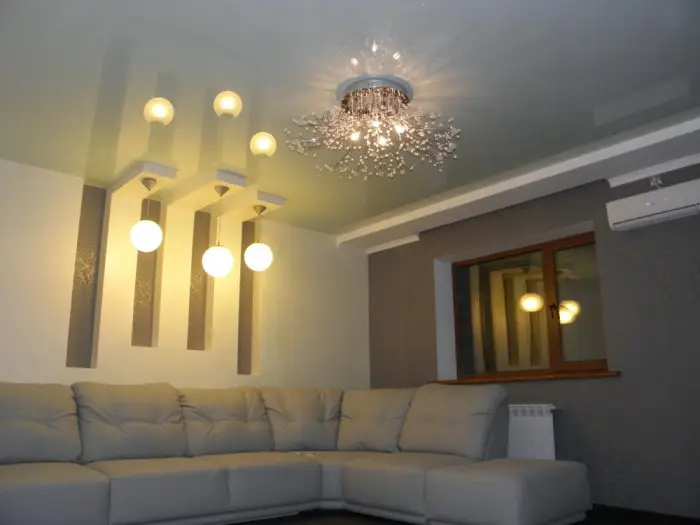
Photo 1 – PVC Suspended Ceiling
Fabric for Suspended Ceilings
Fabric for suspended ceilings is also synthetic, impregnated with a special composition. The fabric is produced by only a few companies, and its color and texture variety is very limited – mostly pastel colors with white being dominant. This type of ceiling can be painted or dyed according to personal preference.
The maximum width of the fabric is over 5 meters, which makes fabric ceilings seamless in small rooms. The fabric is positioned as a more ecologically clean and breathable covering. Unlike PVC films, fabric ceilings are more resistant to damage from sharp objects: if such a damage occurs, the tear does not spread as quickly as it would on PVC.
The impregnation makes the material fire-resistant, but fabric ceilings do not mix well with water: the fabric allows moisture to pass through, and in case of flooding, there is no option to dry and rehang the ceiling – the fabric will be hopelessly damaged. One of the important advantages is the fabric's resistance to various temperatures, with a wider temperature range.
For example, in unheated rooms where the temperature may drop below zero, PVC ceilings cannot be installed – they will simply burst, but fabric ceiling material can easily withstand a small negative temperature. Fabric is considered an elite material for ceiling finishing, so its price is accordingly higher than that of film.
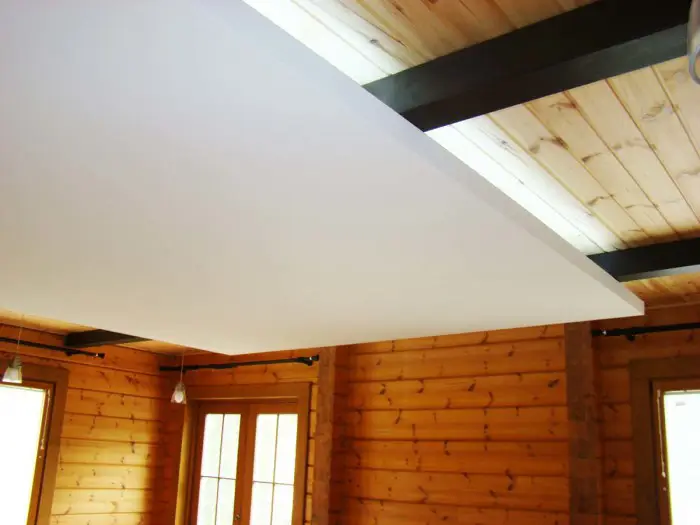
Photo 2 – Fabric Suspended Ceiling
You can buy material for suspended ceilings in bulk either from well-known European factories, small domestic firms, or Chinese manufacturers. For example, to buy fabric such as Clipso, you can contact one of the official dealers of the French company. The price for this company's fabric is 1 sq m – from 6.5 euros at large bulk orders.
Mounting of Suspended Ceilings
As mentioned earlier, in addition to the film or fabric itself, many accessories and tools are required for creating a suspended ceiling. Mounting of suspended ceilings is provided by special profiles (boxes), masking tape, inserts (baseboards), wedges or clips, hooks, screws, and tools for installing the fabric in the box – spatulas, etc. The use of various combinations of these elements depends on the chosen mounting system.
Mounting Methods
Types of mounting can be divided into hook, wedge, and clip methods. The last two are somewhat similar, so they are sometimes grouped into one. A separate method is mounting of seamless ceilings.
Hook Mounting System
The hook method differs significantly from the other two methods. Ceiling work begins with precise measurements of the room perimeter, based on which the PVC film is cut. Using a special technique, a hook – a plastic bent element shaped like the letter 'L' that acts as a hook during installation – is soldered to the edge of the fabric. Special plastic or aluminum profiles for the hook mounting system are screwed onto the ceiling perimeter.
The room is heated to a high temperature, and the hook is secured in the profile. A special baseboard is inserted into the profile from below. This system is used only for film ceilings. Its advantage lies in easy installation and the possibility of detaching and repositioning the ceiling edge if needed. This method is best suited for ceilings with patterns.
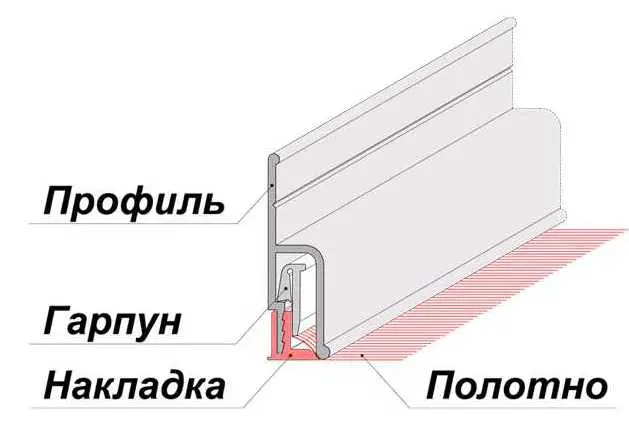
Photo 3 – Principle of Mounting a Suspended Ceiling with a Hook
Clip Mounting System
The clip mounting method is quite simple; this method is one of the cheapest, but the installation process is very labor-intensive. Measurements are made only approximately, and the fabric is cut with a sufficient margin that is trimmed after installation. An aluminum U-shaped profile is mounted around the room perimeter. The fabric is inserted using a spatula into this profile, and then a plastic or wooden clip is placed on top of it. The installation process ends with fixing the fabric using an insert – a baseboard.
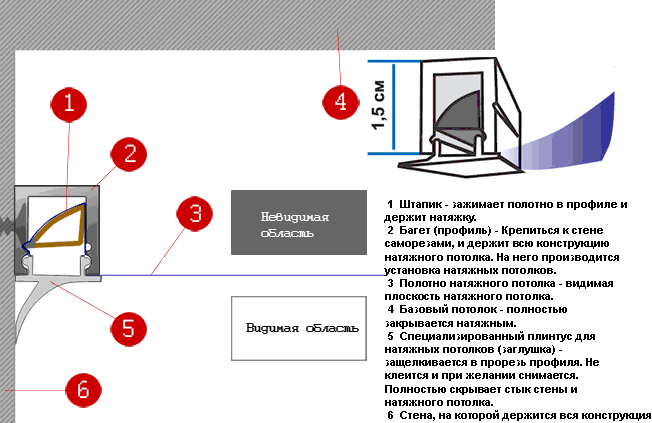
Photo 4 – Clip Mounting Method for Suspended Ceilings
Wedge Mounting System
The mounting fasteners are installed using the same principle as for the clip method. However, different profiles and a plastic wedge instead of a clip are used. The difference between this system and the clip method is its greater flexibility: this system is used for non-standard ceiling shapes, while the clip method requires straight angles.
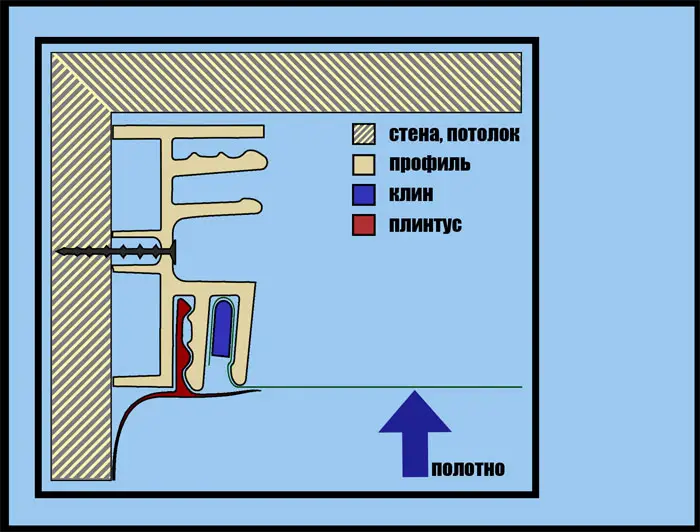
Photo 5 – Wedge Mounting System for Suspended Ceilings
Mounting Seamless Fabric Ceilings
A special mounting node is provided for fabric ceilings – a plastic clip-profile, whose clamps fix the fabric. It does not require additional fixing or mounting of baseboards.
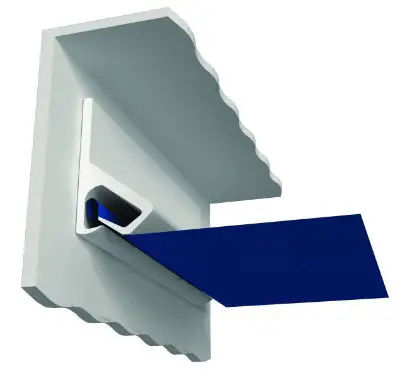
Photo 6 – Mounting Seamless Fabric Ceiling