How to Remove Yellow Stains and Mold on Ceiling
How to Remove Yellow Stains on Ceiling
One of the most frequently encountered ceiling problems is removing stains that appear after flooding. Many residents of apartment buildings are familiar with "water procedures" from neighbors above. Residents of private houses and top floors suffer from the same consequences during snow melting or heavy rains.
There are many tips for eliminating this defect. One way is to use whitening agent to clean the stains. However, rust stains that appear because water seeps through panels and reaches the reinforcement are not always removed with this method.
Other means that can be used to remove yellow stains on ceiling include vinegar, citric acid, copper sulfate, and even household chemicals designed to remove rust.
When treating stains on ceiling, it is important not to forget eye protection. First, the ceiling is scraped - a damaged section of finish is removed, then it is wiped with any of the previously mentioned agents and left to dry. After drying, the surface is thoroughly primed and painted.
It is better to repaint the entire ceiling to avoid streaks. However, once stains are removed, it cannot be guaranteed that they will not appear again.
Therefore, one of the universal solutions is a suspended ceiling, ceiling tiles, or plastic-covered ceiling. Such ceiling finishing will prevent any leaks from ruining the renovation.
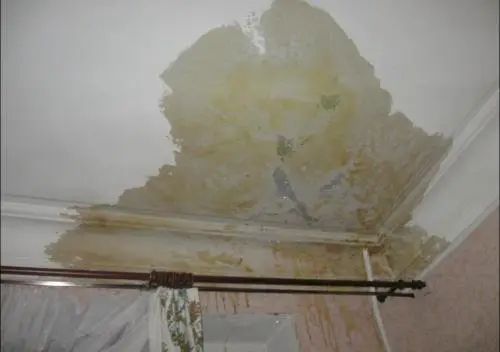
Photo 1 — Yellow Stains from Leaks on Ceiling
Mold on Ceiling
The question "how to remove mold or mildew" is even more serious than the previous one.
IMPORTANT! Mold on ceiling and walls is a serious enemy of human health. The first step in destroying mold is to control humidity in the room. The predecessor of mold is moisture.
Therefore, when such problems arise, it is necessary to check ventilation. If it is a bathroom, ensure forced ventilation; on the kitchen, install a powerful exhaust fan.
When mold appears in other rooms, it is also necessary to ensure they are dried out – if possible, open windows and doors. If the ceiling is plastered, the affected area and surrounding area must be cleaned down to the concrete. The affected area should be treated with a disinfectant.
To fight mold in extreme cases, bleach or copper sulfate can be used. However, to get rid of mold, it is better to use special anti-mold products such as Capatox by Caparol, Anti-septic, and similar.
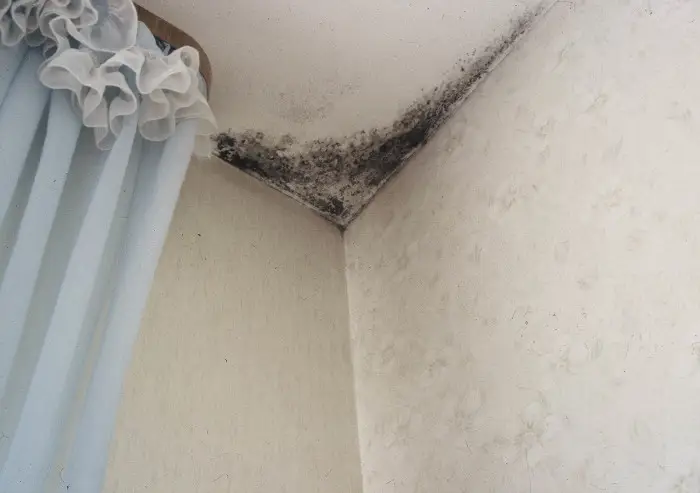
Photo 2 — Black Mold on Ceiling
First, the mold-affected area is treated with a solution using a sponge, brush, or sprayer, and then it is scraped off, rinsed, and left to dry.
Subsequent finishing should be done with primers, plaster, spackle, and paints that contain anti-mold additives and are resistant to moisture. The area treated with anti-mold agents must be thoroughly dried before priming several times with deep-penetrating primer containing the above additives.
Then plastering, spackling, and painting or spackling and painting are performed. The key in fighting mold is to prevent moisture accumulation, ensuring each layer of finishing is well-dried.
If mold has affected a gypsum board ceiling, cleaning and washing the gypsum board panel from mold is a lost cause. The damaged sheet must be removed and replaced with a new one. In humid rooms, only moisture-resistant gypsum board should be used, and hydro-isolation materials and sealants must not be neglected even during ceiling finishing.
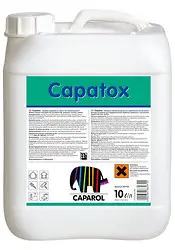
Photo 3 — Anti-mold and Mildew Agent Capatox by Caparol
Ceiling Collapse
Yellow stains and mold are flowers in comparison to the next problem. If the ceiling has collapsed, intervention by specialists is unavoidable. The action plan depends on the type of room and the scale of the collapse.
If it is a multi-family home and a through leak occurs from neighbors above, it is necessary to urgently involve housing and utilities services and negotiate with neighbors. Self-activity here is not encouraged.
Specialists must inspect the site of the incident and assess the situation: how much damage has been done to the panels, what is with the reinforcement, have the walls, especially load-bearing ones, been affected, is there a danger of further collapse, and perform reinforcing and repair work.
The same applies to an unexpected hole in the ceiling. If the slab is intact and only part of the finish has collapsed, there are two options: clean and repair the collapsed area or completely redo the entire ceiling.
When plaster collapses, tap and check entire sections to determine how securely they are attached. If securely attached, only the collapsed area can be plastered. However, the best option is a full ceiling repair, as collapse of one part is like the first sparrow - it indicates that the adhesion between the plaster and ceiling has weakened, and more unpleasantness is to be expected.
When redoing the ceiling, all steps must be performed in accordance with the technology of plaster or gypsum board works, following instructions for the materials used and not neglecting primers, as they will serve as a guarantee of ceiling strength.
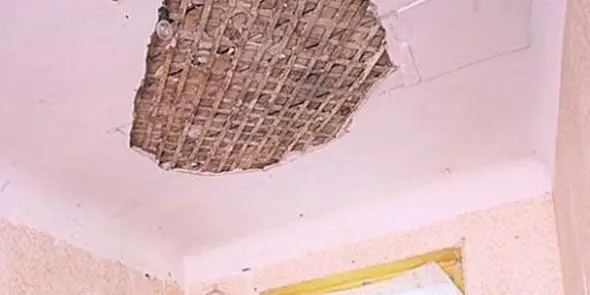
Photo 4 — Collapsed Plaster on Ceiling
Ceilings in Different Rooms
After a collapse, if deciding to completely replace ceiling finishing, one wishes for it not to collapse again and for the installation to be fast and inexpensive, with a final result that is aesthetic. Of course, such an ideal variant is unlikely to come true. The combination of "quality" and "cheap" is rare. But, for achieving the best outcome, a few recommendations can be considered.
The ceiling in a bathroom and toilet should be made of moisture-resistant materials. A suspended ceiling can be used, but it will be very expensive compared to other types of finishing. When choosing a ceiling for a bathroom, attention can be paid to options such as regular painting, ceiling tile sticking, and plastic sheeting.
Tiles are the simplest way; plastic can hide utilities and ceiling leaks, while plastering and painting are the most familiar, eco-friendly, and aesthetic solution.
Bathroom ceiling photo:
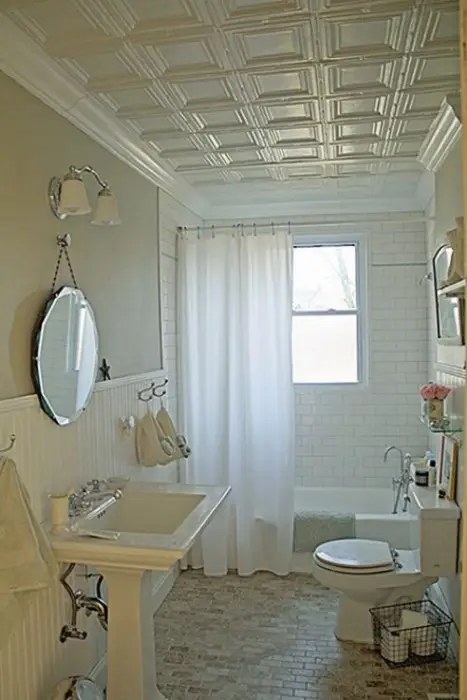
Photo 5 — Ceiling in Bathroom Tiled
The ceiling on a balcony is often finished with wood, plastic, or gypsum board - all depends on the budget and purpose of the balcony. The ceiling on a balcony, just like in a bathroom and toilet, can be significantly exposed to moisture. This must be considered when choosing finishing.
Simple and moisture-resistant for a balcony is plastic. If the balcony needs serious insulation, then moisture-resistant gypsum board.

Photo 6 — Suspended Ceiling on Balcony
The ceiling in a garage can quite easily be built by oneself using readily available materials. In a garage made of concrete, the ceiling can be made from moisture-resistant OSB panels mounted on wooden beams.
Gypsum board is better not used for finishing unheated rooms. Possible options are plywood and plastic paneling.
Garage ceiling photo:
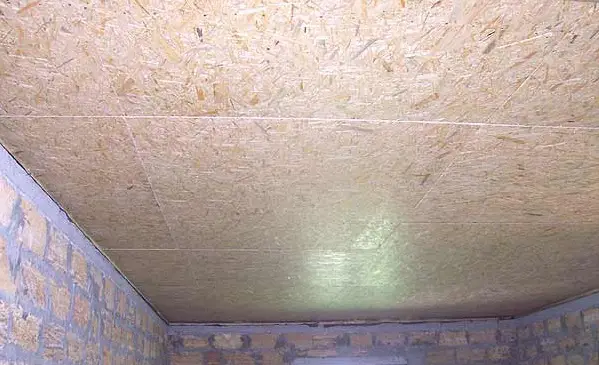
Photo 7 — Garage Ceiling from OSB
The ceiling on a country house is quite a broad topic. Everything depends on the scale of the country house: how to make a ceiling in a full-fledged country home or how to finish a ceiling in a country house by oneself.
IMPORTANT! If the country house is made of wood, special attention should be paid to fire safety requirements.
Regarding gypsum board, if the country house will not be used in winter, this option is eliminated (in a worst-case scenario, floating ceiling made from moisture-resistant gypsum board can be tried). In such cases, it is better to use laminated MDF sheets. A wooden ceiling can "play," which is inconvenient if the surface is intended for finishing.
A country house can also be finished with a suspended ceiling on fabric, known for its lightness and resistance to temperature and humidity fluctuations.
Country house ceiling photo:
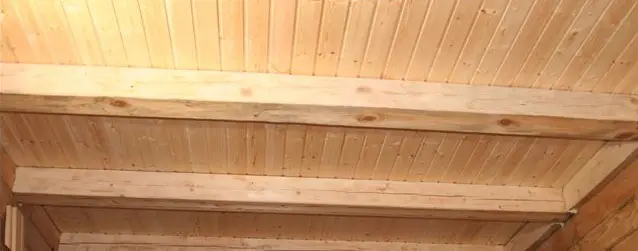
Photo 8 — Wooden Ceiling on Country House